
‘Quilt of Names’ brings lost names to the light
Wini McQueen’s “Quilt of Names” honoring names lost during the decades of slavery in the U.S. and years that came after has its debut showing Oct. 31 and Nov. 1 from 11 a.m. to 3 p.m. each day at Oak Ridge Cemetery
A new chapter for The Melody
Our team and coverage are moving to The Telegraph. Make sure you look for The Melody's community-first journalism as a section highlighting the people, places and moments that are the rhythm of Macon.
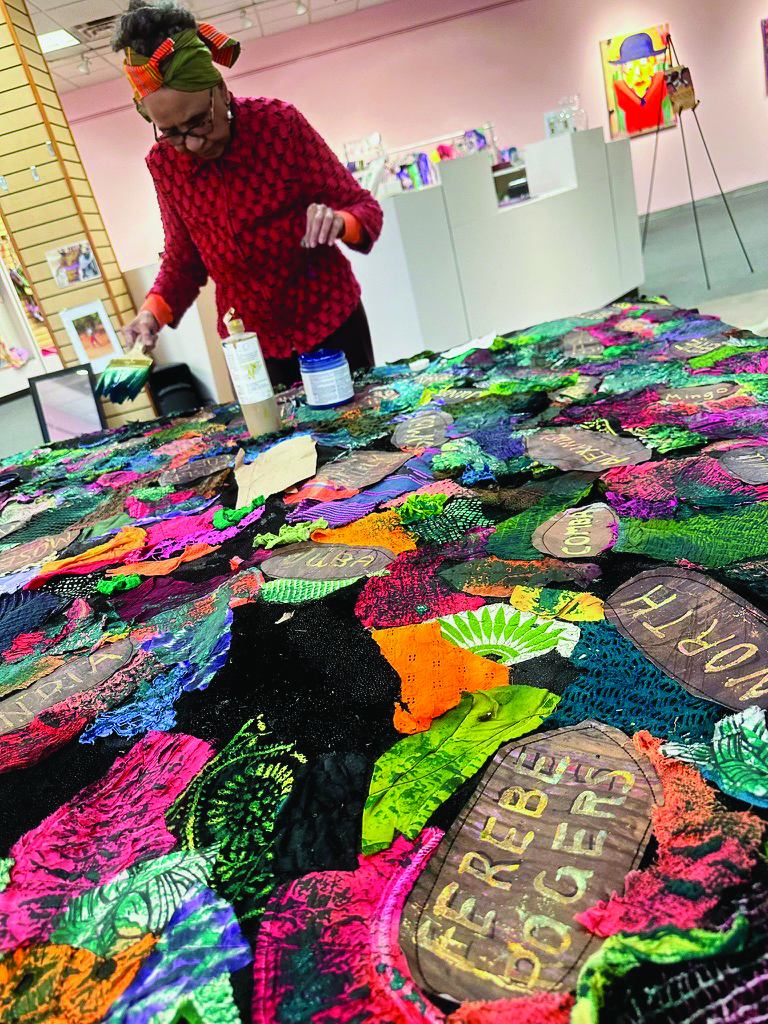
When Wini McQueen was young, twice a year her grandfather would pose the same series of questions: What is your grandma’s name? Your great-grandpa’s? Your great-great-grandpa’s?
McQueen’s grandfather believed it was important she remember these and other family names.
Why?
“Slaves were not allowed to keep their African names or often even the names given them by their parents as enslaved people,” McQueen said. “This added to their separation from their families and communities and their history — and it was done on purpose.
“Taking away people’s names makes it almost impossible for them to reconnect to their past or even their families. Names are very important in African culture, so 10 million people of the African Diaspora losing their names along with their freedom in the Transatlantic Slave Trade was truly sad.”
Her “Quilt of Names” honors these individuals and highlights their history and everyday life.
McQueen said she’s never been into genealogy, but because of her research for this and other projects she’s learned the importance of names and history and how intertwined they are. She knows more of her family’s names than most do because of the emphasis her grandfather put on knowing where she came from. A few of their names are included in her quilt project.
Physically, the “Quilt of Names” is a 12-by-12-foot quilt, but it’s more than that. It’s a mixed-media artwork incorporating textiles, quilt pieces, paint, collage and other techniques.
To recognize and honor the enslaved people whose names were lost and whose unpaid labor built businesses, transportation systems and agricultural empires, a program each day during the debut will include the music of Kelley Dixson, information on the textiles and cotton cultivation expertise African people brought to the South, information from Historic Macon Foundation and an opportunity to help seed a garden of forget-me-not flowers at Oak Ridge Cemetery.
According to its historical marker, Oak Ridge Cemetery was officially established in 1851 within Rose Hill Cemetery specifically for African Americans, both enslaved and free. Many graves are now unmarked.
McQueen began work on the “Quilt of Names” several years ago, inspired by a quilt project she did for a group from Alabama.
“A group called the Mount Willing Quilters had the names of about 150 enslaved people whose names had been or had almost been forgotten,” McQueen said. “They commissioned me to make a quilt with their names, so I used it to tell their story. I don’t remember how many weeks or months I worked on it, but when I finished, it was very, very painful.
“When the Mount Willing Quilters came and picked it up, it was like, ‘You’re taking my people away.’ It made me feel very responsible for helping to tell that story. I decided that one day I would make another story quilt and that day came much quicker than I had expected.”
McQueen is a world-renowned textile artist who grew up in Durham, North Carolina, where her grandfather would bring her scraps from the textile mill he worked in. She moved to Macon in 1985.
Among the many places her quilts and textile works have been featured are the Museum of African American Folk Art, the Taft Museum, the Bernice Steinbaum Gallery, the Williams College Art Museum, Macon’s Museum of Arts and Sciences and countless other public spaces.
McQueen’s work has made her an expert on cotton and textile processes and allowed her to travel internationally. She will participate in a panel discussion, “Fashion: Past to Future,” during Macon Fashion Week on Nov. 4.
As part of Macon’s bicentennial celebrations in 2023, McQueen presented her Canopy project exhibit and installation at the Macon Mall, consisting of 25 40-foot-long, radiantly dyed and carefully patterned fabric banners running almost all the way from the mall’s top floor skylight down to the first level floor.
McQueen also operated a gallery at the mall featuring her textile art, fashion designs, accessories and various other art pieces.
She also did much of the initial work on the “Quilt of Names” there as her appreciation for the importance of the names she worked with grew.
“It made me realize that there really was something very special about an experience I had had during my last stay in Africa,” she said. “I was in a community working with women who spun cotton into yarn. During the course of my stay, I got to work one day and there was no one there. Usually, they were up at daybreak, so it was very unusual.”
McQueen recalled hearing the sound of women singing — a part of a naming ceremony still prevalent in Africa today. Children aren’t named until after they’re born, when the parents know the child is going to live, she added.
“They even put the baby in my lap and brought it gifts and sang the whole while. When it was over, we got back to work,” she said. “It has helped make a deeper and deeper impression on me of how important these names are. How tragic it is that they were lost to those who were given them.”
While working on the quilt at Macon Mall, McQueen said children would often examine the quilt and read names on it — some as simple as Wednesday or June, others bearing traditional African names. She’d have them look for items woven within, such as the likeness of a ship used to carry kidnapped, enslaved people across the Atlantic.
Even though the African language was lost, people in Africa often named children by the day of the week they were born, McQueen said, and that custom became an English naming option. It’s that sort of thing she hopes to teach and bring to remembrance along with the individuals represented and the tragedies forced upon them.
McQueen is a storyteller at heart. She said she’s eager for her art to help explain Black people’s history, struggles and heartaches as well as perseverance and accomplishments.
What will come of the “Quilt of Names” after its outdoor debut in the historic Oak Ridge Cemetery?
McQueen said she believes the community will see their stories reflected in the quilt, take interest in it and interact with her project.
“It won’t be like taking it to a museum that’s 200 or 1,000 miles away and me just being there at the opening,” she said. “Where will it go? I hope people will come forward who want to show it in a variety of spaces and let it travel throughout the community.”
McQueen can be contacted at winimcqueen.com.
Contact Michael W. Pannell at [email protected]. Find him on Instagram: michael_w_pannell.
Author

Related Articles
The Odyssey embarrasses anti-woke crusaders
While I am no movie critic, I applaud Nolan for his recreation of the epic, but perhaps one of his greatest accomplishments was embarrassing anti-woke crusaders.
Don’t blame data centers for failed public policy
Data centers have become a kind of boogeyman among voters lately. Recent polling even suggests that new data center construction is less popular than the IRS.
The World Was Meant to Meet
It is all over now, and I already feel a certain emptiness, Christopher Blake writes in his final column about the 2026 FIFA World Cup.