
A disaster shaped Macon’s water system — and the work continues decades later
The Great Flood of ’94 helped shape how the Macon Water Authority provides water to customers.
A new chapter for The Melody
Our team and coverage are moving to The Telegraph. Make sure you look for The Melody's community-first journalism as a section highlighting the people, places and moments that are the rhythm of Macon.
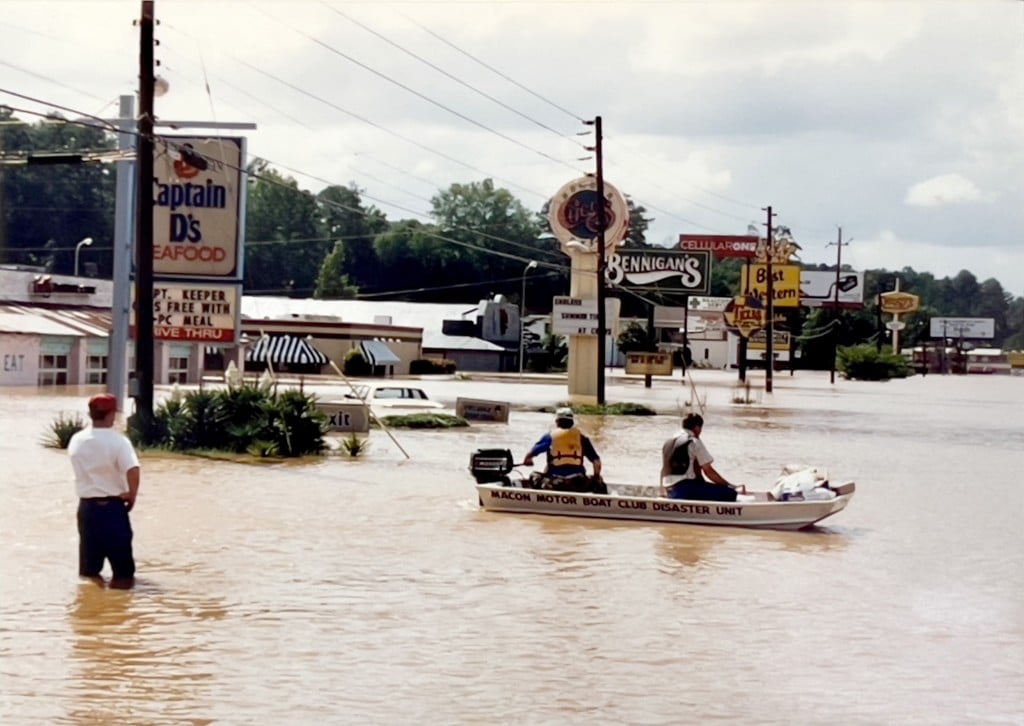
An unusually wet June had already saturated the ground in Macon, leaving streams and creeks straining at their banks.
Then came Alberto, a weakening tropical storm that meandered toward the city — and unexpectedly paused.
For days in early July, it just hovered.
The relentless downpour that followed is etched in local memory as The Great Flood of ’94.
The Ocmulgee River rose to more than 35 feet and breached the city’s levee — a 5-mile earthen wall that begins at Central City Park and rambles through farmlands and pastures before ending at the railroad tracks in Bronson Yard.
For the city’s engineer at the time, it was a wakeup call.
“We were stunned,” Bill Causey said. “Little drainage issues we never knew existed had suddenly become drainage problems that were endangering people’s fences and houses and things like that.”
The deluge left parts of Macon submerged.
Upstream, the water treatment plant off Riverside Drive — where Amerson River Park is now located — also flooded.
Many residents went for about two weeks without access to water to drink, cook, shower or flush a toilet.
Herbert Dennard, who was serving on the Macon Water Authority board then, looks back at the flood 32 years later and sees it now as a sort of “blessing” in disguise. Some $93.5 million in disaster money from the federal government helped the MWA build a new reservoir at Town Creek across the river in Jones County.
“It opened up so many things for us,” Dennard said. “We still spent more money, but we spent a lot less than we would have had to.”
Javors Lucas Lake, which opened in 2003, holds about 5.8 billion gallons of water that is siphoned from the river. Water from the lake is then pumped into a treatment facility, where it is cleaned with chemicals and stored in clear wells, tanks and water towers. The authority has about 40 million gallons of clean water in storage just in case the river dries up — or another flood of similar magnitude occurs.
“We take pride in what we do,” Interim MWA Executive Director Michel Wanna said.
The MWA is not only responsible for stewarding water and sewer services. It is also tasked with street sweeping, catching up on hundreds of millions in deferred maintenance, upkeep of the levee and, as of 2021, dealing with the county’s stormwater issue.
READ MORE: Aging stormwater system, growing county have MWA playing catch-up
One authority, many responsibilities
Before the MWA was formed in 1974, the city of Macon and the Bibb County government each had a governing board that controlled water and sewage services in their respective territories.

As the new, combined authority board was being formed, development was booming outside city limits and annexations expanded on all sides. The city and county governments struggled to coordinate the expansion of water and sewer services.
In 1972, a county attorney made a proposal to the city and its water board: have one agency to oversee it all.
Two years later, the legislature did just that.
The MWA — which was called the Macon-Bibb County Water and Sewerage Authority up until 1992 — is composed of four district-elected members, an elected chair, and two appointees decided by the Macon-Bibb County mayor and commission.
Each of its four elected members represent about 29,000 people — more than double the roughly 12,000 residents represented by each county commissioner.
Day-to-day operations are handled by a CEO, who reports to the board. It’s responsible for setting policies and developing the rules by which the authority operates.

The board sets rates for water, sewer and stormwater services; issues bonds; applies for grants; and has power to exercise eminent domain.
Since the MWA’s inception, its meetings have featured fiery debates among longtime leaders with strong personalities and lasting impacts. Many of the board’s legacy members have their names on MWA facilities: the Frank C. Amerson Jr. Water Treatment Plant, the Albert Billingslea Building on Second Street, Javors Lucas Lake and the Herbert Dennard Support Services building on Martin Luther King Jr. Boulevard.
Still, said Dennard, who was a member of the board for 17 years, “No one person has all the answers. All of us wanted what’s best for the authority.”
Leadership at the authority is in flux as the MWA has been without a permanent CEO since February, when CEO Ron Shipman died. In May, voters will decide who will sit inthree of the board’s seven seats.
Arms of the authority
As of 2014, the MWA has a nonprofit subsidiary called Macon Water Alliance, formerly known as Macon Water Environmental Education.

The nonprofit arm was established to help customers in need pay their water bills. Employees and board members can opt to donate a portion of their paychecks to the charity. There is also an option on customers’ bills to make donations.
The alliance recently voted to approve sending some of its money to other entities that are better positioned to help MWA customers. It donated $7,000 to the state Department of Family and Children Services in Bibb County and $20,000 to a nonprofit called the Macon-Bibb County Economic Opportunity Council.
MWA also has another nonprofit subsidiary — Macon Soils, established in 1998 — to handle the sludge from its sewage treatment plants.
“Macon Soils works for us very well because, if we have to take the sludge to a landfill, it’s going to take a lot of money,” Wanna said, adding disposal fees would add up quickly. “What we do is, we take it and they spread it on farmers’ land.”
Macon Soils applies around 23,000 tons of biosolids to farmland in Bibb and Cobb counties. The nutrient-dense material can be used as a fertilizer or lime supplement.
Fast facts
- Meetings: MWA committees and subsidiaries meet on the first Thursday of each month at 2 p.m. in the board room at 790 Second St. The MWA’s regular board meetings follow at 4 p.m.
- Board members are Chair Gary Bechtel, Elaine Lucas (District 1), Dwight Jones (District 3), Frank Patterson (District 4), and Macon-Bibb County appointees Bill Howell and Valerie Wynn. The District 2 seat is vacant.

This story is the final installment of “Power,” a series by Senior Accountability reporter Laura E. Corley that examines local authorities — quasi-governmental bodies that make consequential decisions about housing, water, transit, development, health care and public spending — that shape life in Macon-Bibb County. Read the entire series at maconmelody.com/power.
Author

Related Articles
Macon’s Boys and Girls Club closed for 90 days, families search for alternatives
The club had many after-school programs that are now on hold.
Downtown Macon breakfast staple Famous Mike’s closes
The restaurant known for its comfort food announced it was shutting its doors Monday.
The lasting legacy of former Macon mayor George Israel, who bridged political divides
Israel, Macon’s second-ever Republican mayor, died last weekend. He was 78.