
Crossing the finish line: Brenda Cliette Thomas, Olympic backup and fire chief, remembers her career
Thomas missed making the cut for the Olympic race by one spot. She used that qualifying sprint, along with her other accomplishments, to leave a legacy in Macon.
A new chapter for The Melody
Our team and coverage are moving to The Telegraph. Make sure you look for The Melody's community-first journalism as a section highlighting the people, places and moments that are the rhythm of Macon.
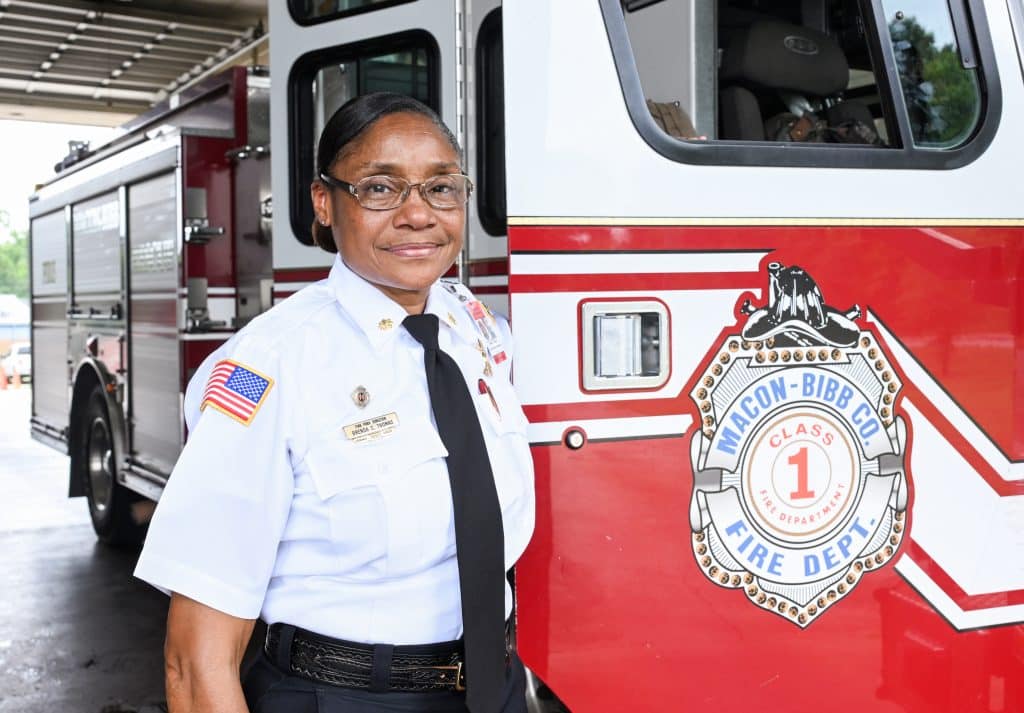
As Brenda Cliette Thomas rounded the last part of the track during the final Olympic qualifier for the 200-meter dash in 1984, her mind was racing as fast as her body.
She wondered where her teammate was. The Macon native and Florida State track star — though Thomas never even really liked track; as she tells it, she only took up running because it was required before she could play basketball at Northeast High School — was accustomed to her fellow Seminole sprinter, Randy Givens, gaining on her by that point in the race.
“I was running, thinking, ‘Where is Randy? She usually passes me by now.’ She always used to start slow, but catch me every time near the last third. I was so used to that happening that I just couldn’t keep my mind off it, it almost affected my speed,” Thomas recalled this week in an office at the fire station on Oglethorpe Street near downtown Macon. “I just kept on going. I was in third, and the top three qualified. So I prayed she didn’t pass me.”
Passing the leaders wasn’t an option. Two of the country’s best runners, Valerie Brisco-Hooks and Florence Griffith Joyner — before she earned the “Flo-Jo” moniker — were already far ahead, set to finish in first and second place.
“I’m clearly in third, because they were both done,” Thomas said. “So here I am, where Randy, my teammate, normally passes me, she’s not there. So I’m thinking I’ll qualify.”
It was her last chance to snag a spot, too. Thomas had already failed to make the cut, as a backup or otherwise, in the 100-meter and 400-meter lengths.
“I was thinking, ‘Man, this is my last shot. Gotta get it here, I gotta do something,” she said.
With all this and more on her mind, Thomas kept chugging around the turn. Then, the last thing she wanted to hear — footsteps crept up on her. Her heart sank.
Just as Thomas neared the tape — lunging for the finish line, her peripheral vision still searching for her teammate — Givens blew by, finishing strong as always.
“I mean, it was from here to that desk,” Thomas says, gesturing to a space of about ten feet between her seat on the sofa and the counter where the fire station radio sits. “I was devastated, crushed. That was what kept me from qualifying. It took her longer than normal to catch me, but she still did.”
As tough as the loss was, she still laughs remembering the last-second lead change.
Her performance earned her a ticket to the 1984 Los Angeles Olympics nonetheless, even if it was as a backup. Four decades later, as the 2024 Olympics in Paris approached, Thomas reflected on how her 1984 race — the sprint itself, the result and everything after — shaped her illustrious career.
An alternate mindset
Thomas is one of few living Maconites with an Olympic connection, her status as an understudy sprinter an unassuming yet prestigious one. Many hear the word alternate and conjure images of failure and shortcomings. Thomas did so herself, about 40 years ago.
“I took it hard. I was in my room a lot for a long time after that, even after the Olympics ended,” she said. “My mom finally made me get out of there and stop dwelling on it. But it was tough to kind of adjust, especially with how the race went down.”
Thomas didn’t get to race in L.A., a blessing, she said, since there were no injuries. She still wishes she had qualified. She thought about trying for the Olympics again four years later, but passed on it — another regret.
“I wish I had tried again. And I wish I had made it that first time around. So there’s regrets there. But that doesn’t define the whole thing,” Thomas said. “It kind of helped define my career in some ways, and not negatively. It became a positive thing. When I thought about it, I realized — we have so many incredible athletes in America, to be the fourth best, the fourth? That was a big deal.”
Plenty about the experience defines her. There’s the feeling of the qualifying race itself — the adrenaline, the raw emotion.
“Now, when I watch the races, I still think about it. I’ll be the same way this year,” she said. “I know exactly how the runners feel when they fall behind, pull ahead. That feeling is still real for me.”
The training leading up to the race, as well, is seared into her memory. Working out two, three times a week drained her leading up to the series of qualifiers. She was out of shape, too, as she hadn’t been running much when they invited her to the training.
Then there was the trip to Los Angeles.
“The people at the parade, oh my,” Thomas remembers. “They were so excited, so passionate that we were representing America in their city. I wasn’t even a runner in the race, and people asked me for my autograph… it made me realize how important it was. I still think about that every four years when (the Olympics) happen now.”
Thomas’ track, cross country and basketball coach at Northeast, Alvin Copeland, recalled that watching Thomas from home always meant the world to Maconites, too.
“We loved seeing her compete at other events. Even when she went to the Olympics, she always kept in touch,” he said. “She inspired a lot of people out there at events.”
There’s plenty to back that up — Thomas is well loved at the fire department. Even before she tried to become an Olympian, Northeast had a Brenda Cliette Day.
The most cogent effect, though, was the aftermath of the fourth-place finish, the brunt of the blow — the “alternate” mentality. Once she learned to process the result of that qualifier, Thomas used it to create a legacy that’s still felt in Macon today.
‘My little sister can run’
Before heading to Los Angeles, Thomas (then just Cliette) dominated in high school and college. Her Northeast career began with a state championship her freshman year. The Raiders won another trophy before she graduated.
“I do think she is the best girl athlete that ever came through here, in my 41 years at Northeast,” Copeland said.
He recounted how reluctant Thomas was to run track. She first popped onto his radar when her older sister, Lynn Cliette, approached him while she was on the team.
“You might not think I’m very good,” Lynn told Copeland, “But my little sister can run!”
Copeland still gives Lynn the credit for recruiting Brenda, who only decided to run once she warmed up to Copeland.
“I told Lynn that she was really, really right. But Brenda, lucky for everyone, liked me enough to run track, she really loved basketball,” Copeland said. “Luckily it worked out, and she became such a star. I think she set a record and won six events one year.”
At Florida State she helped guide the Seminoles to a national championship, but something else at FSU contributed to her current mentality.
“I actually flunked out at Florida State,” Thomas said. “I had to go to community college for a year. I was lucky they gave me a second chance, they didn’t have to do that. Along with the way I missed that qualifying Olympic spot, I used that to change my outlook on life.”
The second chance gave Thomas the opportunity to become the first college graduate in her family, an achievement she still glows over. She won plenty of other medals on the track, too, in other competitions like the Pan-American Games, and even considered playing for the quickly-defunct Atlanta Glory, an ABL women’s basketball team.
Thomas briefly tried teaching and found it wasn’t for her, then helped at a social work camp in Juliette for troubled teen girls until the camp closed down. In 1990, she was looking for a job.
It was her stumbles that made her want to try harder in a new walk of life — Thomas ended up working at the fire department on a whim, where she’s now worked for almost 34 years.
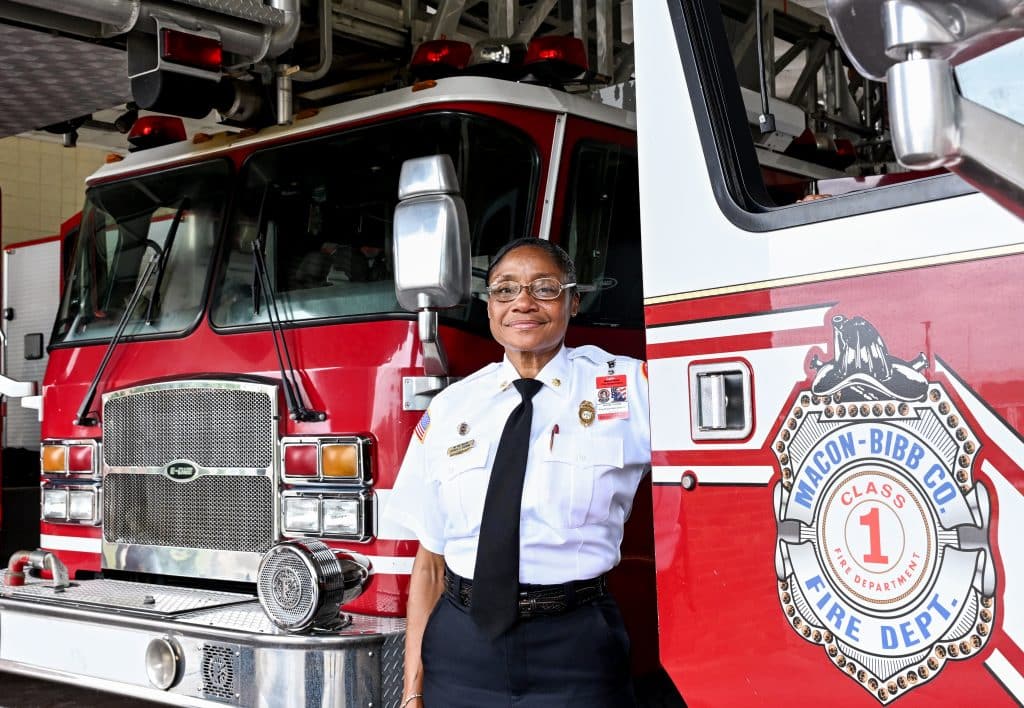
“The most important thing to me was helping people in Macon,” she said. “It didn’t always work when I tried to teach or do other things. When I actually went and worked with the fire department, it was supposed to be just one thing for me to do shortly… when I saw how much they did in the community, I was like, ‘Wow!’ And I never left.”
A new kind of dominance
Thomas went on to become the first woman in Macon’s history to earn the rank of fire chief. She speaks often at local schools or events. Contributing to the community remains her biggest boast, her gold medal.
“I never forget to tell the kids, ‘You know I was a college flunkout?’ They look at me like I’m crazy,” Thomas said. “But I always use it to tell them to try their hardest. And when I talk about that Olympic race, I know it as a great accomplishment, not a failure.”
Her athletic accolades have almost as much of an impact as her barrier-breaking achievements with the fire department. Copeland remembers her feats on the field vividly, four decades after witnessing them unfold.
“She used to bring tears to my eyes when she ran anchor for us in the relay,” he said. “She’d get the baton, the other teams would be comin’ out of the curve, and she’d be behind. The folks in the crowd would say, ‘Oh, this girl might catch ‘em.’ And I’m saying, ‘Oh, she might?’ And she’d always be there at the tape, first place.”
And now, while she thinks about her brush with Olympic competition as this year’s festivities draw near, she mentions an endpoint.
“It’s only 10 more months until I’m done, you know,” Thomas said, almost as if it weren’t important. “It’ll be almost 25 years that I’ve worked here.”
Retirement will give her more time with her family, who she loves. It will give her more time to watch basketball, which she loves. And it will give her time, too, to watch track and field, the Olympics — she may love them less, but she owes them more than one might think a backup sprinter would.
Author

Related Articles
Mercer Athletic Director Jim Cole steps down; Bears picked to win SoCon
Get updates from sports across Macon and our weekly sports notepad.
After last year’s state title run, Stratford ready to run it back
After taking home the trophy last year, a talented Stratford team wants to do it all again.
Macon’s first pro pickleball tourney complete; Covenant drops football for 2026 season
Get sports updates from across Macon in our weekly sports Notepad.