
Holy Cross Greek Orthodox Church’s iconography taps into ancient tradition
Greek iconographer Aristidis Kovaci and his team will complete iconography in the Holy Cross Greek Orthodox Church on First Street by the end of this week.
Kovaci’s work is part of the fourth phase of the church’s Project Agape — an effort to install church furnishings, flooring, lighting and iconostasis that began 10 years ago.
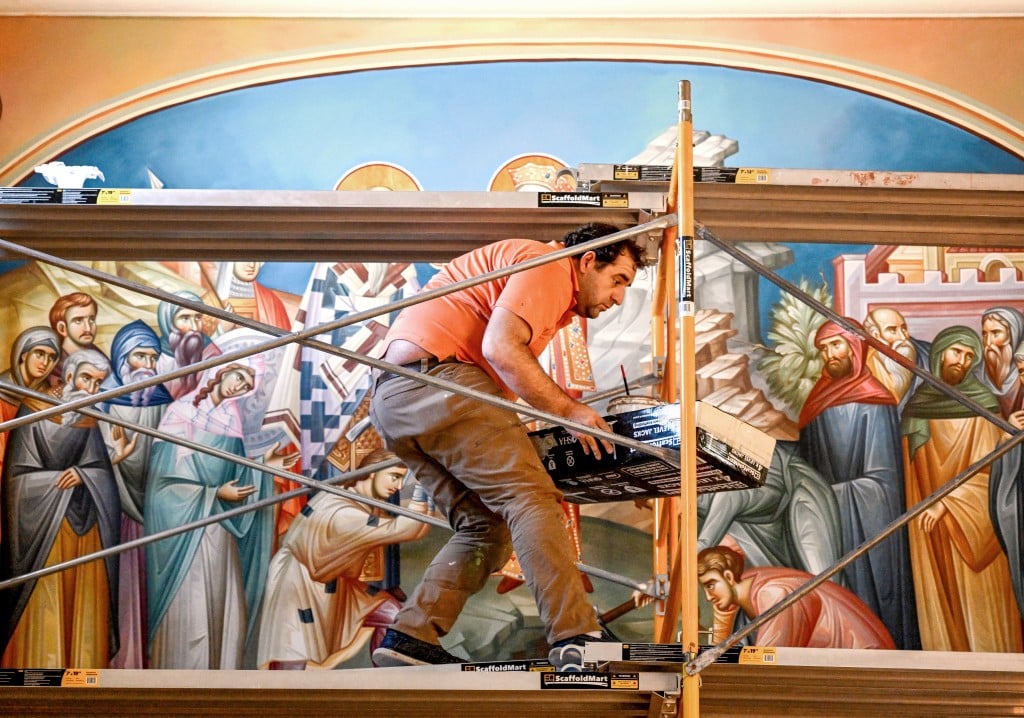
Greek iconographer Aristidis Kovaci and his team will complete iconography on the altar and west wall of the Holy Cross Greek Orthodox Church on First Street by the end of this week.
“This is something that the parishioners have been dreaming of for decades,” Father Theodore Ehmer said. “It feels like we’re tapping even further into that ancient apostolic faith, which we hope to pass on to those who come after us as well.”
Kovaci’s work is part of the fourth phase of the church’s Project Agape — an effort to install church furnishings, flooring, lighting and iconostasis that began 10 years ago.
Holy Cross originally began as a satellite congregation of Atlanta, and in 1976, the parish purchased a church in Bloomfield. The church’s current First Street location was purchased in 2004 and underwent extensive renovations.
Iconography is a style defined by geometrical lines, sharp contours and flattened colors. It has not changed much over the years, Kovaci said, and iconography carries an old spirituality with it.
Kovaci hails from Pirgos Ilias, Greece, and came to the United States 13 years ago. He learned iconography in a monastery and has been a part of several iconography projects throughout the Peloponnese.
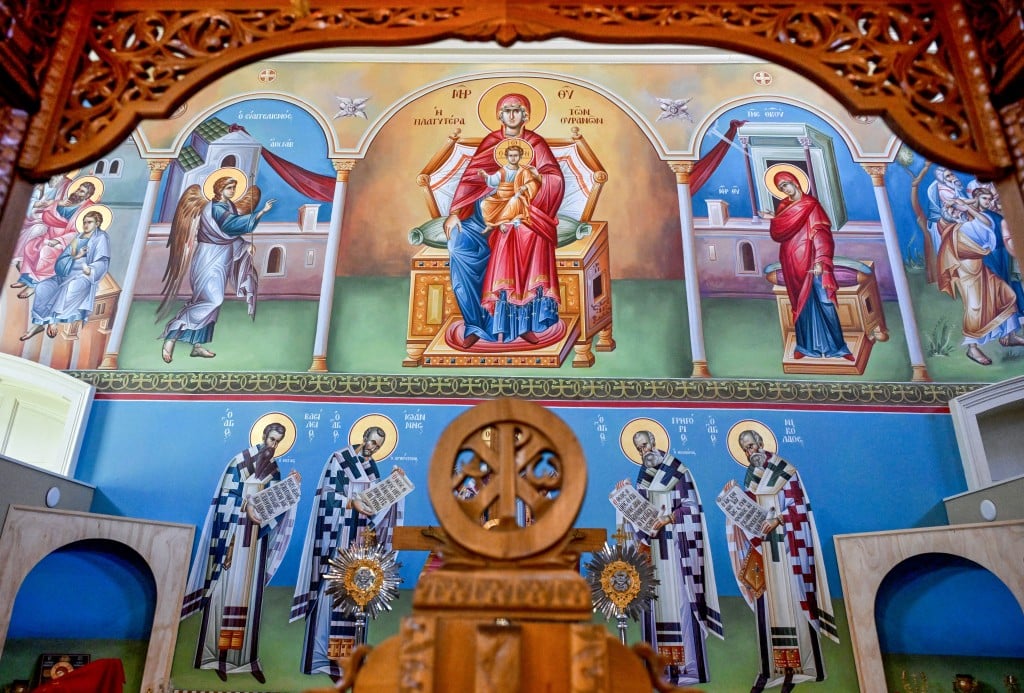
Kovaci has specialized in Byzantine iconography for more than 20 years. Today, he lives in Jacksonville, Florida.
He started planning the project in 2021 and began the actual painting process a year ago.
The planning is complicated and goes through many stages, Kovaci said, designs are chosen carefully to represent the Bible and must be approved by the Metropolitan of Atlanta Alexios, a bishop of the Ecumenical Patriarchate.
Kovaci and his team started by painting on a massive canvas which is then cut out and placed on the wall. Next, he blended the background and added detailing.
Working with canvas is more suitable for humid environments in the South, said Emily Dermatas, 2nd vice president of the church’s Ladies Philoptochos Society.
The iconography on the holy altar wall depicts several biblical scenes, including “The Annunciation,” “Christ at the Table Blessing the Bread and Wine,” “Ascension” and “Pentecost.”
“Everything feels flat, like it’s in the wall there and it comes towards us,” Kovaci said.
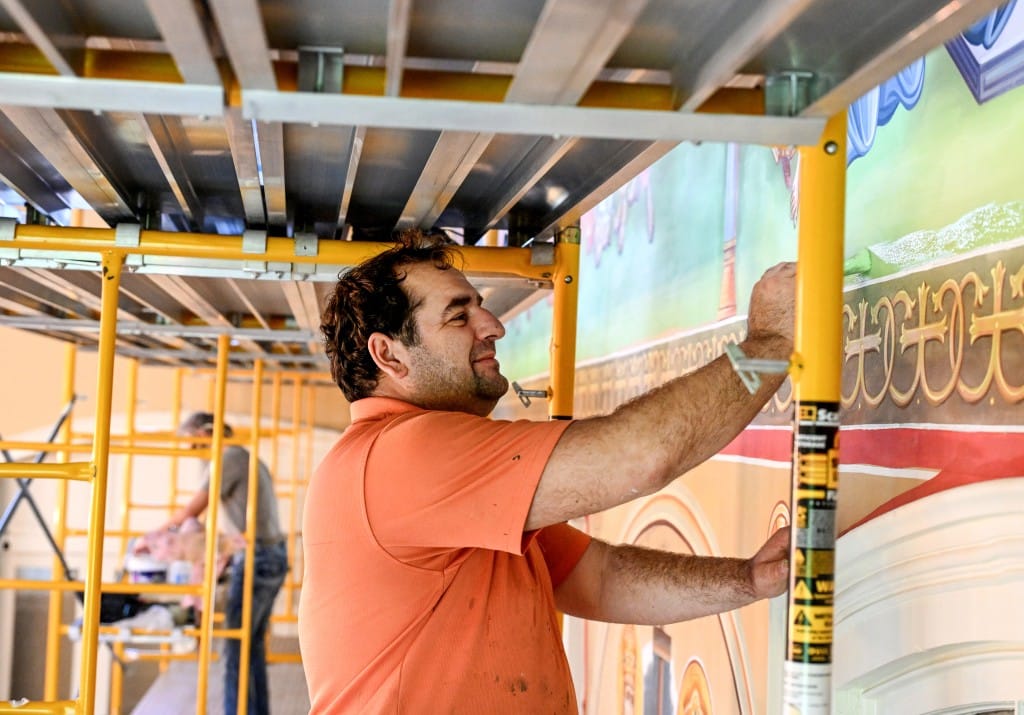
The connection between the people and the iconography creates the third dimension, he explained.
The west wall portrays scenes such as “the Dormition of the Theotokos,” “The Discovery of the Holy Cross by St. Helen” and “Sts. Constantine and Helen.”
The intention isn’t just to create a visual scene of something that once happened, he said, but to bring that spirituality alive and make it present within the church. Being able to serve the church and seeing parishioners’ reactions to the ongoing project is the highlight of his work, according to Kovaci.
“They haven’t seen something like this happening,” he said. “It’s the first time they’re experiencing such a project and how it’s done.”
Iconography is the crown jewel of what’s traditionally seen in a Greek Orthodox church, said Ehmer, who has been with the congregation since 2018.
“Now to see the iconography on the walls — it’s unbelievable,” he said. “Glory to God for that and honestly, though, it just feels like it’s always been there.”
Kovaci plans to return to the church next year to do the north and south walls.
Before you go...
Thanks for reading The Macon Melody. We hope this article added to your day.
We are a nonprofit, local newsroom that connects you to the whole story of Macon-Bibb County. We live, work and play here. Our reporting illuminates and celebrates the people and events that make Middle Georgia unique.
If you appreciate what we do, please join the readers like you who help make our solution-focused journalism possible. Thank you
Author

Related Articles
Macon Volunteer Clinic helps uninsured patients get care
A local clinic has been treating uninsured Maconites since 2003. In 2024, volunteer medical providers served more than 300 patients.
After loss, Georgia mom pushes for change in pain and addiction care
A Georgia mother turned loss into change with her organization, Christopher Wolf Crusade.
‘A real feel-good time’: Locals share magical Christmas memories
Ten Maconites shared their Christmas memories and traditions with The Melody.