
Led by women’s basketball, Middle Ga. State athletics tackles Division II
The women’s team defied expectations and found success in its first Division II season, setting the table for MGA’s other programs.
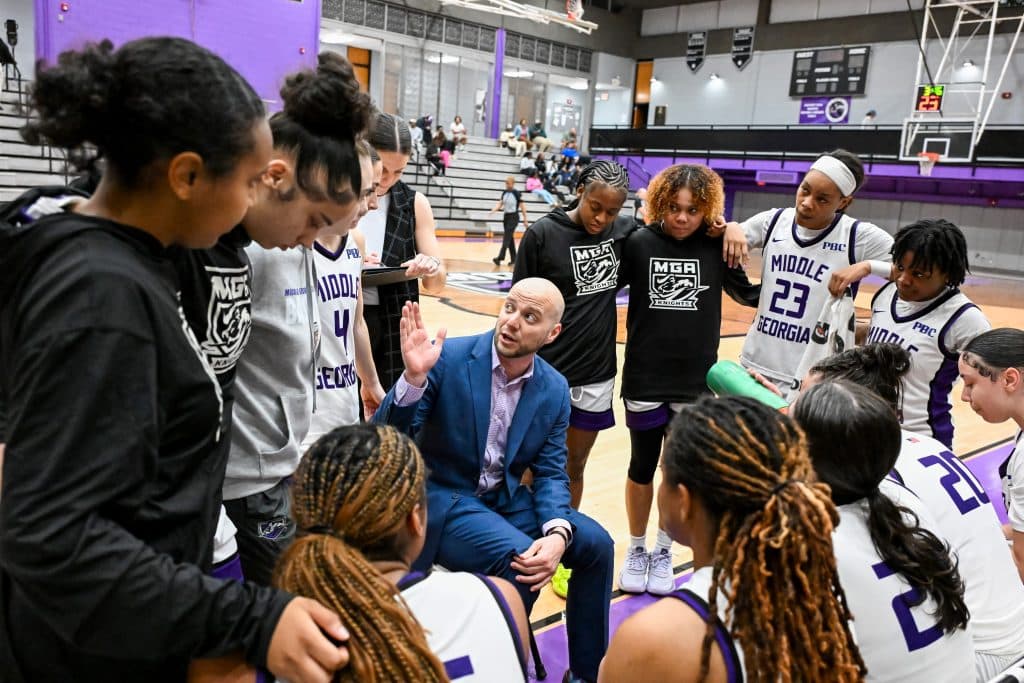
It was the beginning of May, and Steven Rhodes was nervous.
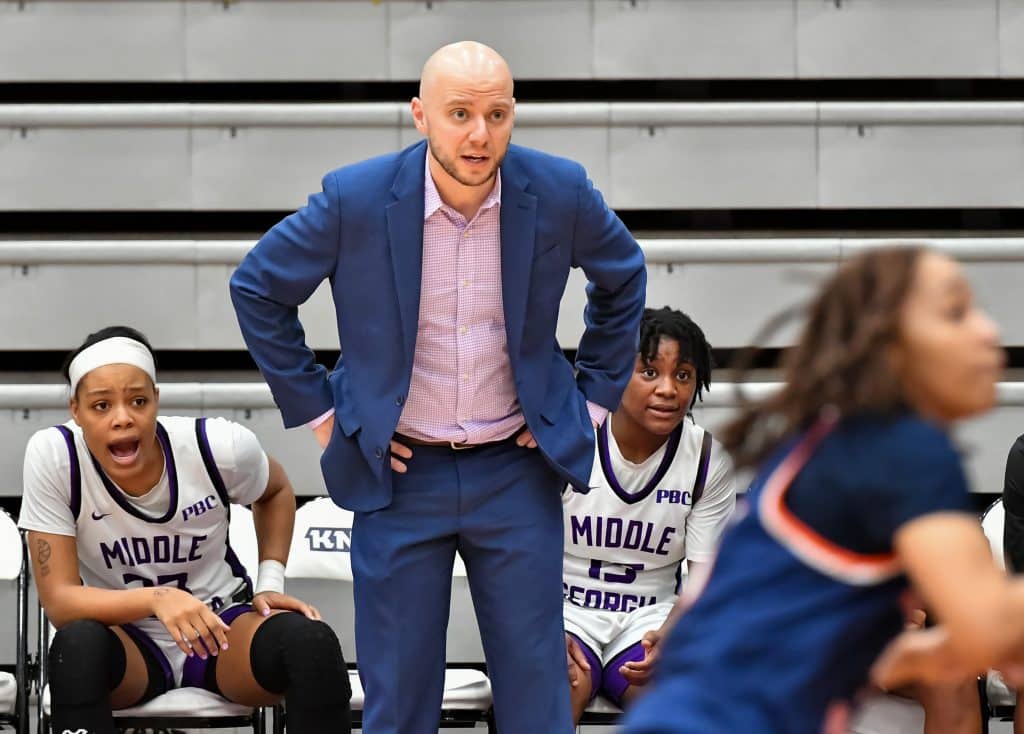
It was only natural. He had been coaching women’s basketball for more than a decade as an assistant, but he was about to take on his first head coaching job at Middle Georgia State.
Rhodes knew Middle Georgia State had gone 3-17 the year before he arrived. He knew the school had only been a university since 2014. And, perhaps most importantly, he knew that the school’s athletics had just announced they would be moving up to Division II from NAIA for the 2025-26 year, a large jump in athletic difficulty.
So yes, Rhodes knew things might be difficult when he was hired to lead the Knights into a new era. But he also knew that if his team could be different in its execution and connection — not the best, just different — then they would have a shot at making some strides.
Perhaps the one thing he did not know was just how different this team would be.
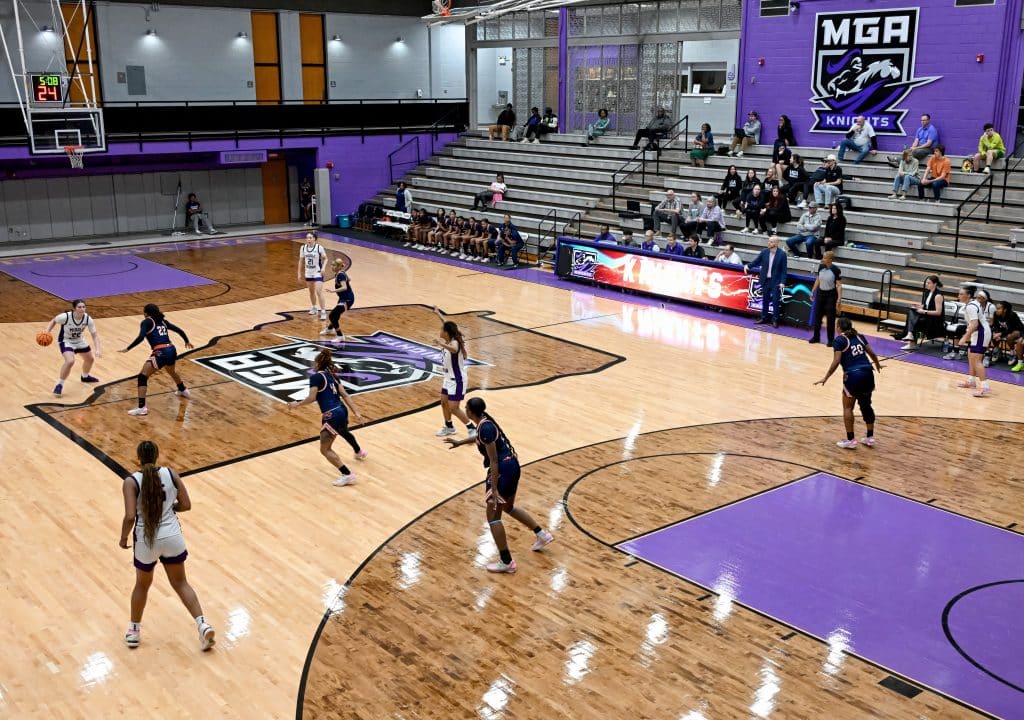
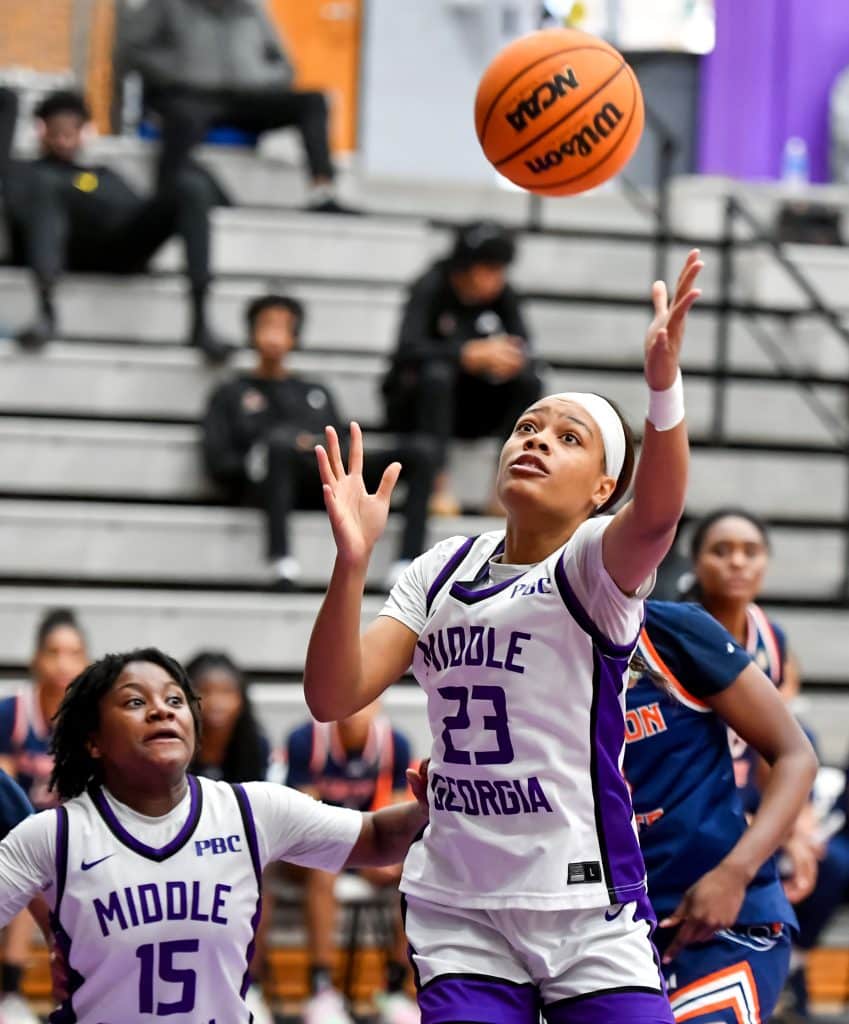
Under Rhodes’ leadership, the Middle Georgia State women’s team finished the regular season 17-10 with a 10-10 record against the Peach Belt Conference, defying expectations that came with the leap in competition. Two players were selected to the all-conference team. Rhodes’ assembly of talent features athletes hailing from as near as Rabun County and as far as Spain.
The excellent debut of the women’s basketball program at the Division II level is more than just a tale of coaching success, however — it is a reflection of a change more than a decade in the making, and the impending challenge that comes with it for the university.
A longtime goal
Middle Georgia State has a unique history that stems back to 1884 and includes the consolidation of Macon State College and Middle Georgia College in 2012, the latter of which had a solid track record in junior college athletics. It’s been an accredited university since 2014 and has campuses in Macon, Cochran, Warner Robins, Dublin and Eastman, though Cochran is where the majority of their athletics programs are based.
Athletic director Michael Brown, who arrived at Middle Georgia in 2023, said rumblings about moving up to Division II started more than a decade ago. With benefits like generating regional rivalries and eliminating distant travel — the sports teams had to go to Mississippi, Louisiana and beyond for games on a fairly regular basis in the NAIA — the move seemed like a natural one.
“The actual momentum started in 2022, when the institution went before the university system and made a presentation to move (to Division II). They got approval then,” Brown said. “I was hired in November 2023, then a couple weeks after that we had a visit with the Peach Belt on-site.”
The visit went well, and the Peach Belt invited the Knights to join in January 2024. After some other logistics, Middle Georgia State applied to move to Division II in January 2025 and got approval in July.
Brown said the university’s strategic plan was laid out before he arrived, which made working with Middle Georgia State an easy choice. The entire university was invested in helping athletics advance. President Christopher Blake, who has led the university since 2014, was a key proponent of Middle Georgia State better aligning itself with the University System of Georgia and the subsequent improvement of athletics, Brown said.
The athletic director also mentioned how Division II is, in some respects, a place where college athletics feels a bit more old-school.
“I’m biased having worked in Division II, but I think it’s the best division. I think it’s the most pure type of collegiate athletics we have nowadays with the way Division I is moving,” Brown said.
Such a jump comes with plenty of challenges, though. Teams have a much more difficult field to play against. The Knights are also provisional members of Division II for the first three years, meaning they can’t play in NCAA postseason tournaments or games for the next few seasons.
“There’s been some significant challenges with stepping up in competition, but (the coaches) have embraced it,” Brown said. “It’s hard knowing that this was going to be a long runway to getting where we want to be, which is (to be) a full member and be supported resources-wise, but they’ve bought in.”
Middle Georgia State also has a luxury Brown said many new Division II schools are not afforded: they are full members of their new conference, the Peach Belt, meaning they can compete in the conference tournament in many sports.
That is the juncture one of the university’s teams found itself at this week as it attempts to set a new standard for what Middle Georgia State’s student athletes can accomplish.
A new beginning
The women’s basketball team was probably not the Knights team that was expected to rise to meet the challenge, but Rhodes described himself as “very competitive” — he wasn’t going to just roll over with a new team at a new level.
“I always grew up and loved rooting for underdogs. It’s fun to be one. I knew we could do things differently. We didn’t have to be the best team, and I knew that would be unlikely, but we could do things differently,” Rhodes said of his thoughts when he arrived at Middle Georgia State.
That included creating a group that Rhodes said was more connected interpersonally this season than any team he’s worked with. That’s a high honor, as Rhodes’ career history includes assistant coaching gigs at various programs in Division II and Division I, most notably a season with North Carolina A&T when it made the NCAA Division I tournament.
As if the jump to Division II and subsequent postseason ban was not enough, Rhodes joined the Knights in May, after the transfer portal closed. The new head coach got to work building a team.
Rhodes evaluated some of the returning players, choosing which of them would return based on their character and academic track records with less emphasis on playing ability. He did the same thing when scouting new players.
“That was my mindset going into recruiting. I was going to find the best people. … My past experience really helped me. At most of my past jobs, I was the recruiting coordinator. I’ve recruited all over the place,” Rhodes said. “I asked coaches for the best character people because I wanted to shift the whole mindset.”
Rhodes’ coaching history allowed him to make recruiting calls in Georgia but also back to his previous school at USC Upstate. The Knights pulled players from Virginia, Minnesota and Spain. A team materialized over the summer — then it was time to get to work.
While his nerves remained, Rhodes started to believe in the team’s potential when practices started up. He ran a program called S.H.I.F.T., where each week featured practices and tasks based around a different word dictated by the acronym.
The final segment was themed around the word toughness.
“When we got to that last toughness practice, it was like ‘Alright, we’re in this,’” Rhodes said. “This is happening. Then the other moment that stands out was our first game against Converse (University).”
That first game, all the way back on Nov. 14, was where Rhodes’ anxieties about being a head coach more or less evaporated. While he was nervous before the game, the leader of the Knights found himself falling into routines and enjoying the place he knows best: the basketball court.
Middle Georgia State got its first win, 66-61, that night in November. The team has skyrocketed since, going 17-10 and finishing fifth in the conference despite being voted as the worst team in the Peach Belt preseason polls. Leading scorers Mauryah Jones and Kennedi Hawkins were named third team all-conference.
They played in the conference tournament for the first time Wednesday, though Rhodes’ worries had completely vanished by then.
“Honestly, my wife was asking me, ‘Aren’t you excited? It’s your first conference tournament game as a head coach.’ I think I’m just so competitive, I haven’t even thought about excitement. I’m just focused on the next thing,” Rhodes said.
That next thing is building up talent and experience across Middle Georgia State’s sports. With his players and coaches behind him — Rhodes is quick to give credit to all of his athletes and assistants before he takes any for himself — the head coach feels like the Knights are on the right trajectory.
“That’s where there is some pride. I do feel like we’ve become the standard in year one,” Rhodes said. “(Assistant Madison Lowery) is a huge part of that. She brought experience from top basketball programs. She puts pressure on everybody to improve with the little details. Other coaches ask how we do things like pregame meals, and she helps take that to the next level.”
As other sports try to match the women’s basketball team’s meteoric rise, it feels like Rhodes may have ushered in a new era at Middle Georgia State.
“It’s a healthy pressure, whether it be on the other coaches or student athletes, to say, ‘Hey, this program was picked to finish last in the conference but finished fifth.’ That’s a huge jump in expectations,” Brown said. “It just shows the other programs that with the right people and the right players, good things can happen quickly.”
Before you go...
Thanks for reading The Macon Melody. We hope this article added to your day.
We are a nonprofit, local newsroom that connects you to the whole story of Macon-Bibb County. We live, work and play here. Our reporting illuminates and celebrates the people and events that make Middle Georgia unique.
If you appreciate what we do, please join the readers like you who help make our solution-focused journalism possible. Thank you
Author

Related Articles
Southwest wins overtime thriller 62-60 over Model to reach Final Four
The Patriots will play in the semifinals for the second year in a row after defense and rebounding helped them get a close win.
Southwest defeats East Laurens 70-58 to advance to state quarterfinals
The Patriots looked set for a deeper playoff run in the impressive win, which was fueled by solid performances by Chase Dupree and CJ Howard.
Size, shooting of Athens Christian too much for Stratford in 47-27 state title loss
The Eaglettes scored just 12 points in the final three quarters of a defensive showdown in the GIAA Class 4A State Championship.