
A year on, Macon-Bibb keeps public comments offline
It has been a year since the Macon-Bibb County mayor decided to stop livestreaming the general comment portion of the meetings, a move he made quietly without input of commissioners or notice to the public.

Renoalda Scott thought at first the Macon-Bibb County Commission meeting livestream she was watching early one evening in March somehow got disconnected.
“Now we’re going to move on to public comment on non-agenda items” was the last thing she heard Mayor Lester Miller say before the video abruptly ended.
Perhaps there was an issue with the internet — “you know, Facebook, sometimes you get disconnected,” Scott, the chair of the Macon-Bibb County Democratic Committee, remembered thinking.
“A lot of my constituents were asking, ‘Hey, is it cutting off on you? Or are we missing something?’” Scott said. “That’s when we noticed that when the public starts to speak, the mayor or whoever’s calling the shots has the comments cut off.”
October marks a year since the mayor decided to stop livestreaming the general comment portion of the meetings, a move he made quietly without input of commissioners or notice to the public.
“Basically, to me, it’s kind of like you’re silencing the community,” Scott said. “It limits transparency and makes everyone feel like their voice does not matter. Sometimes that can discourage participation and undermine trust in the process. … Most of the time we’re speaking on community issues and sometimes people don’t know what community issues are until they hear someone else say them or bring them up.”
County spokesperson Edna Adams confirmed via email that livestreaming of general comments ceased in September 2024 “to maintain a respectful, productive, and legally compliant meeting environment.”
“While public participation remains a vital part of our process, recording unscripted remarks on non-agenda topics can create challenges, including the potential spread of misinformation, disclosure of sensitive or personal information, and disruption of meeting decorum,” according to an email from Adams. “Public comments on non-agenda items will continue to be welcomed and fully considered by the Mayor and Commission, and the official minutes will continue to reflect the concerns brought forward. Public Comments on agenda items are still broadcast and recorded to ensure transparency on matters before the Commission. This adjustment allows us to protect individual privacy, uphold community standards, and ensure our meetings remain focused on serving the public interest, while still maintaining transparency and accountability through our established records.”
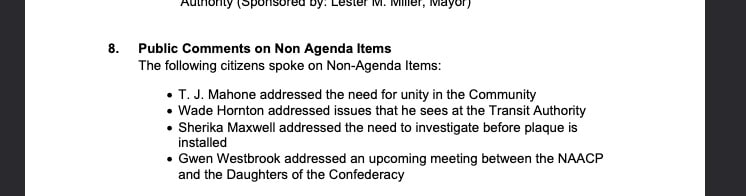
The county’s notes from the commission meeting in October 2024 show four people addressed the commission in general public comment. All speakers’ names are misspelled, with only a few words describing their topics.
L.J. Malone, who is listed as “T.J. Mahone” in county notes, said he did more than “addressed the need for unity in the community,” as indicated in the meeting minutes.
“I led a group that was protesting against the Charley Benger placard that day, and we made them rescind their decision due to the bad publicity it was getting,” Malone said.
The placard for Benger, a Black Confederate soldier, was a proposed donation to the county by the United Daughters of the Confederacy. The commission ultimately decided to decline the offer.
‘We did not have a say’
The mayor’s new public comment policy separates “general public comments” from comments related to items on the agenda. Comments related to agenda items take place earlier in the meetings and are livestreamed.
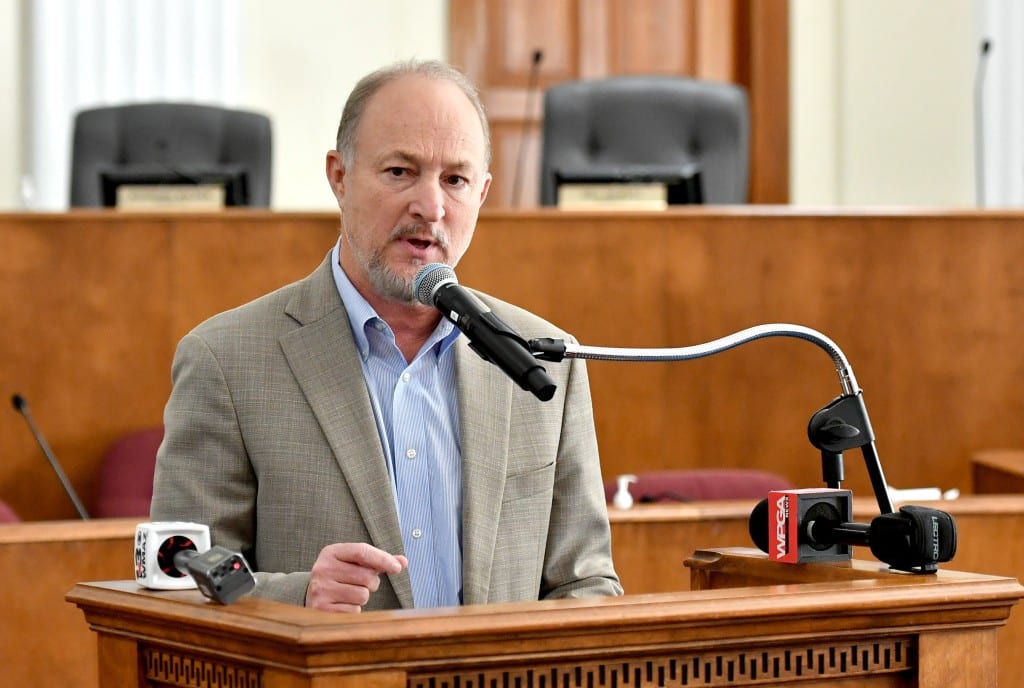
“We did not have a say in the decision,” said Macon-Bibb County Commissioner Donice Bryant, who represents parts of central and west Bibb County. “I think the whole thing should be streamed. It’s their right to free speech. As long as they’re not threatening to anybody, I think everything should be streamed.”
Elaine Lucas, who served on the commission until January and now serves on the Macon Water Authority board, quickly picked up on how to work around the mayor’s new policy.
“I started signing up for comments on agenda items because there’s always an agenda item you can tie something to,” said Lucas, who has addressed the board numerous times since reaching her term limit on the county commission in December. “I would get recognized then because they knew they would be challenged.”
Like Lucas, Democratic Committee Vice Chair Julia Callahan also adapted to the mayor’s new policy.
“In order for me to get livestreamed, I had to make a public comment and specify it pertains to the agenda,” Callahan said. “You’ve got to do it that way or else the people who are livestreaming the meeting won’t hear you.”
Sometimes, people who sign up to speak appear frustrated and have exhausted all other means known to them for getting the county to address an issue.
That was the case for Darryl Gadson, who spoke at one of the last meetings during which the mayor allowed public comments to be livestreamed. The mayor warned Gadson not to mention any county employees by name as he spoke about alleged misconduct, negligence and abuses of power within the code enforcement department.
When Gadson asked the mayor why he was prohibited from naming individuals, the mayor said, “Because it violates our policy and we’re not going to allow you to do that.”
Instead, Gadson used the word “blank” in place of names in what was to be some of the final general public comments livestreamed from the meetings.
On other occasions, people just want to announce information of interest to the commission and the broader community.
At a recent meeting, Harold Michael Harvey announced plans to honor the first Black members of the Macon City Council, individuals he credits for “doing the dirty work” to get the city’s segregationist mayor to pave roads and build parks in Black neighborhoods.
“It is both a privilege and a profound honor to stand before you today to share news of a milestone event in our community’s history — a celebration that echoes with pride, progress and the enduring progress of equality,” Harvey said.
Harvey asked the county to join in commemorating the 50th anniversary of the swearing in of the first Black council members in an event on Dec. 12.
Those individuals “shattered barriers and opened the doors of public service to all regardless of race, background or circumstance,” he said. “Their election is a testament to the fortitude of those who fought for inclusion, dignity and representation in the heart of our city.”
Harvey’s touching tribute to Macon’s Black leaders was heard only by those in the commission’s chambers.
Access versus order
Earlier this year, Macon Water Authority Board Chairman Gary Bechtel unilaterally decided to stop livestreaming monthly meetings.
Instead, videos from the meetings are posted weeks after they occur. Neither Bechtel or the authority provided notice of the change to the public and no other board members were consulted about the change.
The water authority has been publicly criticized for holding hourslong meetings during the day when many people are working.
The trend of government officials cutting public comment sections in livestreamed meetings — or nixing livestreamed meetings all together — is becoming increasingly widespread.
In Johnson County, Kansas, the county commission chair instituted similar rules as Macon-Bibb County, also citing the spread of false or misleading information.
The same goes for city leaders in Glendale, Arizona, who said it was a way to stop broadcasting inappropriate remarks.
Archon Fung, a Harvard University professor who studies transparency and democratic participation, has said that full public access — including livestreaming — is vital for building trust in government.
But officials in jurisdictions such as Glendale contend moderating or restricting portions of meetings is necessary to prevent disruptions and avoid broadcasting inappropriate remarks.
Editor’s note: An earlier version of this story mistakenly referred to the proposed United Daughters of the Confederacy donation as a statue. We regret the error.
Before you go...
Thanks for reading The Macon Melody. We hope this article added to your day.
We are a nonprofit, local newsroom that connects you to the whole story of Macon-Bibb County. We live, work and play here. Our reporting illuminates and celebrates the people and events that make Middle Georgia unique.
If you appreciate what we do, please join the readers like you who help make our solution-focused journalism possible. Thank you
Author

Related Articles

Advocate who pushed for safer streets killed while biking in Macon
Louis Michael Ryan was a member of the Pedestrian Safety Review Board and was known by Maconites as a staunch supporter of safer streets.
Bibb schools end high school summer school, emphasize year-round credit recovery
The Bibb County School District noted the change in an email to parents in early December.
‘A real feel-good time’: Locals share magical Christmas memories
Ten Maconites shared their Christmas memories and traditions with The Melody.