
Macon Mental Health Matters’ survey on adverse childhood experiences offers ‘snapshot’ but will need to dig deeper
Andrea Cooke and her team presented Macon Mental Health Matters’ Adverse Childhood Experiences study at City Hall. The data collected could be used to identify particular areas in need in Macon
A new chapter for The Melody
Our team and coverage are moving to The Telegraph. Make sure you look for The Melody's community-first journalism as a section highlighting the people, places and moments that are the rhythm of Macon.
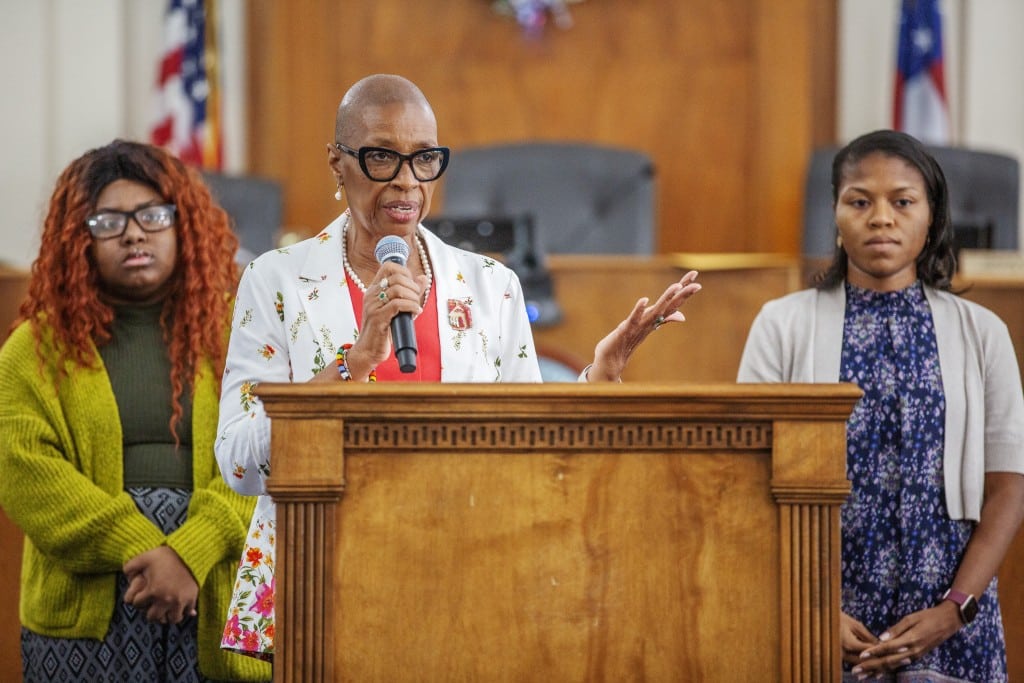
A local mental health initiative conducted a study to raise community awareness on the impacts of adverse childhood experiences.
The results of Macon Mental Health Matters’ (MMHM) study may open doors to a broader discussion of mental health in the community, and if expanded, has the potential to inform which areas need services.
MMHM Development Director Andrea Cooke led the study in collaboration with her mother Dr. Gloria Cisse’s organization – Southern Center for Choice Theory – which Cooke co-founded. Funding for the study came from Macon-Bibb County as a part of its “no cost mental health services,” Cooke told The Melody.
The mother/daughter duo and their team presented their findings on Adverse Childhood Experiences (ACEs) July 29 at Macon City Hall, which included a panel discussion with professional family counselors and therapists.
What are adverse childhood experiences?
ACEs are defined as any traumatic occurrences that people experience before the age of 18, including abuse or neglect. Such trauma can impact one’s long-term mental health, development and contribute to generational trauma.
“There are some African American communities where there are life stressors, and there are many societal messages received by the individuals in that community,” said licensed associate marriage and family therapist, Shameyrae Miller, during the panel at city hall.
Approximately 64% of adults in the U.S. have reported experiencing at least one type of adverse childhood experience before 18, according to the CDC, and females; non-Hispanic, American Indian, and Alaska Native adults; and unemployed adults or those unable to work experience the highest adverse childhood experiences.
“There are traumas that started way back in slavery that were just passed down from generation to generation. So a lot of behaviors and coping strategies and responses to trauma have been normalized,” said Miller, who is also the child and adolescent program manager at River Edge Behavioral Health.
The study
Psychologists developed a survey that presents 10 different adverse experiences for which the respondent checks “yes” or “no.” Each “yes” counts as one point. An individual’s ACEs score equals the total accumulated number of points.
“What we’ve done in this community is attempt to take that study that is based on the individual and transfer it to a community,” said Cisse during the city hall unveiling. “We wanted to get a snapshot of what might be going on.”
Cooke and Cisse developed the 10 ACEs questions into a Google form survey and included two qualitative questions. For the main portion of the survey, each respondent answered yes or no questions.
Some questions included, “Did you often feel that you didn’t have enough to eat, had to wear dirty clothes, or had no one to protect you? Or that your parents were too drunk or high to take care of you or take you to the doctor if you needed it?” or “Did you live with anyone who was a problem drinker, an alcoholic or who used street drugs?”
The only demographic information collected were respondents’ zip codes, in order to identify areas with particularly high ACEs scores.
A HIPAA consultant advised on privacy and safety for the project, Cooke told The Melody, which is why her team did not collect back-end data, like respondents’ email addresses or any additional demographic information, such as age, children, etc.
For four weeks, the survey circulated on flyers, the organization’s official website and social media. In addition, Cooke and Cisse worked with the city to get the word out and with their community partners who shared it in newsletters. One hundred and four individuals from 21 different zip codes completed the online survey.
“We wanted as many people as possible to participate in this study, but we recognize that a lot of people don’t know what it is,” Cooke told The Melody, noting that those who had prior knowledge of ACEs were more likely to complete the survey.
Nearly half of the 104 individuals learned about the initiative directly from MMHM or the Southern Center for Choice Theory, which indicates prior familiarity with community resources and that the survey was not necessarily reaching audiences in need who don’t already know what help is available. In addition, close to 70% of respondents had previously heard of or used MMHM services, prior to taking the ACEs survey. This suggests that the pool of survey respondents mostly consists of those already receiving professional help, which may lead to inflated ACEs scores that don’t accurately reflect the community.
The organization also conducted focus groups with members of the community, who Cooke said were less hesitant to participate.
“We really wanted a lot of the qualitative data, because we wanted to hear people’s personal experiences,” she said.
Those participants cited poor public education, a lack of resources and lack of mental health professionals as the “most pressing issue” within the community.
The main goal of the survey, Cooke explained, is to increase awareness and knowledge of adverse childhood experiences and help people understand the resulting long-term effects of not pursuing mental health services.
The results
Cooke and her team revealed the top four zip codes with the highest number of respondents, which they called the “most impacted.”
Highest number of respondents by zip code
31204 had 26 responses
31201 and 31210 both had 15 responses each
31211 had 11 responses.
The community-wide ACEs score, calculated as the average of all survey respondents’ individual ACEs scores, is 4.07. She also released the average ACEs scores for each of the 21 zip codes.
Based on their score, respondents were directed to resources upon completion of the survey.
Resources
Score of 0-4: online resources and support from Southern Center for Choice Theory
Score of 5-7: connect with a professional or encouraged to attend an MMHM community event, like a drum circle or knitting or a men/women mental health meetup
Score of 8-10: Individual therapy/Teranga, therapist-led group men’s/women’s meetup, healing hike or Yoga in the Plaza.
Interpreting the data
Putting the survey’s 104 respondents in context with Macon’s population size of roughly 157,000, it might be challenging to understand how informative such a “snapshot” is for the community. Can the data be expanded from a “snapshot” of particular areas to the Macon community as a whole? Cooke believes, yes.
“From a research perspective, it’s not small. From a community-wide or from a numbers game, yes,” she said. “But in doing a quantitative or mixed method study, it’s not a micro number. It appears that way, considering how many people we have in our community.”
However, gaps in the data released by MMHM make it challenging to apply the study on a broader scale.
For instance, the 21 zip codes included in MMHM’s survey each have an average ACEs score calculated as the average of all individual respondents’ scores within that zip code. However, the number of respondents per zip code is unclear. There’s no definitive way to tell whether a few folks or hundreds of community members from that particular zip code contributed to the average score.
Mercer psychology professor Tanya Sharon, who specializes in developmental psychology, provided The Melody with her assessment of the data.
“Since the sample was a convenience sample (drawn by soliciting current clients as well as community members through advertising and word of mouth) rather than a truly random sample, it is not possible to know how closely these results represent the entire Macon population,” she wrote.
Cooke and her team could have used a representative sample, in which the percentage of survey respondents per zip code reflects the population size of those areas, but this is expensive and difficult to accomplish, according to Sharon, making the convenience sample a more practical option.
Though, she noted demographics like race, gender, education and age are commonly collected when using a convenience sample.
Despite the study limitations, Sharon asserted that identifying zip codes in need is an important “first step towards addressing current challenges.”
“All the same, the study is very helpful in identifying the most common adverse experiences,” she said. “thereby suggesting possible areas for preventative intervention for children, as well as the zip codes with highest current adult needs.”
Next steps
Next summer, Cooke hopes to attract more people to the ACEs survey to build upon the existing data, which she believes could inform the distribution of mental health services.
“We need to take the services where the people need it,” she said.
After a break this August, Cooke and her team intend to restart work in September. They plan to begin advertising for the next round of surveys in December. The data collection period for the second round of ACEs surveys will expand to eight weeks.
This time around, Cooke wants more media attention on the initiative leading up to the data gathering period and more door-to-door canvassing with interns interacting directly with the community.
Earlier this month, Cooke’s nonprofit mental health organization, C-QUL
C-QUL, received a $12,500 grant from Macon Violence Prevention (MVP) program. Her organization was one of 25 non-profit organizations to receive a grant.
Cooke applied for the first time this year, as she has previously been on the MVP leadership team and grant selection committee. In order to apply for this year’s round of grants, Cooke stepped down from her committee position.
Parts of the grant will go towards MHM’s efforts , Cooke told The Melody, because, like C-QUL, it also operates out of the Booker T Washington Community Center.
Funding will go toward events like their weekly conflict resolution program, in which they provide participants with a warm meal, yoga events and other classes to benefit the community. Cooke mentioned wanting to start a sewing class or financial literacy course.
“The goal is to program out this space so that people are fully utilizing the facility,” she said.
Some of the grant money will also go towards developing Linear Park.
“It is my belief that Macon is the most mentally healthy city in Georgia,” asserted Cooke. “I mean, it’s a huge effort by so many partners to ensure that we’re not just providing no cost services, but no cost services that are innovative and that are stigma free and barrier free.”
Cooke and Cisse went before the commission on Aug. 20 to request a $500,000 contract for Macon Mental Health Matters, which the board approved, according to The Macon Newsroom’s Liz Fabian.
Author

Related Articles

Retail boom poised to strain North Macon’s already clogged roads
Retail development is expected to outpace road work in north Macon.

Map redraw could cost Black voters in Bibb, legislators warn
The Georgia General Assembly meets this week to consider redrawing district lines and Bibb County’s delegation is concerned changes will disenfranchise Black voters.
Macon copper thieves pocket little but leave businesses with steep bills
Copper prices are high and thieves are stripping air conditioning units from businesses and homes across the country.