
Macon’s Uber-like public transit service heads south
The Macon Transit Authority’s Rapid Transit program is expected to expand to the Middle Georgia Regional Airport once payment methods are added to the service’s mobile app.
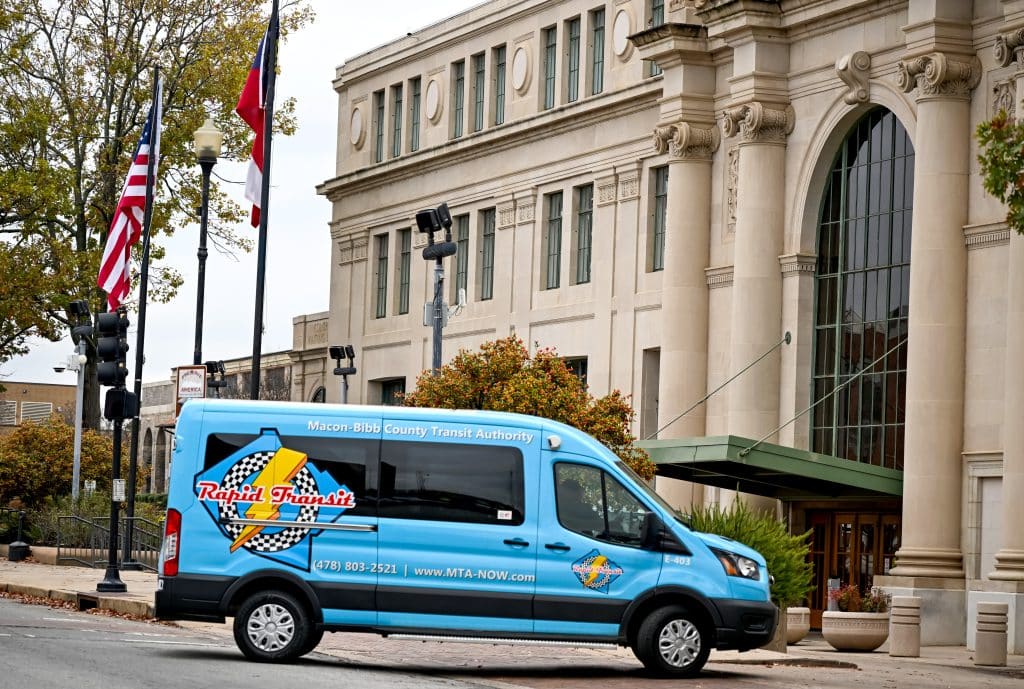
Rapid Transit, Macon’s pilot program that allows public transportation passengers to use an app to request specific pick up and drop-off locations, is looking to expand into southern Bibb County.
The Macon Transit Authority’s rides-on-demand program rolled out its microtransit fleet of five colorful vans in July with service in a zone that included the downtown area and extended to Walmart on Gray Highway and as far south as MLK Jr. Boulevard and Mercer University Drive. Passengers use an app to arrange rides — similar to Uber and Lyft ridesharing — instead of gathering at bus stops along fixed routes.
In Bibb County, just more than 1 in 10 households lack personal vehicles, according to a U.S. Census Bureau estimate in 2023. That’s slightly higher than the national average of 8%.
The second phase of Macon-Bibb’s Rapid Transit program, which was supposed to begin in November, will start offering service to the Middle Georgia Regional Airport when a payment wallet is integrated into the Rides on Demand app, said Mark Strozier, the authority’s transit planner and the program’s manager. While Rapid Transit was initially a free service, riders can expect to pay $5 each way for rides before 6 p.m. and $8 each way for pick ups from 6 p.m. to midnight.
The microtransit service is funded through a Federal Transit Authority grant. Similar services are available in other parts of Georgia, including metro Atlanta and Savannah, as well as other areas of the country.
“Microtransit in general is really doing well across the state,” said MTA Chief Operating Officer Tony Woodard. ”We are excited that it’s viable and it’s gonna meet a need.”
Locally, 967 trips were logged on Rapid Transit in September, compared to 70,816 trips on Macon’s fixed route network, according to an operations report from that month.
The goal is to eventually reach 20,000 Rapid Transit rides a year while covering all of Macon, Strozier said.
Kai Monast, the associate director of the Institute for Transportation Research and Education at North Carolina State University, said the new form of transportation offers convenience and “richer” data so transit officials know exactly where and when rides are being called.
The Macon Transit Authority contracted TripSpark — which is responsible for the app along with Macon’s bus tracking software and route optimization — to connect payment options to their app.
The app had yet to begin collecting payment as of Dec. 3.
The biggest complaint officials hear is that the vans don’t yet go to the areas people want, Strozier said. But the authority plans on expanding the service to the entire county by 2027.
The vans can hold six to seven passengers. The number of trips being carried out has doubled with each passing month.
The same vehicles will be used to service paratransit riders.
Paratransit services — which is also an on-demand transit system and is federally required for individuals with disabilities — were recently cut to some areas for financial reasons.
There are a lot of rules and regulations when implementing paratransit, Monast said.
It’s important for microtransit services to be mindful of riders with physical or cognitive disabilities and making sure technology assigns safe pickup areas and ensures passengers make it home safely, he said.
All of the Rapid Transit vehicles are handicap accessible and ADA compliant.
“I think it’s a wonderful way of making public transportation accessible to different groups,” Monast said.
Monast said as microtransit programs reach capacity, it can become harder for people to book trips because of longer wait times, impacting people with higher-priority trips like going to school or work.
Also, bus riders who are not as adept with technology or don’t want to engage with it might find themselves being left behind.
Bus service is not at risk of being cannibalized by Rapid Transit, Strozier said. From 2024 to 2025, fixed route ridership increased by “leaps and bounds” — 19%.
Monast questions how much microtransit can grow in Macon and elsewhere. “It’s a great laboratory,” he said. “But, eventually, it won’t be financially feasible as the system becomes more popular.”
Strozier and transit officials are working through data on ridership, including trips per day, pickup locations and total passengers. While not demographic heavy, data has shown preferences for trips on Thursdays and Fridays.
Strozier said the authority will facilitate bus ridership by rolling out “first mile, last mile” service at the end of next year. The microtransit vans will take passengers short distances to and from bus stops for a reduced fare.
“We plan to expand as much and as quickly as we can,” Woodard said. “One of the things we are absolutely adamant about is we don’t plan on starting something and having to retract.”
Grant Goodrich, who lives and works downtown as a bartender, used the service three to four times a week coming back from work during the pilot program. He said he doesn’t own a car.
Although he hasn’t ridden as often since the program announced payments, Goodrich said the service is much more affordable than Uber, even with the $5 charge.
He said the vans are clean, well-lit and it’s “easy to get in and out.” The only downside of the program is having to schedule rides 20 to 30 minutes in advance, he added.
“It’s one of the better things I’ve seen Macon do in a long time, hopefully they can expand it a little further,” Goodrich said.
Before you go...
Thanks for reading The Macon Melody. We hope this article added to your day.
We are a nonprofit, local newsroom that connects you to the whole story of Macon-Bibb County. We live, work and play here. Our reporting illuminates and celebrates the people and events that make Middle Georgia unique.
If you appreciate what we do, please join the readers like you who help make our solution-focused journalism possible. Thank you
Author

Related Articles
Mercer selects new provost and vice president of academic affairs
Lisa Murphey Lundquist, the university’s former senior vice provost, has worked at Mercer for two decades.

Advocate who pushed for safer streets killed while biking in Macon
Louis Michael Ryan was a member of the Pedestrian Safety Review Board and was known by Maconites as a staunch supporter of safer streets.

New Melody newsletter offers fast weekday briefing
The Macon Melody will launch The Riff, a new weekday morning email newsletter, on Jan. 5.