
MGA establishes federal partnership for enhanced air traffic controller training program
MGA joins several other college programs in the enhanced Air Traffic Collegiate Training initiative as the federal administration faces a shortage of nearly 3,000 air traffic controllers nationwide.
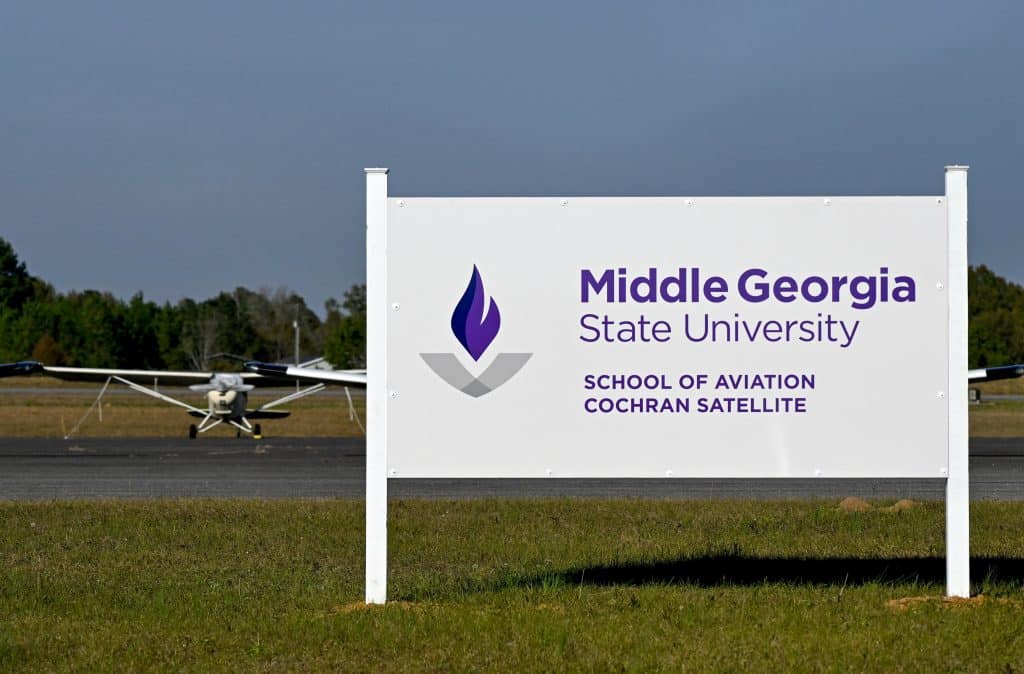
Middle Georgia State University’s School of Aviation signed onto the Federal Aviation Administration’s enhanced air traffic controller program earlier this month, shortening students’ path toward certification.
MGA joins several other college programs in the enhanced Air Traffic Collegiate Training initiative as the federal administration faces a shortage of nearly 3,000 air traffic controllers nationwide, according to a FAA press release.
Under the enhanced program, students can go directly to a facility for localized, or facility-specific, training to earn their certification, unlike in a regular CTI program where students would have to attend the FAA’s academy.
Students who go through the enhanced program may be employed by one of the FAA’s private contract companies.
“It’s important work,” said MGA’s air traffic control tower manager Angela Taylor. “You’re saving lives and keeping people safe as they travel. It is a very serious job.”
Taylor has been teaching students in MGA’s air traffic management program for 14 years, overseeing about 50 to 60 students each year. The enhanced program promises a more in-depth training with more rigorous testing and evaluations, Taylor said.
She added that other ATC programs have seen their enrollment numbers double under the federal partnership.
“We’re just really excited to help the FAA combat that issue of critically manned places and having people funneled into that career field,” Taylor said.
Middle Georgia State University’s ATC program was established 20 years ago.
Students in MGA’s two-year air traffic controller program learn by taking classes but also get experience in simulated environments and by working in the control tower on MGA’s own airfield.
The school also plans to implement an additional program where students can earn their control tower operator certificate at MGA’s airfield, allowing students to be hired right into a facility.
Taylor said only a handful of other schools have their own control tower, and eight students who went through a pilot of the program went on to get jobs in the industry.
“Middle Georgia State University is in a really good spot where we have a control tower, where we have live traffic where students will be able to come up and work and there really isn’t anything that can replace live traffic.”
A high dropout rate has contributed to the shortage in ATC controllers.
When students are in MGA’s program, Taylor said they get students ready to work under pressure and being able to work with live traffic is a big plus for its students.
“There’s nothing to really prepare you for the real thing unless it’s the real thing,” she said.
Working at a facility, Taylor said, gives students the opportunity to learn “localism,” or the quirks specific to a control tower.
“The rules are the same, but you’re dealing with different airspaces and different aircraft and runways,” she said. “They’re having to learn that and then be able to apply what they’ve learned to a real-world situation.”
Before you go...
Thanks for reading The Macon Melody. We hope this article added to your day.
We are a nonprofit, local newsroom that connects you to the whole story of Macon-Bibb County. We live, work and play here. Our reporting illuminates and celebrates the people and events that make Middle Georgia unique.
If you appreciate what we do, please join the readers like you who help make our solution-focused journalism possible. Thank you
Author

Related Articles

Land bank converts tax-delinquent properties into community assets
This “Power” installment examines the role of the Macon-Bibb County Land Bank Authority.

Economists see transition year ahead for local economy
Slower but positive growth is expected in the Middle Georgia region heading into 2026, economists told locals at a Jan. 23 UGA luncheon.
Macon housing market shifts toward buyers as listings linger longer
Prospective homebuyers have more options and stronger negotiating power, said Taylor Thanos, president of the Middle Georgia Association of Realtors. Prices in Middle Georgia are “more attractive” than the rest of the country, he said.