
Ocmulgee Mounds National Park to redefine how communities, Native Nations work together
Macon could soon become the center of Georgia’s first national park. Ocmulgee Mounds National Park is a fundamentally new way that local, state and federal governments can work with Indigenous Nations to co-manage conserved land.
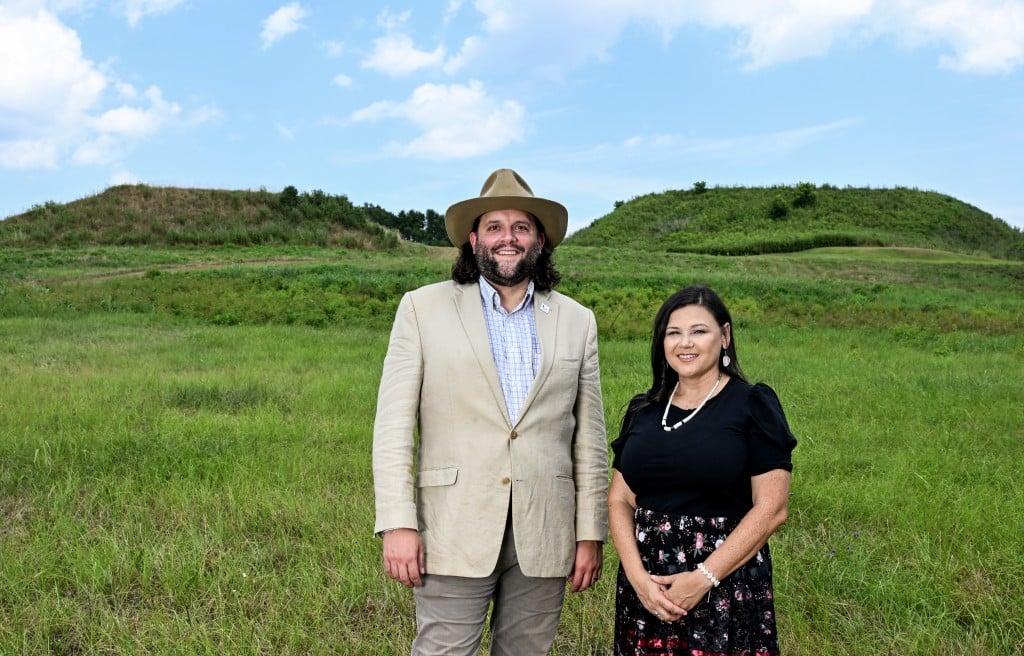
The Ocmulgee Mounds National Park will be the culmination of a process that began almost a century ago, an economic juggernaut, a cultural reckoning.
It will fundamentally redefine the relationship between the Muscogee (Creek) Nation, whose ancestors called Macon home, and the folks who live here now.
A new day
The Ocmulgee Mounds National Park will be unique: the first national park co-managed by a removed tribe.
Tracie Revis is the director of advocacy for the Ocmulgee National Park and Preserve Initiative. She was the first woman to serve as chief of staff to the Principal Chief of the Muscogee Nation.
With her background as an attorney and gaming commissioner for the Muscogee Nation and her personal connection to the park — family members worked there in the 1970s, and her aunt’s photo can be found in the visitor’s center — Revis is uniquely qualified to connect Macon and Okmulgee, Oklahoma, the capital of the Muscogee Nation since 1868.
While four other national parks have co-management agreements with Native nations, the Ocmulgee National Park will be unique, Revis said, because the Muscogee Nation has been involved from the beginning.
“Tribes are always seen as important when looking at things through a cultural lens,” she said. “What we’re asking for is to truly be co-managers, not just cultural interpreters. We want to do land management and species management.”
The park will “knitting together” the National Park Service, U.S. Fish and Wildlife, the Middle Georgia Regional Commission, Georgia Department of Natural Resources and the Muscogee Nation. The details will need to be fleshed out via a management plan, but a seat at the table means there is no doubt regarding the Muscogee role: this is a true partnership.
“It’s a new day in Indian Country,” she said.

‘They have no idea who we are’
“Vinson seeks national park for Ocmulgee Indian Mounds” read a headline in the Macon News in 1934 regarding the area now designated by the federal government as the Ocmulgee Mounds National Historical Park.
Damaged by two railway cuts in the 19th century, the area drew interest as an archeological site in the late 1920s and early ‘30s, with everyone from Boy Scouts to professionals flocking to
Macon.
What followed was the largest archeological dig in U.S. history: from 1933-36, more than 800 men employed by a variety of Depression-era federal agencies excavated the site and surrounding area, finding some 2.5 million artifacts.
None of this was done with any input or oversight from the Muscogee Nation, which Revis said has a different perspective on how to handle artifacts (“The Nation believes that what’s found in the ground should stay in the ground.”) The dig and display of the artifacts led to a local belief that the people indigenous to Middle Georgia had disappeared, a lost civilization.
“The history has been told from an archeological standpoint, as if we are the dinosaurs of the days that came from this land,” Revis told GPB’s Grant Blankenship earlier this year. “And there is no context of who we were culturally and how long we were here before.”
That is beginning to change. In the past decade, the Muscogee Nation, which is the fourth largest in the country with around 100,000 citizens, acquired more than 150 acres in the Ocmulgee corridor under former principal chief James R. Floyd. Meanwhile, the national park initiative was gaining momentum.
“The special resource study had already been commissioned, but the Nation didn’t really have a true relationship with Macon,” Revis said. “[Principal] Chief David Hill said ‘We have to do a better job of working with this community.’”
Hill, Revis and other leaders visited Macon in February of 2021. On that trip, they realized something was fundamentally wrong: Maconites “had no idea” who the Muscogee (Creek) Nation was.
Macon has struggled mightily over the past two centuries to understand its complex relationship with the Muscogee (Creek) Nation. Common misconceptions, myths and malicious lies abound, from the true context of removal in the 1820s and 1830s to the cultural, social and religious significance of what we now call the Ocmulgee Mounds National Historical Park.
Some of Bibb County’s mistakes are hamfisted, almost farcical. Others, such as an initiative designed to bring Muscogee citizens back to Macon in the early 1970s titled the “Trail of Cheers,” were egregiously ignorant.
“We were at the park doing interviews, and I was talking with a kid who had just done the tour,” Revis said. “He said ‘The Indians don’t exist anymore.’ We realized we had to do something.”
The Nation met with Macon-Bibb County Mayor Lester Miller. Soon Macon-Bibb County District 5 Commissioner Seth Clark taking the executive director position at the park initiative. After some time going back and forth between Oklahoma and Georgia, Nation leadership realized they needed someone on the ground. So two years ago, Revis moved to Macon.
The fruits of that partnership are obvious. Drive past city hall, and you’ll see the white and green Muscogee flag flapping in the Middle Georgia breeze. Downtown will soon get street signs in both English and Muscogee. Muscogee citizens sit on key Macon-Bibb County boards. Cultural exchange programs are sending Maconites to Oklahoma and bringing Muscogee citizens to Bibb County for visits.
There’s still plenty to learn and unlearn.
The fundamental flaw of all of previous efforts to understand the park, well-intentioned or otherwise, was they weren’t centered in a deep understanding of the land and who has lived there.
“This land has been here longer than any of us,” she said. “It wasn’t just our story that was a part of that land, because it immediately became a slave plantation. It gave a lot of people a place to work in the 1930s. There’s room for all of us, which means there’s room for reconciliation and truth for all of us.”
A park is born?
When the President signs the legislation establishing Ocmulgee Mounds National Park and Preserve, it will immediately exist, at least on paper, born from the current 2,800 or so acres that comprise the Ocmulgee Mounds National Historical Park.
The legislation will authorize the acquisition of some 10,000-20,000 acres, but it prevents any of the municipalities from using eminent domain to acquire it, initiative executive director Seth Clark said. So those acres will be added, in chunks large and small, over the coming decades.
“We will have a national park in name only, that’s how these national parks are created,” Clark said. “There are a bunch of private inholdings that are eligible to be part of the park. This is the beginning of the process for the next century.
“One of the main civic activities will be the land acquisition of building this park, getting the infrastructure in to accept visitors and integrate it into downtown Macon.”
The national preserve portion of the park — which will conserve land along the Ocmulgee River floodplain, including the current Bond Swamp National Wildlife Refuge — won’t be established upon the bill’s passage and signing, however.
“We’re buying 1,000 acres to expand Bond Swamp,” Clark said. “The Secretary of the Interior [Deb Haaland] could say ‘We’ll go ahead and make that the preserve,’ but that’s up to her.”

‘This is how we take care of ourselves’
Ocmulgee National Park should be a major economic force. A study commissioned by the Knight Foundation and National Park Conservation Association determined the park would bring more than $200 million a year in economic activity to Middle Georgia, as well as $76.5 million in labor income and almost $30 million in added tax revenue. That’s thanks in part to the more than 1 million visitors the park is projected to bring to Macon.
The expected national park is driving the East Bank development, which is part of a special tax allocation district that will invest dollars back into neighborhoods like East Macon and Pleasant Hill.
“This is how we take care of ourselves,” Clark said. “As [American Rescue Plan] dollars dry up, this is how we backfill programs like blight fight, how we roll back Macon-Bibb County property taxes. This shifts the tax burden from residents to visitors.
“When you look at statistics that plague Macon — 26% poverty rate, 70% of which is Black residents — this is how we lift up neighborhoods that have long been neglected.”
The Muscogee Nation is a significant part of ensuring the economic success of the project as well, from their management of a cultural center to their experience in tourism.
“The way that the Muscogee (Creek) Nation partners with municipalities in Oklahoma to address infrastructure and education needs, I know that [Macon-Bibb County] can’t do that,” Clark said. “We don’t have the manpower or finances to do it, but together as a region with the Nation, I think we do.”
Why now?
The Muscogee Nation never forgot its homeland. Violently forced to cede their land by the United States government in the 1830s, the Muscogee citizens who survived removal had to figure out how to live in unfamiliar, more barren land in what is now eastern Oklahoma.
Federal laws restricted tribal governance. Nation citizens were forced to attend boarding schools designed to strip them of their language and customs. Indigenous women receiving medical care were sterilized.
“We’re still surviving forced removal,” Revis said.
Slowly, Indigenous Nations began to claw back control through legislation like the Indian Reorganization Act of 1934, the Indian Civil Rights Act of 1968 and the Native American Graves Protection and Repatriation Act in 1990. The 1988 Indian Gaming Regulatory Act gave Indigenous Nations economic muscle.
“Tribes started reorganizing and operating as their own sovereign nations,” Revis said. “Now, how do we provide for our own people? You can’t collateralize our land to start businesses, because our land is held in trust. It’s really only been the past 30 years that tribes have had the economic power to start fighting for their voice back in their ancient lands.”
Before you go...
Thanks for reading The Macon Melody. We hope this article added to your day.
We are a nonprofit, local newsroom that connects you to the whole story of Macon-Bibb County. We live, work and play here. Our reporting illuminates and celebrates the people and events that make Middle Georgia unique.
If you appreciate what we do, please join the readers like you who help make our solution-focused journalism possible. Thank you
Author

Related Articles
Race for vacant Middle Georgia senate seat ramps up
Six candidates are running to replace former state senator John F. Kennedy after he resigned to run for lieutenant governor.
Charter changes, taxes and more: Bibb lawmakers prep for Gold Dome business
Here’s what Macon-Bibb County’s delegation is focused on as the legislative session begins.
Sex offenders list odd ‘homes’ as sheriff struggles to track
As the county continues to grapple with the growing problem of homelessness, vagueness in state law makes it difficult, if not impossible, for the sheriff’s office to keep tabs on the small portion of offenders who lack a fixed address.