
Own property in Georgia? Here’s how to read your 2026 tax assessment
Georgia’s annual tax assessment forms look different this year. Here’s how to read them.
A new chapter for The Melody
Our team and coverage are moving to The Telegraph. Make sure you look for The Melody's community-first journalism as a section highlighting the people, places and moments that are the rhythm of Macon.

By now, if you own land in Bibb County, you’ve probably received a property tax assessment in the mail — and you’ve probably noticed it looks different from last year’s.
The 2026 notices, mailed last month, reflect changes approved earlier this year by state lawmakers, said Andrea Crutchfield, chief appraiser for the Macon-Bibb County Tax Assessors’ Office.
Property owners are taking notice of a key piece of information missing on the new notices: an estimate for how much taxes they owe. Crutchfield said the state form has included that estimate on assessment notices for at least the past five years.
“These notices only include an estimated tax savings,” Crutchfield said, adding that her office has been fielding calls from property owners confused by the notice’s new format.
The absence of an estimate means property owners will have to do some calculations themselves to estimate how much they owe in taxes.
“I know people think that maybe we’re trying to make this difficult, but it was a legislative change,” Crutchfield said. “We didn’t have a problem really with the estimate being on there.”
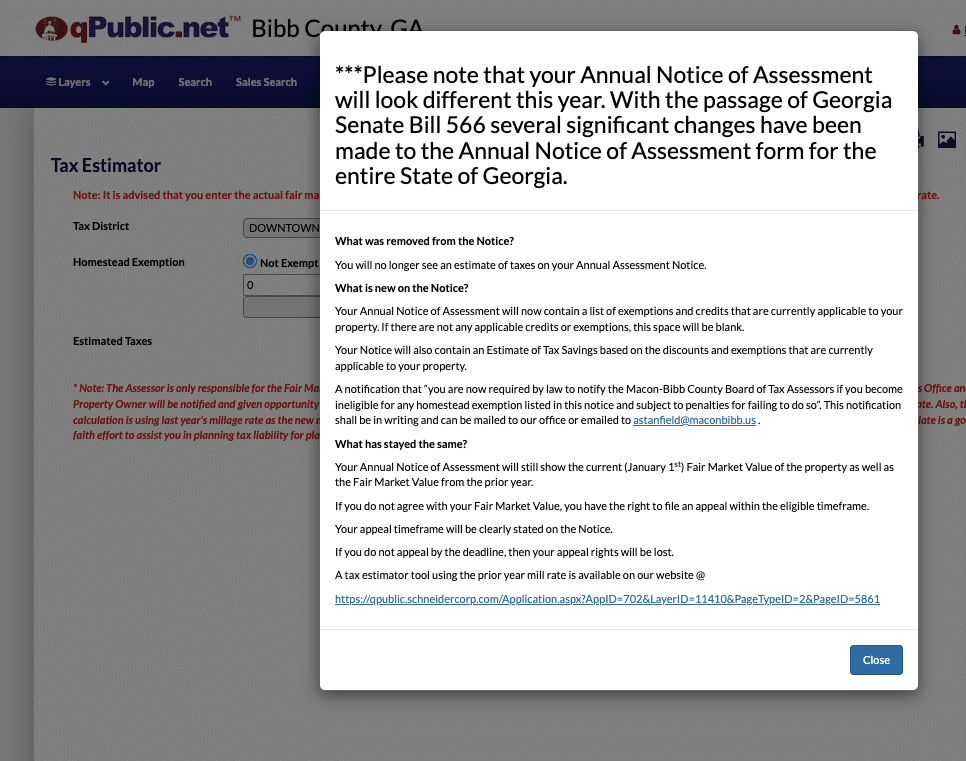
This year’s form also only includes the property’s 100% fair market value whereas the old form included the property’s 40% assessed value, as well. In Georgia, property taxes are based on 40% of the fair market value multiplied by the millage rate. Crutchfield said lawmakers nixed the 40% assessed value listed in previous years’ forms because it was thought to be “confusing for property owners.”
A tax estimator calculator for property owners is available on qpublic, a website for searching property information.
Values on the recently mailed notices are based on the 2025 millage rate since the 2026 millage rates had not yet been approved by the Bibb County Board of Education or the Macon-Bibb County Board of Commissioners.
Appeals and homestead exemption applications must be made within 45 days of the “Date Notice Mailed” printed in the top right hand corner of the bill. The deadline for Bibb County is July 27.
More appeals expected
Most owners of the 70,600 properties in Bibb County will see a change in value this year because of adjustments made to the county’s cost tables, Crutchfield said.
Cost tables, developed by the tax assessor’s office, are based on land and construction costs. State law requires counties to keep those figures updated to reflect what the market is doing.
Crutchfield said she is expecting a high number of appeals on values this year. That was the case in 2023 when the county last updated those tables. Nearly 2,500 people filed for appeals that year. Crutchfield said more than half of those appeals were dropped because the appellants didn’t show up for a hearing.
“Everybody assumes that, if their value went up, we think something changed at your property, that you made some type of improvement, and that’s not necessarily the case,” Crutchfield said. “The value is just more based on what it costs to build a brand new house. So, that means your house is worth more because now you can’t replace it for probably, what you have in it. … It’s hard to understand for a lot of people, especially if you’ve been in your house for some time.”
How to appeal
Property owners can appeal the assessment value for specific reasons, such as uniformity cases in which the property owner contends the assessed value doesn’t match other similar properties. Appeals may also be made on exemptions and taxability.
There are four ways to appeal, and each one starts with filling out an appeal of assessment form available on the tax assessor’s website and mailing it to that office by July 27.

If the tax assessors’ office finds that a change needs to be made, it will make a change. But if it decides its assessed value is valid, the appeal is forwarded to the Board of Equalization and an informal hearing is scheduled.
“It’s a very informal hearing where there are three Board of Equalization members that would present, that would listen to the hearing, and then (there) would be a representative from our office and the property owner,” Crutchfield said.
After the property owner and the Tax Assessors’ Office representative make their case, the board issues a decision.
”Once their decision is made, the property owner can appeal that on to superior court,” Crutchfield said.
The Board of Equalization is the most common route for appellants because it is free. Equalization board members are appointed by the grand jury through the Bibb County Superior Court Clerk’s Office and must live in Bibb County and meet certain educational requirements.
A less common route for appellants is to request to see a hearing officer, who is a state-certified appraiser chosen by the Bibb County Superior Court Clerk. Crutchfield said that option is exercised mostly by commercial property owners whose properties have fair market values of more than $500,000.
Non-binding arbitration is also an option for appealing assessment values, but it is less common because it requires a certified appraisal, which can be costly for property owners.
Another alternative is to appeal directly in Bibb County Superior Court, but that requires the county board of tax assessors’ to agree to that.
Here’s a guide to the new form now being used by all Georgia counties:
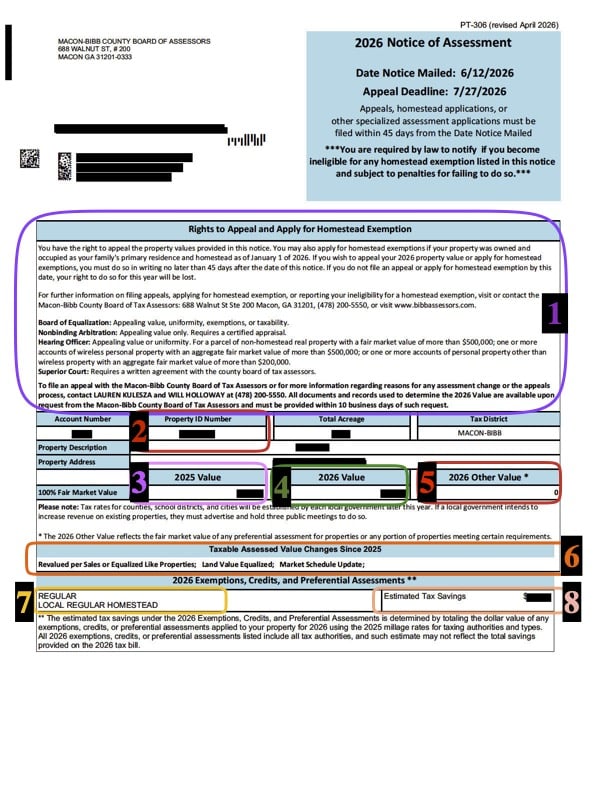
#1 Right to Appeal: Details the four avenues available for property owners to appeal the assessed value.
#2 Parcel Number: A special code the county uses to identify your property in legal notice, court records and on digital maps.
#3 2025 Value: The value of the property last year.
#4 2026 Value: The estimated property taxes owed may be calculated by taking 40% of this number and multiplying it by the millage rates listed on the form.
#5 2026 Other Value: Details about whether the property requires preferential assessment because it is historic or used for conservation. A total listed here reflects how much the taxpayer saves from exemptions such as homestead, agricultural or historic uses.
#6 Reasons for Change in Value: Here is where the tax assessors’ office lists details about what changed from last year, including whether there was new construction, improvements or changes made to the property.
#7 Exemptions: Deductions made via homestead exemptions, non-taxable nonprofit status, historic or conservation exemptions are listed here.
#8 Estimated Tax Savings: The total a taxpayer is expected to save through exemptions listed in No. 7.
Author

Related Articles

All aboard? GDOT asks residents to weigh in on restoring passenger train service to Macon
The Georgia Department of Transportation is surveying the public through Aug. 6 to gauge interest in Atlanta-to-Savannah rail service that could include a stop in Macon.
Are corporate investors responsible for one-third of all housing sales since 2020?
Learn the answer to this question in the fact brief in partnership with Gigafact.

Macon’s Boys and Girls Club closed for 90 days, families search for alternatives
The club had many after-school programs that are now on hold.