
Pulling Macon history up by its roots in Oak Ridge
A twilight tour of Oak Ridge, the historically black section of Rose Hill Cemetery, gave visitors a glimpse into Macon’s long history of slavery.
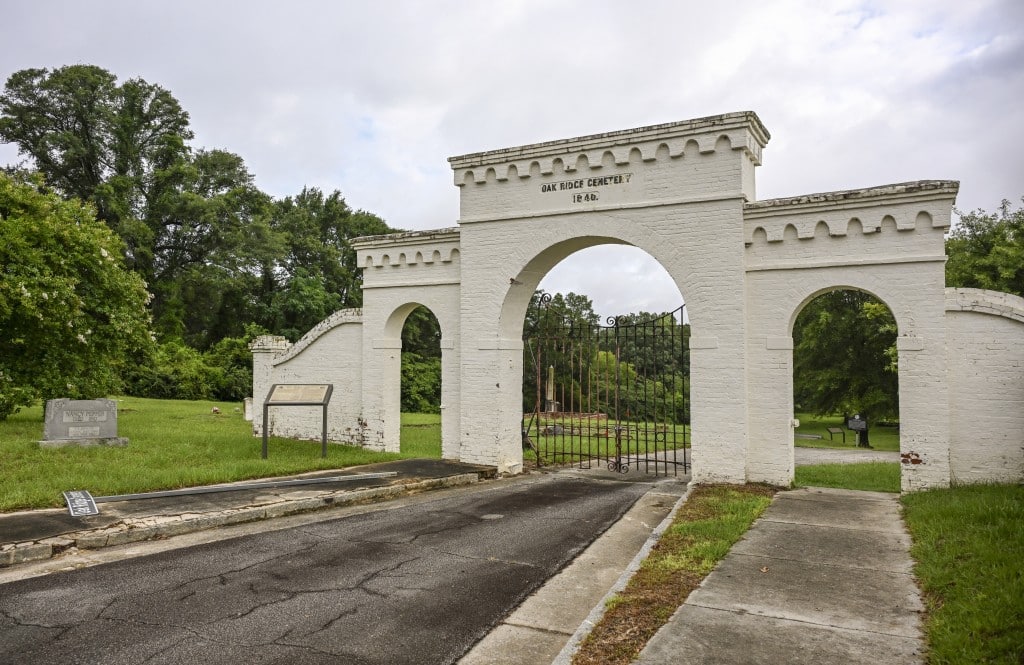
Driving through the well-worn paths of Macon’s historic Rose Hill Cemetery– trails originally intended to be navigable by horse-drawn carriage – Kathleen O’Neal steers her orange, stick shift Veloster around tight bends and up lofty inclines.
She gestures toward a sea of headstones, obelisks, stone columns and crosses, some of which sit askew in overgrown grass and sink unevenly into the earthy soil. Each one memorializes a Maconite, though long-gone, who paved a little part of the town’s rich and evergrowing history.
As she drives, O’Neal offers a handful of historical tidbits that breathe life into those buried within the cemetery’s 50 sprawling acres, from iconic figures in Macon’s music history to Civil War soldiers.
Horticulturist Simri Rose, the cemetery’s founder and namesake, designed Rose Hill as both a cemetery and a walkable park , she explained, and it’s divided into labeled sections, such as “Ivy” “Pine” and “Forest” Ridge.
A Macon native who grew up in the historic district, O’Neal has generations of family buried in Rose Hill and knows each ridge, corner and crevice like the back of her hand. Her visits began in high school when she made a bug collection for biology class and collected butterflies from Rose Hill.
“When you’re in high school, things that happened 20 years ago seem an eternity. So, things that happened in the 1860s, that might as well have been pre history,” she said. “Age brings wisdom. It has given me an appreciation for all of these people who are buried here, because now I think that 1860 wasn’t that long ago.”
O’Neal visits the cemetery often, recognizes the regulars who stroll the paths and is all too accustomed to visitors inquiring about the location of Duane and Gregg Allman’s resting place.
She is a member of the Historic Macon Foundation, volunteers with Rose Hill Preservation & Restoration and is also a tour guide for Visit Macon. She led her first “ramble” or tour of the cemetery for Historic Macon last April and earlier this month, she conducted a twilight tour of Oak Ridge.

Oak Ridge
A long stretch of seemingly empty terraces, Oak Ridge is situated just within the Madison Street brick entrance way of the cemetery and runs all the way down to the train tracks by Ocmulgee River. Its absence of monuments or other markers, save for a few crumbling bricktop tombs or faded headstones, is a stark contrast to the busy array of limestone, marble and granite monuments sprinkled throughout Rose Hill.
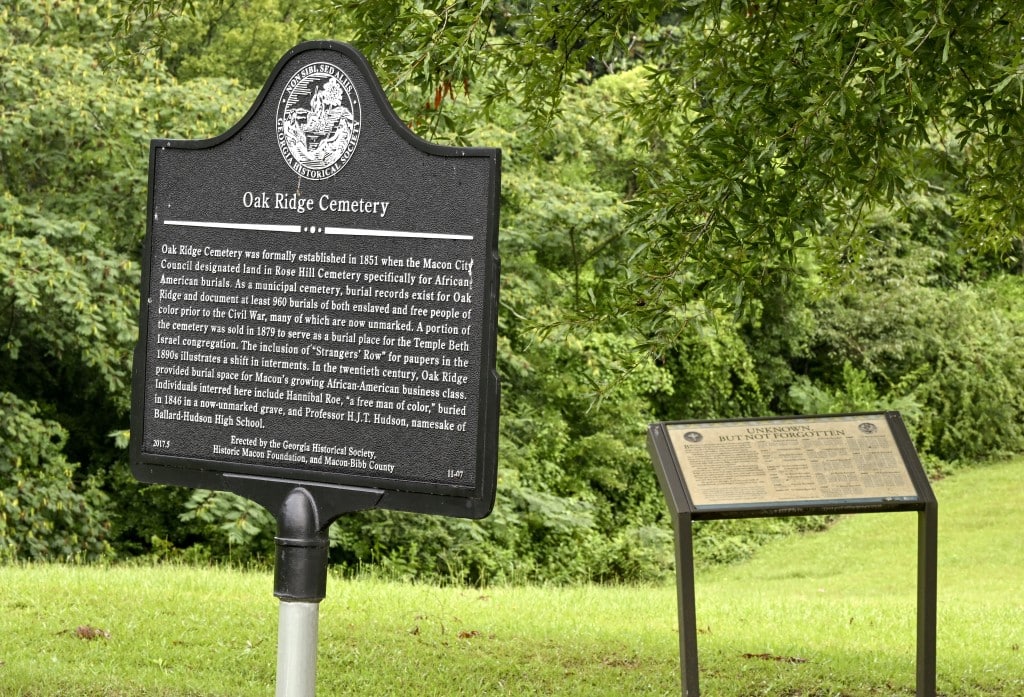
Oak Ridge is the historically Black section of the cemetery where many enslaved individuals and unidentified “paupers” (in “Stranger’s Row”) are buried. Although always a part of Rose Hill, the Macon City Council officially designated Oak Ridge as a burial site for African Americans in 1851. At first glance, it’s far from obvious how much history lies just below the grassy surface.
A few well-known Black families in Macon are buried near the front of Oak Ridge, including the Hutchings family who opened a successful funeral home in 1895. The prominent family rebuilt the business, named C.H. Hutchings and Son, in 1927, and it is still open today at 536 New St. The Hutchings family is memorialized by well-kept stone markers in a terraced area surrounded by brick fencing.
Several plain headstones dot Oak Ridge’s seemingly empty terraces as well. For instance, Virginia native Eady Beecher was 103 when she died in 1903 in Pleasant Hill after her clothing caught fire in her home. She was purchased by a wealthy Milledgeville resident in 1811 and brought to Georgia where it is believed she had at least eight mixed-race children with her owner. Beecher’s headstone depicts a small engraving of a lamb and her name is barely readable, having lost its sharpness over time.
Then there are the hundreds and hundreds of graves in Oak Ridge that remain unmarked and unknown – often enslaved individuals who were given cheap burials. While some folks are aware of Oak Ridge’s history, until recently, few efforts have been made to understand the full scope of the area.
With a grant from Historic Macon through Georgia State University, Quinn Connally began a ground-penetrating radar (GPR) project in January of 2023, investigating the number of unmarked graves in Oak Ridge. Connally was also pursuing his master’s program in anthropology at GSU during this time.
He began by sectioning off Oak Ridge into several different 20-by-20 meter grids. Then, he pushed a three -wheeled cart with a plastic bucket holding the GPR unit over the gridded areas, scraping along the ground. The GPR utilizes electromagnetic waves to detect contrasts in the soil as far as three meters below the surface. When it detects changes in the velocity of an electromagnetic wave, it indicates an irregularity in the soil, produced by buried tree roots, rocks, caskets, air pockets, water retention or pipes.
Driven by his efforts to show that somebody cares about these long-forgotten individuals, Connally continued visiting Oak Ridge and cataloging his findings, completing his work in September of 2023.
“No one’s gonna know who these people are,” he said, pointing to the difference between the nearly unmarked areas of Oak Ridge and the towering monuments in other parts of the cemetery.

Despite having a general idea of the number of unmarked burials, he recalled the shock of seeing the data for the first time. Through a GPR processing software, the electromagnetic signals look similar to a fuzzy tv screen with hyperbolas to indicate underground soil changes, explained Connally.
“There’s no rhyme or reason to it,” he said of the randomness of the burial site. “It took me aback a little bit. I was like, ‘whoa, that’s what it looks like when there’s just tons of people buried on top of each other all over the place.’”
Although he worked with a GPR unit roughly 20 years old and did not have a professional company to interpret his data, he noted his work confirms the historical knowledge that many already thought to be true, while providing a more concrete estimate of the number of graves.
“It’s a stepping stone,” said Connally, who passed his completed research along to Historic Macon. “My survey was kind of like a proof of concept for future work.”
Cadaver dogs further confirmed his data; Oak Ridge is oversaturated with unmarked burials – more than 950 of them.
“It’s just full,” founder of Rose Hill Preservation, Joey Fernandez, told visitors of the cadaver dogs’ findings during the twilight tour on Aug. 10. “Hit after hit after hit. We’d stick a flag there. After we put out 50 flags, we might as well just stop, because they’re everywhere.”
When human remains decompose, they emit toxins which are absorbed from the earth and released back into the atmosphere by nearby trees in a process called phytoremediation. Varying soil types preserve remains differently, according to Fernandez, the soil in Rose Hill is sandy which lets in more air and moisture than red clay. Even so, the cadaver dogs could still track the scents more than 100 years later.
“They would sniff at the bottom of the tree and they would go up the tree and smell it all the way up as high as they could get,” he said.
The twilight tour
When Historic Macon asked O’Neal to lead the Oak Ridge tour, she welcomed the opportunity to share her penchant for local Rose Hill history with others, but didn’t feel right taking on the project by herself.
“I said, ‘but we need to reach out to the Black community, because this is their section of the cemetery,” she said. “I just didn’t feel like I should be the only one talking about who’s buried here.”
O’Neal teamed up with Y-O Latimore, who is heavily involved in the preservation of Pleasant Hill’s historically Black Linwood Cemetery, and Brenda Williams whose connection to Historic Macon arose from her interest in African American genealogy.
Starting with the worn etchings of names and dates scrawled on grave markers, the three women began following a trail of census records, birth and death certificates, ancestry websites, marriage licenses and property deeds, slowly unearthing the stories of those buried in Oak Ridge.
“When I do the research for the other part of the cemetery, it’s so much easier, because the history of the white settlers and residents of Macon are well documented,” O’Neal said. “Here, sometimes all we have is a name and we can’t find anything more than that.”
Oak Ridge has never been documented as thoroughly as the white sections of Rose Hill. In fact, Black folks often didn’t even have obituaries in the newspapers and if they had an ornate monument erected in their memory, it was often done so by the wealthy, White family who owned the enslaved individual.
“The Black history is untold sometimes, and many times, you have to look to white history and how we were intertwined,” Latimore told The Melody. “A lot of us aren’t fortunate to have those springboards, as far as family legacies being passed down, we have broken history.”
She believes many Black individuals, like herself, feel a lack of being and belonging. In addition, she hopes learning about history from diverse perspectives will help folks empathize, understand where others come from and demonstrate how people are more connected than separated.
The stories of Beecher and other Black Macon residents, left siblings Vincent Waring and Lorretta Hunte appreciative for a glimpse into Oak Ridge’s “broken history” at the twilight tour.
They both expressed appreciation for O’Neal, Latimore and Williams who didn’t shy away from Macon’s racial history, making the topic of slavery and the marginalization of the Black community a central aspect of the tour.
“It wasn’t hidden or just talked about a little bit, sprinkled in. It was really talked about,” Hunte, a Warner Robins resident, said.
Waring, who was visiting his sister from England, called the tour “hard-hitting” and praised it for highlighting the “cruelty of mankind” as evidenced by some of the tragic lives of those buried in Oak Ridge
“People being sold like furniture was heartbreaking for me,” Waring told The Melody. “If we was born back then, we would’ve been slaves.”
Still work to be done
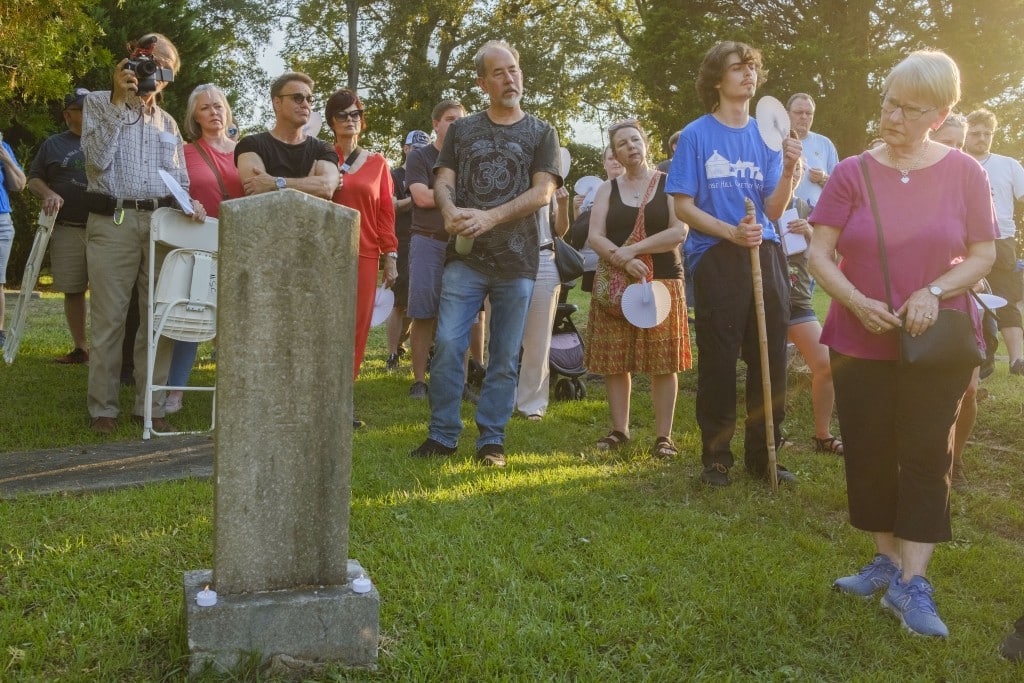
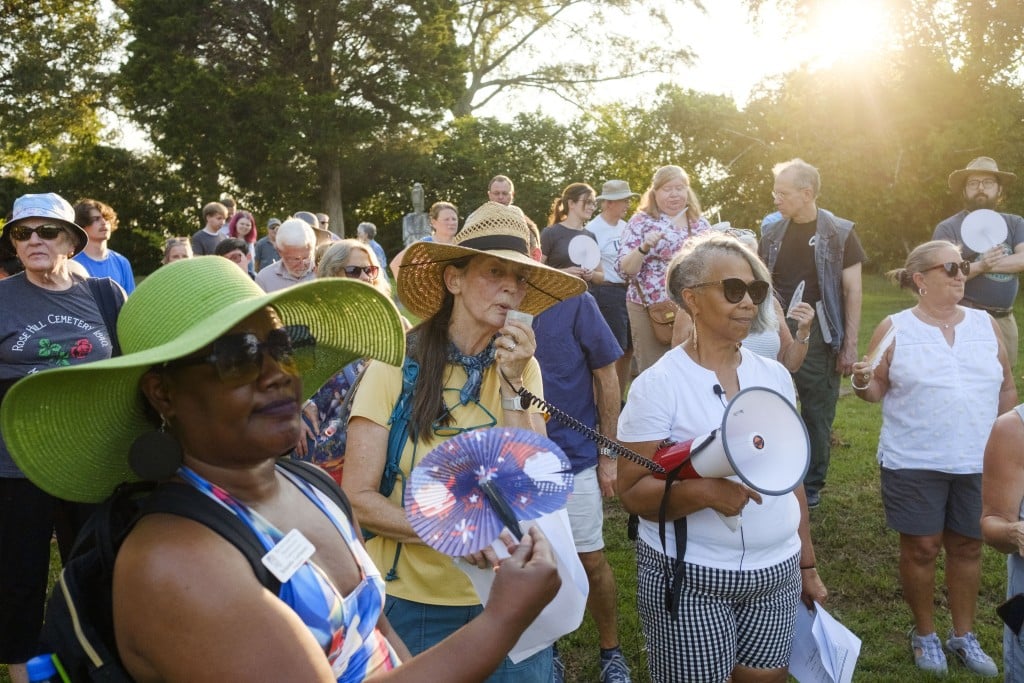
Around 60 people attended the twilight tour of Oak Ridge, many donning Rose Hill preservation T-shirts and waving paper fans to stay cool in the evening heat.
Such a high turnout of folks interested in the cemetery’s history is a good sign for Adrian Jelks who knows that there is a lot more work to be done in preserving Rose Hill’s history.
Growing up in Macon with a strong sense of ancestry and history instilled by her parents, Jelks’ appreciation for Rose Hill developed at a young age.
“I have been walking Rose Hill Cemetery all my life,” said Jelks, who recalled her mother, now buried there, bringing young Jelks to the cemetery to scrub headstones. “Rose Hill is in my blood.”
Jelks now lives in Taos, New Mexico where she does interior plaster repair work and runs a pigment business. Since 2003, she has traveled back and forth from Taos to her hometown. Her work began as a personal effort – cleaning and caring for certain plots whenever she came to town.
However, it wasn’t until 2021 that Jelks, a member of Historic Macon and board member of Rose Hill Preservation, began looking into expanding her personal cleanup projects into a more collaborative effort.
“There was always an acceptance growing up in Macon that, ‘Oh, the missing iron work’ or ‘oh, the broken headstones, that’s just the way it is,” she said. “There’s nothing we can do about it.’ Well, that’s not really true.”
She has organized four volunteer work days so far and collaborated with Macon Parks and Beautification to have trees and debris removed. In addition, the Fringed Campion Chapter of the Georgia Native Plant Society has brought volunteers to remove invasive plants from the cemetery.
“We get to this place where we feel like we owe it to our community. I owe it to my family name that was a long time Macon family name,” Jelks said. “I just feel like it’s the right thing to do.”
Jelks and her volunteers have removed trash, tires, tree limbs and grass trimmings that become matted over the top of burials, trapping them underneath.
Fernandez once worried that his efforts alone could not save Rose Hill, but Jelks and others who care, have demonstrated that the cemetery is in good hands.
“When I started nobody was doing it, and now there’s a hundred people out there and that’s what really matters,” Fernandez said, pointing to a clearing once overrun with greenery, but now cleared.
Jelks has recently introduced an Adopt a Plot program for volunteers to take responsibility for the care and upkeep of a specific plot. She hopes that a host of Maconites committed to keeping Rose Hill’s long-buried history alive will keep up the work, so folks can continue to appreciate Macon’s complex historical roots.
Another Rose Hill Ramble is scheduled for Oct. 27, with all proceeds going toward the cemetery.
For more information on how to adopt a plot, visit rosehillcemetery.org
Editor’s Note: This story has been updated to reflect the correct spelling of Quinn Connally.
Before you go...
Thanks for reading The Macon Melody. We hope this article added to your day.
We are a nonprofit, local newsroom that connects you to the whole story of Macon-Bibb County. We live, work and play here. Our reporting illuminates and celebrates the people and events that make Middle Georgia unique.
If you appreciate what we do, please join the readers like you who help make our solution-focused journalism possible. Thank you
Author

Related Articles
Mini-grants, new amenities rekindle Pleasant Hill park
Macon-Bibb UDA uses mini-grants to jump start a stagnant public space and agrees to repair Third Street sidewalks.
Hopkins takes over at Historic Macon
Historic Macon’s new executive director began her first month at the local foundation this February. She takes the helm after nearly a decade with NewTown Macon.
Global leaders talk tariffs, Ga. workforce at trade & investment symposium
Global Atlanta hosted its 7th annual trade and investment symposium last week. Top leaders discussed tariffs, Georgia’s growing workforce and developing industries.