
Rise in student homelessness as funding for family support shrinks
Inflation, rising utility bills, stagnant salaries and a dearth of affordable housing are among factors fueling a growing population of homeless students not only in Bibb County but across the country.
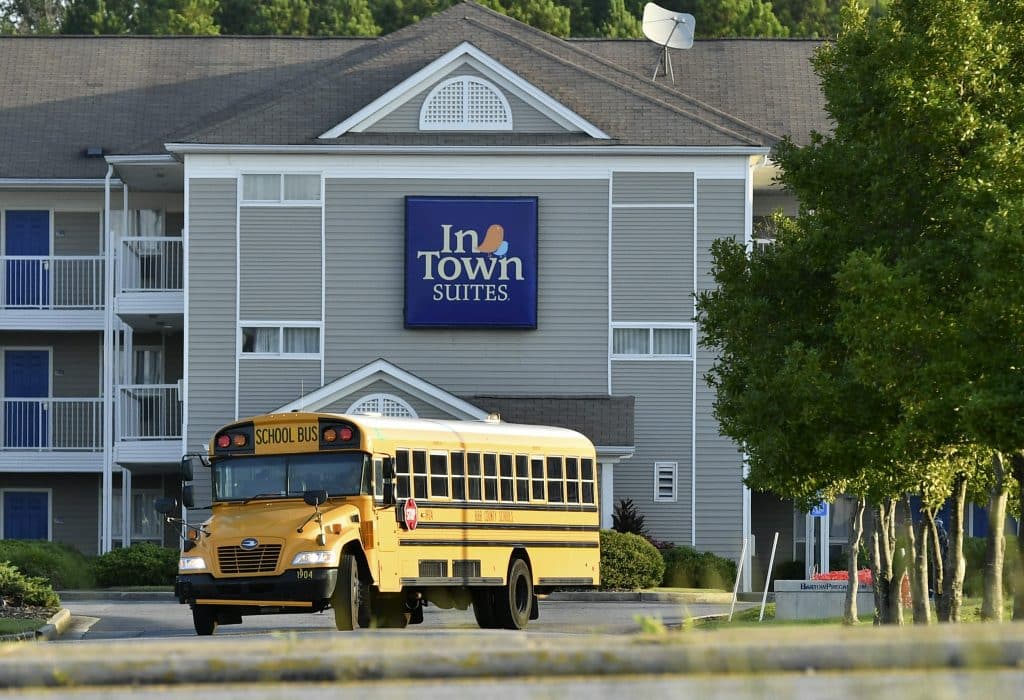
A handful of kids toting backpacks sat together on a curb in front of the InTown Suites one dewy August morning after sunrise.
Their parents, standing by, trained their eyes toward Eisenhower Parkway and watched for the yellow school bus that would wheel in at any minute.
The extended stay hotel is one of dozens of hotels across the county where more than 100 Bibb County School District students are living.
“I try to let the hotel stop be the first stop in the morning and the last stop in the afternoon – that way other kids won’t see that the kids are getting on the bus at the hotel,” homeless and foster care liaison Danielle Jones said.
The rooms at InTown Suites and many other hotels rent for $50 per night, but Jones negotiated a cheaper rate of $35 with at least one hotel. The cost for a monthlong stay at those rates ranges from $1,085 – $1,550.
“They’re getting water, they’re getting lights, they’re getting internet, they’re getting cable,” she said. “So, once they pay that amount, they don’t pay anything else.”
Inflation, rising utility bills, stagnant salaries and a dearth of affordable housing are among factors fueling a growing population of homeless students not only in Bibb County but across the country.
“All of these new apartments that they’re building in Macon, I mean, the rent is upwards of $2,000 a month,” Jones said. “A single parent, multiple kids, they probably don’t even make that kind of money.”
For example, a two-bedroom, two-bathroom apartment at Thomaston Crossing costs $1,800 per month. A single mother Jones recently helped move there took advantage of the management’s special offer: $1,675 per month for a three-bedroom apartment. The total cost, after utilities were transferred, “basically came out to like $2,300,” Jones said.
Though motel room rentals include water and power, many lack kitchen appliances and several motels prohibit them. Some motels don’t offer free internet, charge extra money for toilet paper and fine parents for leaving their children “unoccupied.”
A few of the hotels exploit long term guests in other ways, by offering them rooms in return for cleaning higher-end hotels in other parts of Macon, Jones said.
Jones said she tries to counsel the parents, telling them, “look, you know, you can work at Burger King and make more money.”
Fewer dollars, more students
On paper, the district reports 653 homeless students enrolled this year, but Jones estimates the true count is closer to 2,000. That’s nearly 10% of the district’s student population.
The under-count, in part, is because the district relies on parents to self-identify as homeless so extra services and support can be provided to their children.
“A lot of parents don’t apply for the program because they feel like DFCS will get involved,” Jones said.
Students living in hotels make up 40% of the students counted in the district’s annual tally of homeless students it reported to the state, Jones said. The lion’s share of those students are “doubled up” or living in a household with other families. Some students live in cars, shelters or transitional housing such as the Rescue Mission of Middle Georgia, Jones said.
The number of homeless students in Georgia reached 46,070 this year, the highest count in a decade and 4,600 more than last year, according to Georgia Department of Education data.
Meanwhile, the congressionally appropriated tax dollars the state receives to support and provide services to its growing homeless student population dropped by $1 million, from $4,005,813 last year to $3,005,765 this year.
“Other states have increased their homeless count so much that we had a reduction this past year,” Georgia Department of Education’s State Coordinator for McKiney-Vento Eric McGhee said.
The McKinney–Vento Homeless Assistance Act requires all public school districts to ensure homeless students are provided with a free and appropriate education as provided to other students. Congress approves state apportionments each year, then the states award subgrants to local school districts. In Georgia, the subawards are competitive grants.
Bibb County School District received about $56,700 this year, a sizable decrease from the $142,100 it received last year when the district reported 100 fewer homeless students.
The money is to be spent on ensuring homeless students have transportation, school supplies, school uniforms and whatever else they need to seize opportunities available to other students. But Jones said the money doesn’t go far because costs are high and rising.
“I have two cheerleaders at one of the high schools,” Jones said. “I have to make sure that I remove all barriers so I had to pay her cheer fees. … If I have a student that wants to play soccer and needs cleats, I’ll get the cleats.”
In addition to fewer dollars from the state and federal governments, Jones has no help.
“It’s an all day, everyday thing,” Jones said of the job she is contracted to work 239 days each year. “I did have an assistant. This is the first year that I don’t have one, and this is the year that I have the largest numbers.”
Jones’s former assistant was reassigned to another position in the central office in July, according to school board meeting documents.
Before you go...
Thanks for reading The Macon Melody. We hope this article added to your day.
We are a nonprofit, local newsroom that connects you to the whole story of Macon-Bibb County. We live, work and play here. Our reporting illuminates and celebrates the people and events that make Middle Georgia unique.
If you appreciate what we do, please join the readers like you who help make our solution-focused journalism possible. Thank you
Author

Related Articles
Bibb schools end high school summer school, emphasize year-round credit recovery
The Bibb County School District noted the change in an email to parents in early December.
Alex II opens to the outdoors with new classroom
The new space will allow students to engage with nature and be even more focused.
Committee pushes for special 1% education sales tax
Voters have a chance this Election Day to decide whether the Bibb County School District will collect a $250 million sales tax.