
Macon-Bibb affordable housing fund tries to iron out issues with new projects ahead
The Macon-Bibb County Affordable Housing Fund is still figuring things out after nearly two years of working to attract developers to build affordable housing in targeted areas.
A new chapter for The Melody
Our team and coverage are moving to The Telegraph. Make sure you look for The Melody's community-first journalism as a section highlighting the people, places and moments that are the rhythm of Macon.
Editor’s note: A previous version of this story mistakenly identified Everett Verner as a member of the Macon Housing Authority board. The Melody regrets this error.”
The Macon-Bibb County Affordable Housing Fund, a private nonprofit the county created with $7.5 million in federal COVID relief money, is still trying to find consistency after nearly two years of working to attract developers to build affordable housing in targeted areas.
Though developers have expressed interest in what the fund offers, “finding developers willing to go through the weeds of it with us” is a challenge, according to executive director Natalie Bouyett.
One of the biggest drawbacks of the program, meant to be a revolving loan for developers, is that construction companies and builders are coming in with prices beyond the fund’s budget, said Bouyett, who was hired as the nonprofit’s director in October.
A developer’s summit at the Macon Mall on Wednesday aimed to educate potential partners about what the fund offers and identify potential obstacles for developers who are interested in partnering with it.
The other challenge is preparing the board to take risks that it hasn’t so far, Bouyett said.
“Affordability” needs to be more clearly defined, she said, as well as how much the fund can afford to lose on each development.
Everett Verner, executive director of the Macon-Bibb County Land Bank Authority, also serves on the nonprofit’s board of directors.
The Land Bank Authority secures properties en masse for developers who may then use loans from the fund to build housing.
“When your buyers are limited because they have to be at a certain income threshold then you can’t charge what you want to charge for the property,” Verner said. “You’re going to be capped at some dollar amount.”
Federal housing assistance is only available to those making 80% or less of the area median income, but Bouyett said the county’s affordable housing fund will include individuals earning up to 120% of the median income.
For Macon, that’s $84,825 for a four-person household instead of $56,550, which is 80% of the median income.
The fund offers private developers lower interest rates as an incentive to develop affordable housing in targeted areas of Macon. For single-family homes, the fund offers interest rates of 4.5-5.5%, Bouyett said. For rental unit projects, the interest rate is 5-5.5%.
If the sale of a property becomes too expensive for the area median income, Verner said the land bank may sell the property to developers to break even or possibly even sell it at a loss in order to ensure the project can move forward.
Verner said the land bank has become more involved in the actual development process than was originally planned.
The affordable housing fund has made progress on some projects including a loan to Habitat for Humanity for the construction of three homes on Holt, Huguenin and Worsham avenues. Though Habitat receives federal funding, Bouyette said delays have tied up the organization’s funds, so the affordable housing fund loaned it the money.
The fund also loaned $2 million to a subsidiary of the Macon Housing Authority to build a 64-unit affordable housing project in the historic Pleasant Hill neighborhood where Macon Charter Academy was located. The affordable housing fund’s $2 million loan helped the subsidiary qualify for a low-income federal tax credit.
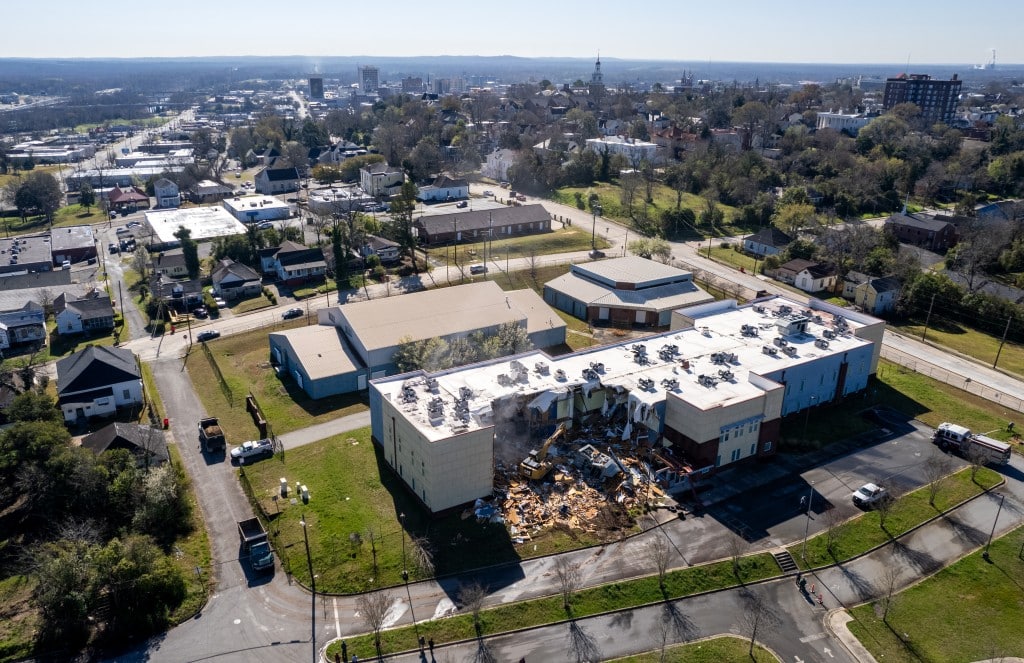
The now-defunct charter school on 151 Madison St. was demolished earlier this month. Construction is expected to start in August and will take 14-18 months to complete.
Bouyett plans to make a standardized application form to streamline the developer application process and is exploring the possibility of creating a downpayment assistance program. The fund is also looking at building in bulk to be cost effective.
The affordable housing fund has a board of directors that includes members representing the land bank, housing authority, Macon-Bibb Urban Development Authority, the Community Foundation of Central Georgia, Synovus Bank and Stafford Builders & Consultants.
How do other affordable housing funds work?
Bibb County’s affordable housing fund is one of only three in the state. Others are in Savannah and Atlanta.
The Savannah Affordable Housing Fund’s mission is to raise local funding to supplement federal affordable housing assistance. The mayor and alderman of Savannah established the fund without federal assistance at the request of StepUp Savannah and with the help of the chamber of commerce and economic development authority.
Housing in Savannah is unaffordable for 40% of the population, said Martin Fretty, director of Savannah’s Housing Services Department.
“The people that are being assisted by this fund are the people that are serving you at the grocery store, the doctor’s office — hard-working people,” Fretty said of people who are helped by the fund and do not qualify for federal assistance.
The Savannah Development and Renewal Authority, the chamber of commerce and several other groups helped launch the nonprofit fund in 2012 with $150,000 for the first year.
In the 13 years since, Frett said the City of Savannah has contributed nearly $17 million and the private sector has invested $5.2 million to the fund.
The affordable housing fund worked with developers to build 93 single-family homes and 271 rental units. The organization has also assisted in developing tiny homes for homeless people and those without shelter after extended hospital stays.
Partnerships with entities such as land banks and nonprofit developers like Community Housing Services Agency Inc. ,which manages the housing fund, are key to the fund’s success in Savannah, Fretty said.
The fund focuses more on helping people who need housing than it does building critical mass in economically depressed areas.
“Our focus isn’t just on developers, it’s on helping homeowners, home buyers, the homeless, renters,” Fretty said. “The people that actually benefit and need the assistance.”
The Savannah affordable housing fund also helps fund home repairs for low-income homeowners, down payment assistance for first-time home buyers and rental housing assistance. In Macon, those are functions of other nonprofits such as Home First and the Macon-Bibb Economic Opportunity Council Inc.
“Part of the fund has been used to help assist families that need the security deposits to be able to rent a place or if they find themselves teetering with eviction due to some unforeseen problem,” Fretty said.
Most of the $17 million in city funding came after 2020, when the mayor of Savannah appointed a 40-person task force to develop the Housing Savannah Action Plan. The task force examined housing resources, affordability and accessibility for Savannah residents in a 10-year-plan aimed at increasing local funding to at least $10 million each year.
“The nice thing about the fund is it is very flexible,” Fretty said. “We’re always fine-tuning and improving.”
Author

Related Articles
Retail boom poised to strain North Macon’s already clogged roads
Retail development is expected to outpace road work in north Macon.

Map redraw could cost Black voters in Bibb, legislators warn
The Georgia General Assembly meets this week to consider redrawing district lines and Bibb County’s delegation is concerned changes will disenfranchise Black voters.
Macon copper thieves pocket little but leave businesses with steep bills
Copper prices are high and thieves are stripping air conditioning units from businesses and homes across the country.