
10 Macon men, five wars and the ones who never came home
Ed Grisamore honors Memorial Day with the stories of 10 Macon men who made the ultimate sacrifice while serving their country.
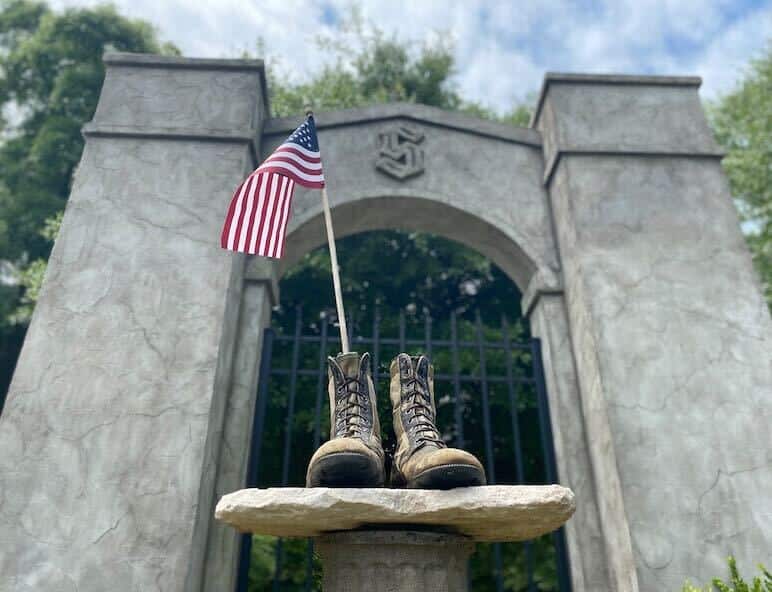
One died on a battlefield in the Civil War. Another was killed on a battleship that was torpedoed at Pearl Harbor.
Others lost their lives along frozen rivers in Europe and frigid foxholes in Korea. Death came at the hands of enemy grenades and suicide bombers. One man, who was on a medical mission, died when his plane crashed into the side of a mountain. His body was never found.
Another was a member of the “Lost Platoon,” a casualty in the first major battle of the longest war the U.S. has ever fought. They made a movie about it called “We Were Soldiers.’’ One is buried in Arlington Cemetery, not far from the Pentagon, where a terrorist attack claimed his life on September 11, 2001.
Their calls of duty were separated by a span of more than a century and a half.
Macon was their common ground. Their roots were here. It was home.
Among the 10 we remember on this Memorial Day weekend was one who was not killed in a military conflict. Instead, he had the grim duty of a notification officer. He had to inform each family their loved one was not coming back.
It was heartbreaking to see the tears fall at his feet.
Maj. Philemon Tracy
Maj. Philemon Tracy was not as well-known as his father, Edward Dorr Tracy, who was one of Macon’s leading citizens. He was the city’s second mayor, elected in 1826, and also served as a judge and state legislator. He offered a toast to Marquis de Lafayette during the renowned French general’s visit to Macon 200 years ago this spring in 1825.
Tracy never gained the same measure of fame as his brother, Gen. Edward Dorr Tracy Jr., who was a Civil War general. A state historical marker in Rose Hill Cemetery was placed in his honor. He joined the Confederate Army at the start of the war in April 1861. He died in May 1863 while leading a brigade of soldiers from Georgia and Alabama into battle at Port Gibson, Mississippi.
His sister, Anne Clark Tracy, married a wealthy banker and railroad man named William Butler Johnston. After an extended honeymoon in Europe, they returned to Macon and built an Italian Renaissance Revival mansion now known as the Hay House. It took four years to construct and is considered one of the most technologically advanced antebellum houses in America. It is sometimes called the “Palace of the South.’’
But Tracy can claim his footnote in a city rich in Civil War history. He was a major in the 6th Georgia Infantry and died in the Battle of Antietam on September 17, 1862.
Antietam, also known as the Battle of Sharpsburg, was the first major battle to take place on Northern soil (Maryland) and a turning point in the war.
It was the bloodiest one-day battle in American military history. More than 23,000 soldiers were either killed or wounded. Gen. Robert E. Lee crossed the Potomac River with 35,000 weary troops to fight against Gen. George McClellan’s rested and ready 70,000 Union soldiers.
Tracy was among the first casualties at Antietam. He died when a bullet struck him in the thigh and severed an artery. When the Confederate troops retreated, he was left in a shallow grave on the battlefield.
Instead of later being returned to Macon to be buried with the rest of his family at Rose Hill Cemetery, his final resting place was Batavia, New York, near the shores of Lake Ontario and Lake Erie.
His uncle, Phineus Tracy, sent an emissary to Sharpsburg to exhume the body and bring it to Batavia to be buried in his family plot near the front of the cemetery. The corpse had to be secretly returned under the guise of a Union officer.
Local historians in Batavia have long claimed Tracy holds the distinction of being buried farther north of the Mason-Dixon line than any Confederate soldier killed during the war. He is also believed to be the only Confederate officer moved from a battlefield and buried on Northern soil.
For more than a century, his military service was never acknowledged on his headstone. His grave carried only his name, the date of his death and his age at 31 years and three months.
Through the efforts of historians and veterans groups, a marker was placed at the grave site in 1990. More than 200 people attended the ceremony, and a Civil War re-enactment group played “Taps.’’
George Vining
George Vining did not live to see the sun rise across Pearl Harbor on the Sunday morning of December 7, 1941. He was a Navy petty officer second class, assigned to the mess hall aboard the USS California.
So it is not known if the 20-year-old Macon man heard the roar of the approaching planes over the clanging of pots and pans at breakfast. He did hear the sirens, though, and he rushed port side to his assigned battle station.
Vining was one of the 20 Black men enlisted aboard the California, all of them mess attendants. His duty was to help pass the ammunition to the gunners on the deck.
The California was the flagship along “Battleship Row” in Pearl Harbor and was on the front line of the first attack wave. It was pounded by six bombs from Japanese fighters and took three torpedo hits from their torpedo planes. The California was one of four Navy battleships that were sunk. A dozen other ships were damaged, and 188 U.S. aircraft were destroyed.
Vining was one of the 104 crew members who died on the California, second only to the USS Arizona in casualties. Another 61 were wounded. The surprise attack, which led to America’s entry into World War II, left 2,402 dead and 1,282 wounded.
Vining was a quiet man, though large in stature. He often stuttered when he spoke. His middle name was Eugene, after his father, who died in 1922 when Vining was a child. The elder Vining was a World War I veteran who never fully recovered from his war injuries.
Vining joined the Navy after attending L.H. Williams Elementary and Ballard High School. He had a sense of adventure and loved to travel. He was sent to basic training in Norfolk, Virginia, before receiving orders to report to Pearl Harbor, where about 60,000 military personnel were stationed.
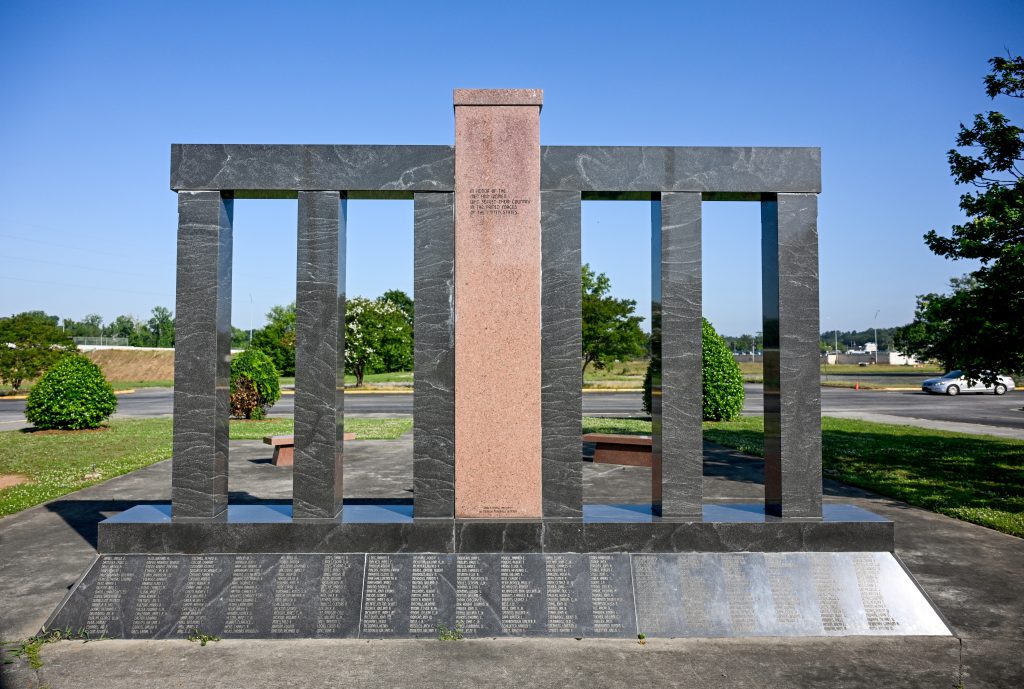
He was the first person from Macon to lose his life in World War II. There are 303 Bibb County residents listed as WWII casualties at the Veterans Memorial Monument outside the Macon Coliseum.
Most of those who died at Pearl Harbor were buried in Hawaii.
Two years after the war ended, at the request of Vining’s mother, his body was returned to Macon. The flag-draped casket arrived by train at Terminal Station on October 21, 1947.
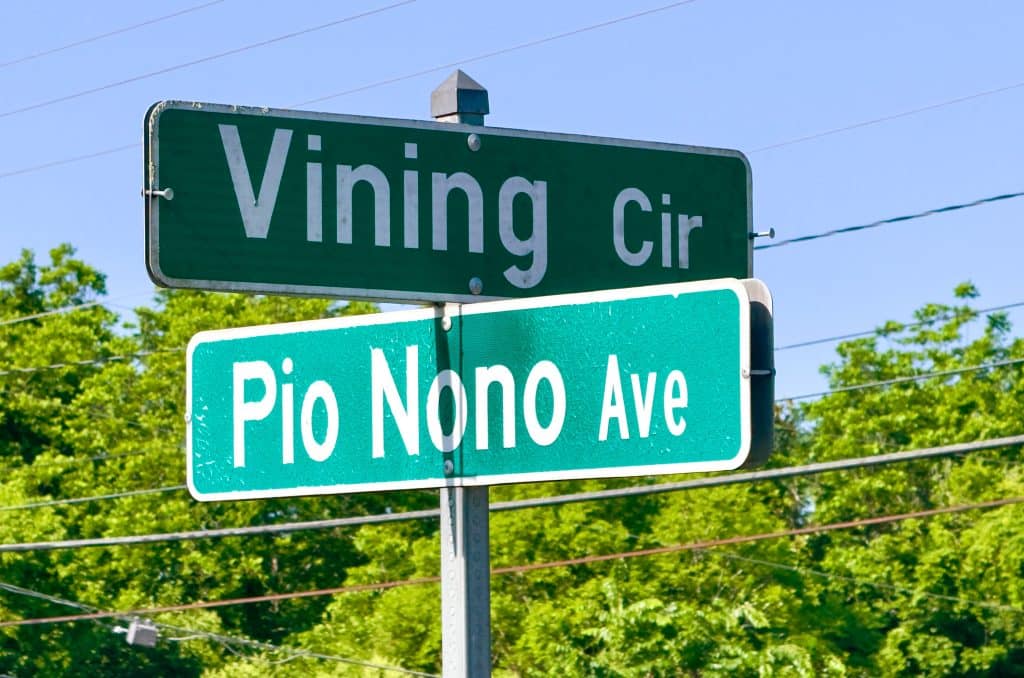
Vining is buried at Macon’s historic Linwood Cemetery in the Pleasant Hill neighborhood. In the late 1940s, the Vining-Goodman American Legion Post 501 was dedicated to both him and Robert Goodman, another black serviceman who died in the war. (The post has since closed.) The Vining Heights neighborhood, which includes Vining Circle, is named after Vining.
Jerome “Jerry” Blumberg
Jerome “Jerry” Blumberg was the oldest of Reuben and Alice Blumberg’s five children. The family owned and operated a jewelry store in downtown Macon. They lived on The Prado.
Blumberg was a member of the 899th Tank Destroyer Battalion during World War II. When he wrote letters home, his words were often filled with hope. Other times, you could read the fear between the lines. He concluded his letters with “It is almost over, and I will see you soon.’’
The war was indeed drawing to a close in late February 1945. In another six weeks, both Hitler and Mussolini would be dead. In another two months, Germany would offer its unconditional surrender.
But Blumberg’s life ended on February 28, 1945, along the Roer River in Belgium.
Blumberg was 26 years old. His body was never returned home. He is among the 7,992 soldiers buried at the Henri-Chapelle American Cemetery and Memorial in Belgium, where rows of headstones softly sweep across the countryside.
Most are the shape of white crosses, which is what distinguishes Blumberg’s 3-foot marker from the others. It represents the Star of David, the six-pointed symbol of the Jewish faith.
Maj. Cole Hogan
Maj. Cole Hogan is buried at Arlington National Cemetery on a hill near a stand of oak trees. In the distance, not far from the banks of the Potomac River, is a view of the Pentagon.
The Pentagon — headquarters for the U.S. Department of Defense — is where Hogan’s life came to an end the morning of September 11, 2001. He was less than a month shy of his 41st birthday and second wedding anniversary to his wife, Pat, a medical doctor at Andrews Air Force Base.
It is 555 miles from his grave site at Arlington to the marker that bears his name at Riverside Cemetery in Macon. It was placed next to the grave of his father, Wallace Cole Hogan Sr., who died 15 months after his son.
Hogan was the only Macon native killed in the terrorist attacks of September 11. A former Green Beret, he was serving as a general’s aide in Washington, D.C. He had moved into the Pentagon’s remodeled west wing only three weeks earlier. His office was at the point of impact when terrorists crashed American Airlines Flight 77.
Hogan graduated from Macon’s First Presbyterian Day School in 1978. His classmates placed a marker in his memory on the school’s campus. An oak tree was planted and dedicated across from City Hall on Arbor Day in 2002.
At the Pentagon, a conference room was dedicated to Hogan and his name was placed at a memorial inside the chapel. Outside the Pentagon, a bench was dedicated in his memory and a tree planted next to a reflecting pool.
There is a commemorative brick in his honor at the Ranger Monument at Fort Benning. His name was placed on a memorial at Fort Bragg. A service supply building was later named in his honor at Fort Lewis in Washington state, where he was stationed for three years in the Special Forces.
In April 2002, the city council unanimously approved the dedication of a small park on Overlook Avenue in memory of Hogan. The triangular park is less than a quarter mile from the house where he grew up.
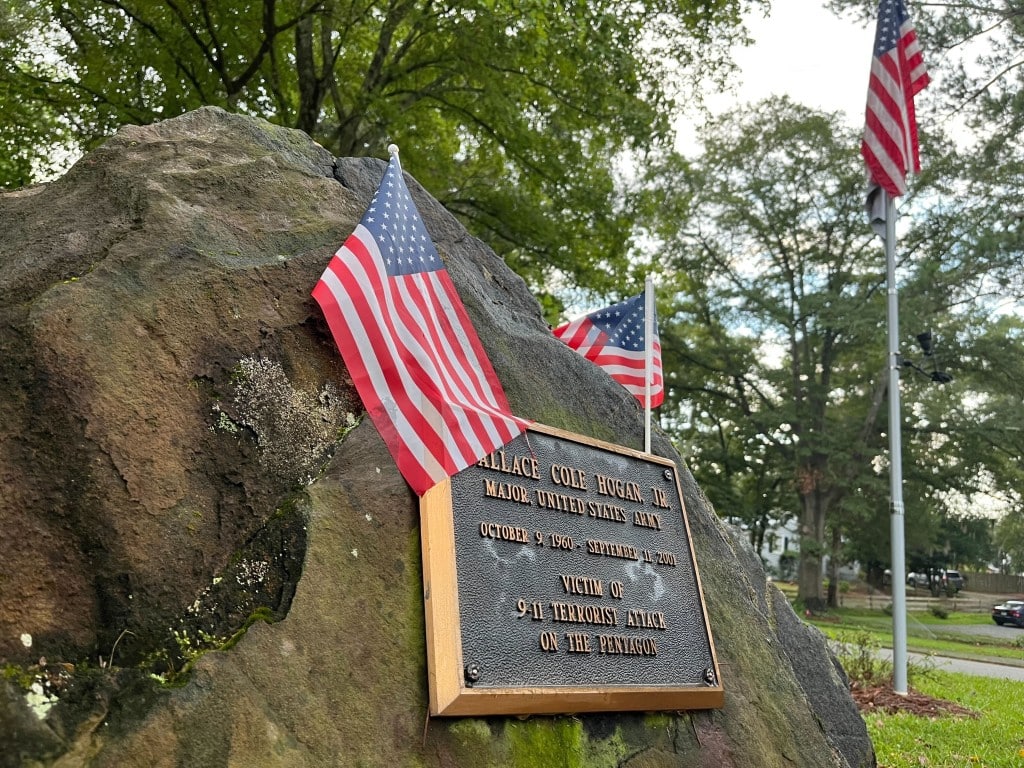
There is an American flag, a memorial bench and a large rock with a bronze plaque bearing Hogan’s name.
Thomas Jefferson “Sugar Boy” Barksdale
Thomas Jefferson “Sugar Boy” Barksdale took his last breath in a foxhole in North Korea on a December day in 1950, as the cold winds swept across the snow-covered hills along the Chongchon River.
It was almost 50 years before his skeletal remains were found, and another nine years before Army forensic officials located a family member living in Macon to make a positive identification through DNA testing.
It took an additional three years to bring him home in July 2012. His funeral was on a sweltering Georgia summer day. His flag-draped casket made the eight-hour flight from Honolulu. It arrived at Hartsfield-Jackson Atlanta International Airport shortly after dawn. The black hearse was escorted down Interstate 75 by the Georgia State Patrol, Bibb County Sheriff’s deputies, the Macon Police Department and 87 Georgia Patriot Guard Riders on motorcycles. The motorcade was a half-mile long.
He grew up on Boone Street in Macon’s Fort Hill. He was the second youngest of Ben and Vilena Barksdale’s 11 children. No one could recall how he got the nickname “Sugar Boy,” except that he carried it with him to the other side of the world as a 21-year-old soldier.
He was on the front lines with the 503rd Field Artillery Battalion of the Army’s 2nd Infantry Division. He was killed after engaging in heavy fighting with Chinese forces.
When he was initially listed as missing in action, his family clung to the hope he might be found. But for those family members who were still living all those years later, closure did not come until August 2000. Military excavation teams from the U.S. and North Korea uncovered the human skeleton of a 5-foot-10 male along a hilltop about 50 miles north of the capital of Pyongyang.
At the funeral home on Millerfield Road in East Macon, American flags lined the driveway. There were 62 of them — one for every year it had been since Barksdale’s death. Seven members of the Georgia Army National Guard carried the casket inside, where it remained in state for four days until the funeral. Barksdale was buried, with full military honors, at the Georgia Veterans Cemetery in Milledgeville.
Eddie Brown Jr.
Eddie Brown’s name scrolls past at the end of the film credits in the 2002 movie “We Were Soldiers,’’ starring Mel Gibson. The movie tells the story of members of the “Lost Platoon,” who died in the famous battle of Ia Drang Valley in Vietnam.
The Valley of Death, as it was later called, was located in South Vietnam’s Central Highlands, near the Cambodian border and Ho Chi Minh Trail.
There, 450 U.S. troops squared off against some 2,000 North Vietnamese in the first major battle of the longest war ever fought by the United States. There were 237 men killed — almost half the platoon.
Brown was Macon’s first casualty in Vietnam. He was 25 when he died on Nov. 16, 1965, two days after the fighting began.
He grew up the oldest of seven children in a house on Society Street in the Fort Hill neighborhood. He dropped out of high school at Peter G. Appling (now Northeast) to work odd jobs to help his family. One of those jobs was working as a caddie at Bowden Municipal Golf Course.
Six months after his death, Brown was posthumously awarded the Purple Heart and Bronze Star in a ceremony at his grave site in Woodlawn Memorial Park off Gray Highway in northeast Macon.
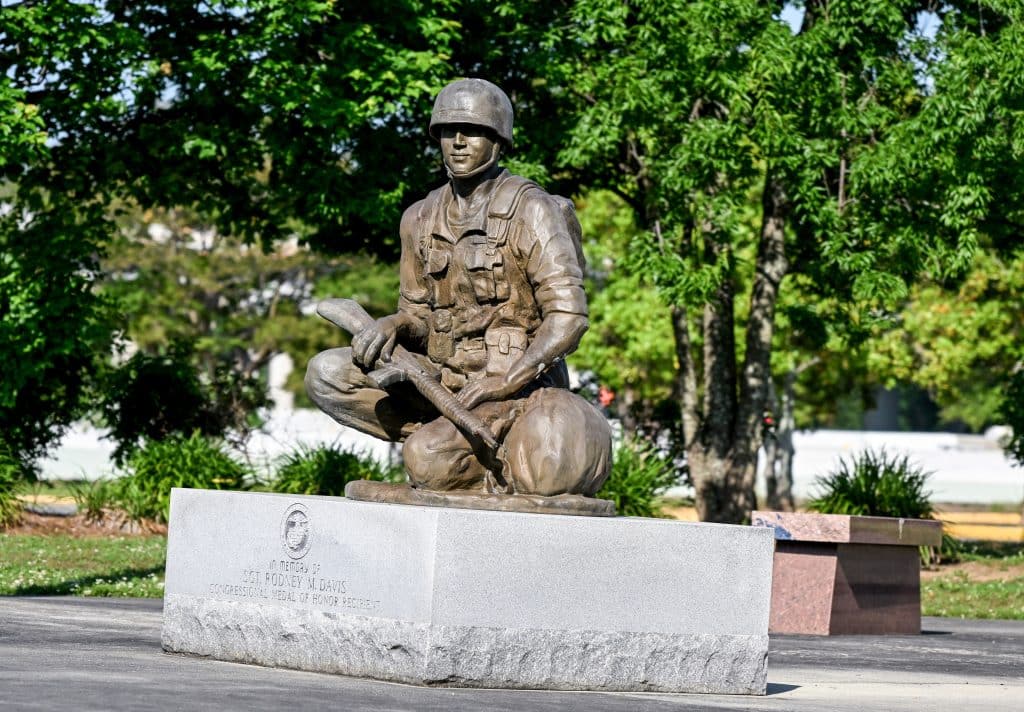
Sgt. Rodney Davis
Marine Sgt. Rodney Davis died on a September afternoon in 1967 during Operation Swift, one of the fiercest battles of the Vietnam War.
Davis threw himself on an enemy grenade in a trench, absorbing its deadly impact and saving the lives of the others in Bravo Company of the First Battalion, Fifth Regiment of the First Marine Division.
He was killed in what was once the Quang Nam Province of South Vietnam. The grenade was tossed into the trench during a heavy ambush by the North Vietnamese soldiers.
Davis was 25 years old. He left behind a wife and two children. He posthumously received the Medal of Honor, the nation’s highest award for valor. He was the 262nd American to be given the award since it began in 1862. Only 3,536 have been issued, and just 268 were awarded for heroics during the Vietnam War.
He grew up in Macon’s Pleasant Hill neighborhood and enlisted in the Marine Corps two months after finishing Appling High School in 1961.
There are memorials to Davis in his hometown and elsewhere. His Medal of Honor is on display at the Tubman African-American Museum, along with his Purple Heart and dress uniform.
There is a memorial at Rosa Parks Square in front of City Hall. A life-size statue of Davis kneeling with his weapon is at the Veterans Memorial in the parking lot at the Macon Coliseum.
A public housing project, Davis Homes, and a Junior ROTC classroom at Northeast High School were named after him.
The Navy named a missile frigate the U.S.S. Rodney Davis, making him the first black Vietnam veteran to have a ship named in his honor. His name is also enshrined at the Freedom Foundation in Valley Forge, Pennsylvania.
Davis could have been buried in Arlington National Cemetery. Instead, his family brought him home to historic Linwood Cemetery, at the upper end of Walnut Street in Pleasant Hill.
John Hollis, a family member, wrote a book titled “Sgt. Rodney Davis: The Making of a Hero.’’
Maj. Bobby Jones
There are 58,281 names on the Vietnam Veterans Memorial Wall in Washington, D.C.
Maj. Bobby Jones is one of them… on Panel 01W, Line 93.
His headstone is in Riverside Cemetery in Macon, next to his father, Marvin, a longtime educator in Bibb County. There is no official date of death on the marker, just an inscription that reads: “Missing in Action South Vietnam Nov. 28, 1972.” Another inscription reads: “Presumed Killed in Action Aug. 29, 1978.”
At Andersonville National Cemetery, there are rows of white markers stretching as far as the eye can see. Among them is a federal marker with the name of Maj. Bobby Jones M.D.
For more than 35 years, Jones was the lone Macon serviceman listed as missing in action from Vietnam. He was the only U.S. military physician still considered missing during that time.
Jones grew up on Adrian Place off Pierce Avenue, not far from Tinsley Elementary, where he was a third-grade student when the school opened in 1953. After his death, his portrait hung in the school’s hallway.
The old Tinsley school (now Northwoods Academy) was located next door to Riverside United Methodist Church, where his family was among the 36 families who were charter members. The church bell was later dedicated in his memory. His mother, the late Christine Jones, could often hear that bell every Sunday morning from her kitchen window.
At Lanier High School, he was among the top officers in the school’s Junior ROTC program. He was an honor student and had always wanted to become a doctor.
He was a passenger in an Air Force F-4 on a non combat mission to deliver medical supplies from Thailand to Vietnam on November 28, 1972. It was five days after Thanksgiving. He had been in Southeast Asia for only six weeks.
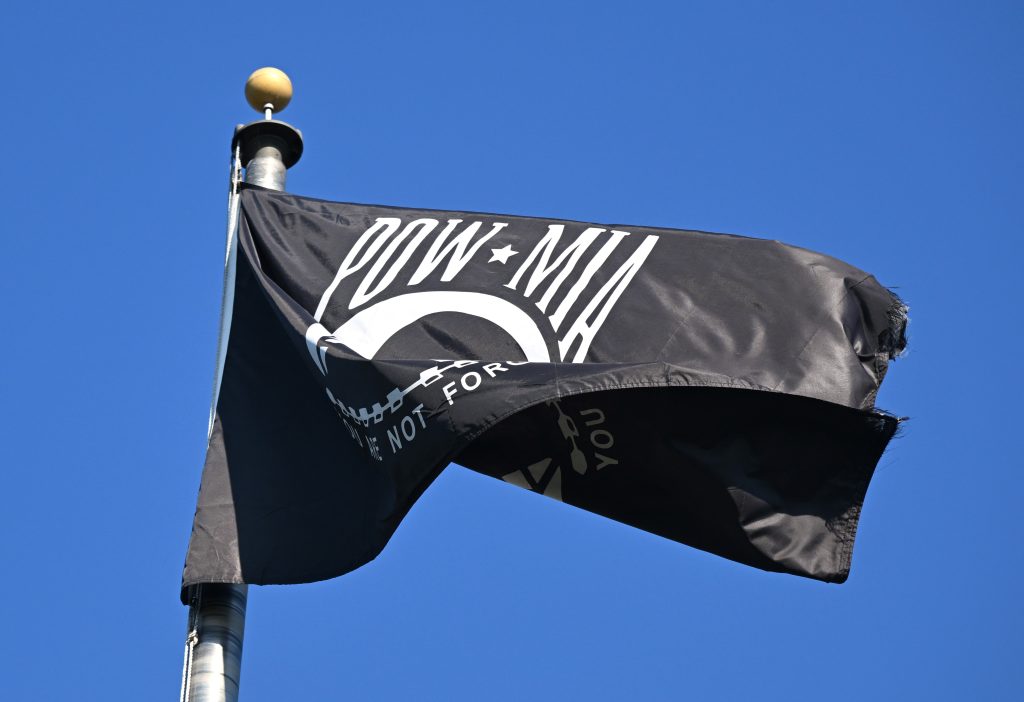
Although his body was never recovered, his family refused to give up hope of finding him. His sister, Jo Anne Shirley, was elected chairwoman of the National League of Families of American Prisoners and Missing in Southeast Asia. She co-founded the Georgia Committee for POW/MIAs. Among her efforts was getting the black POW/MIA flags flown at rest stops and weigh stations across Georgia.
In July 2008, the Jones family was notified that a search team, led by a forensic anthropologist, had discovered what was believed to be the crash site on Bach Ma Mountain, about 20 miles north of Da Nang.
A military identification card or voucher — sometimes known as a “blood chit” — had been found. Military records verified it had been issued to Jones, finally giving the Jones family closure.
In 1999, the Interstate 75/16 interchange in Macon was named in his honor.
Sgt. Kelley Courtney
Macon Marine Sgt. Kelley Courtney was a 28-year-old counterintelligence officer who was one of eight Marines killed when a convoy truck was struck by a suicide bomber outside of Fallujah on October 30, 2004.
He was the first serviceman from Macon to die in action since the Vietnam War. He left behind a wife and two children.
After earning his GED, he took classes at Central Georgia Tech. His father had been in the Air Force, and Courtney made an appointment to see a recruiter. But the Air Force officer was a no-show, and a Marine recruiter noticed Kelley standing outside and invited him into his office. He became interested in counterintelligence and went through training in Beaufort, South Carolina, and Dam Neck, Virginia.
Courtney had only been in Iraq for six weeks when he told his family that he would be taking part in an extensive, weeklong mission. The American forces had been in Fallujah for less than six months, and the insurgent activity was at its peak. He confided in his family that it would be like going into a “hornet’s nest.’’
His mother, Gena, was watching the evening news when it was reported that eight Marines had been killed outside of Fallujah. There were images of black smoke on the TV. The following day, a U.S. government car pulled into the driveway and three notification officers arrived to bring the sad news.
There were two funerals. The first was on November 14, 2004, just three days after Veterans Day, at Glen Haven Memorial Gardens on Houston Road. The procession was lined with people waving flags and holding “God Bless America” signs. There was a flag-draped casket and a 21-gun salute.
In April 2006, the new Marines counterintelligence building at Camp Hansen in Okinawa, Japan, was named Courtney Hall. Eighteen months later, the I-75 interchange at Hartley Bridge Road (Exit 155) was dedicated in his honor.
His father, Bobby Courtney, died in 2023 … on Veteran’s Day.
Maj. David Carter
Maj. David Carter was one of the fortunate ones.
He returned home from the brutal war he fought in.
Others he knew – and fought beside – did not.
Carter spent seven months in combat in Korea. In 1950, he was selected as a member of an elite special operations company known as the “Raiders.’’
The Raiders conducted amphibious raids, reconnaissance raids, and demolition missions. They carried out intelligence operations against the Communist forces. They were the forerunners to the U.S. Army’s Special Forces – also known as the Green Berets – which was created two years later.
He came to Macon in 1962 as commander of the 1,300 cadets at Lanier High School, which boasted the largest Junior ROTC program in the country. His ROTC units won seven national championships in rifle drills and two in marksmanship.
Carter, who died in 2021 at the age of 90, was also known for his 17 years on the Macon City Council, including eight as council president. He served as mayor of Macon in 1995, finishing the term of Tommy Olmstead after Olmstead left office to become head of the state Department of Human Resources.
But Carter always claimed the toughest job he ever had – even worse than being in battle – was his role as a military “notification” officer during the Vietnam War.
Dressed in his Army uniform, Carter had to show up at the doorsteps of families to tell them that their loved one had been killed or was missing in action.
He had mothers and wives collapse in his arms and fathers so grief-stricken they could not speak.
He was responsible for making arrangements for the military funerals, taking care of every detail from the pallbearers to the color guards to the bugles that played “Taps.’’
He once had to deliver a eulogy for a young soldier after the preacher’s car broke down on the way to the funeral.
He lost count of how many times his phone rang before dawn, how many doors he knocked on and how many hearts his words broke.
One was one too many.
Before you go...
Thanks for reading The Macon Melody. We hope this article added to your day.
We are a nonprofit, local newsroom that connects you to the whole story of Macon-Bibb County. We live, work and play here. Our reporting illuminates and celebrates the people and events that make Middle Georgia unique.
If you appreciate what we do, please join the readers like you who help make our solution-focused journalism possible. Thank you
Author

Related Articles
A parade of color: the magic of native azaleas
With careful planning and species selection, one can have native azaleas blooming from March into September in Georgia.
Gallery West to close doors, ‘reSISTERS’ exhibit opens at Macon Arts Alliance
Macon artist She Keene’s exhibit, “reSISTERS,” focuses on heroes of the women’s right-to-vote movement.
A local gallery will close its doors at the end of May.
Billy dishes on Food Truck Frenzy and supporting local businesses
While the Cherry Blossom Festival brings in visitors from all over, it is also powered by the people who live here. The families, the workers, the small business owners and the locals who show up year after year to support what makes Macon special.