
Homeowners do not dig armadillos
Learn about armadillos and how they can affect your garden.
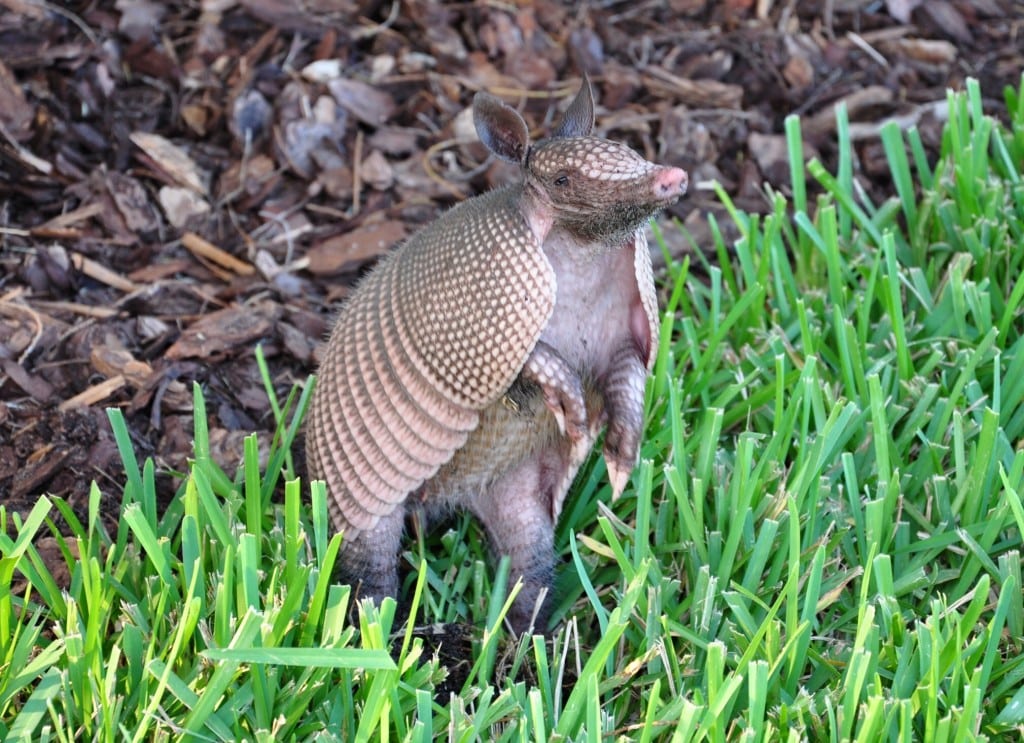
As I was scaling a hillside controlling invasive trees in my family’s woods last weekend, I stumbled across what appeared to be invasive wildlife as well. I found three ‘dens’ with dug out piles of fresh soil. They were approximately 100 ft apart and nestled beneath stumps or fallen branches. The openings were eight to nine inches in diameter. Since it was likely that I was seeing signs of armadillos, I figured it was time to do a little research.
There is only one species of armadillo that lives in Georgia, the nine banded armadillo. It is the only mammal in Georgia that has a “shell.” However, it is a myth that they can curl up into a ball to protect themselves. They live near streams but avoid places that are excessively wet or dry. Armadillos are common in south and central Georgia and are continuing their pilgrimage northward. However, because armadillos do not tolerate cold temperatures, their migration is likely limited. They also do not tolerate excessively warm temperatures, preferring 85°F or less. Since armadillos are temperature sensitive, they are most active in the daytime during the winter months and most active at night during summertime. They spend the remainder of the time in their burrows.
One armadillo can have five to 10 burrows and their home territory can range up to 22 acres. Much of the time outside of their burrows is spent foraging. They “hunt” using smell and sound. Their diet consists mostly of insects, but studies have shown they also consume fruit, seeds, and a variety of other protein sources and plant matter. Although their diet can be beneficial to homeowners because they feed on white grubs and fire ants, their digging is much more of a nuisance. Armadillos cause damage to lawns by digging holes that are a few inches deep and wide while they are foraging. They can also uproot desirable landscape plants as they hunt. While the damage is not considered to be a great economic loss, it is a problem for those striving for the perfect lawn.
As with many other landscape nuisances, armadillo control is not easy or simple. There are no repellents or pesticides registered for use on armadillos. Insecticides, however, can be used to reduce the insect population, thus reducing the amount of food available for their foraging. Live trapping is another option for armadillo control. Wire cages are placed along natural barriers or at burrow entrances. Boards are placed in a V-shape funneling the animal into the trap. There is not any specific bait that has been shown to increase the success of capture, but overripe fruit is something that is easily accessible to put in your traps. However, before setting out traps, be sure to have a plan to humanely dispatch of any wildlife you capture.
Since armadillos are not a protected species, they can be hunted year around. Remember to check with city and county ordinances before firing a weapon. Handle your weapon safely to not put yourself or your neighbors at risk.
As for my newly discovered armadillo, I’m going to share the forest with it for the time being. I’m much more worried about the privet, Tree of Heaven, and chinaberries encroaching on us!
For more information, visit https://extension.uga.edu/search.html?q=armadillo
For questions about gardening and landscaping, call Bibb County Extension at 478-310-5350 or email us at
bibb.extension@uga.edu.
Before you go...
Thanks for reading The Macon Melody. We hope this article added to your day.
We are a nonprofit, local newsroom that connects you to the whole story of Macon-Bibb County. We live, work and play here. Our reporting illuminates and celebrates the people and events that make Middle Georgia unique.
If you appreciate what we do, please join the readers like you who help make our solution-focused journalism possible. Thank you
Related Articles

Nurturing creativity: art and mental health
Local artists talk about creating and using art as a diagnostic and restorative tool.

Georgia heat is no joke: how to protect your health this summer
While summer can be one of the best times of the year, the Georgia heat can be dangerous.

Local documentary on World War II veterans to air in Macon
Director Trent Jones tells the story of veterans who served on a “Flying Fortress” during the war.