
Once a ‘train wreck,’ Macon’s public transit system is back on track
The Macon Transit Authority says it is financially stable, seeing more riders and rolling out new ways to get people where they need to go.
A new chapter for The Melody
Our team and coverage are moving to The Telegraph. Make sure you look for The Melody's community-first journalism as a section highlighting the people, places and moments that are the rhythm of Macon.

Thirty years ago, when Craig Ross was appointed to the board of the Macon Transit Authority, it didn’t take long for the banker to realize that the city’s public transportation system was misfiring and sputtering, like an old engine on its last leg.
“The buses were just in really bad shape,” Ross said, adding the county wasn’t providing enough funding for the MTA to buy new ones. “I say this in jest, but it’s almost true: I think there were more buses coming in on the back of a wrecker than there were going out in the morning. … The audits were horrible. It was just a train wreck.”
Twenty-one years later, when he took over as CEO of the MTA, he found out the system was even worse off than he’d imagined.
Though he had served as the authority’s board chair, Ross said, he wasn’t privy to details of the authority’s operations and finances.
“You don’t really get down in the weeds when you’re on the board,” he said.
But he got a close-up look at the situation as CEO. He discovered a host of additional problems, he said, including unpaid bills, as well as bills that were being paid regularly for services the authority no longer used.
So, Ross rolled up his sleeves and went to work.
“It was quite a task,” he said. “The first thing that we did was start on the inside of the business. You’ve got to have a clean business before you can do anything else.”
As the MTA sorted out some of the financial disarray, it began upgrading its aging fleet of buses.
It took teamwork, he said, but the authority is back on track. Save for a minor finding or two, Ross said, “all of our audits have been good.”
And, last year, “we had almost a 100,000-passenger increase,” he said. “People don’t know how much other folks depend on public transportation…. We’re the only people that carry people to work or to the doctor. …We can make people’s lives better.”
Right now, he said, a plan is underway that will make bus service accessible to even more Maconites.
It’s just the latest evolution in the management of Macon’s public transportation system, which has been operating in one form or another since post-Civil War streetcars first linked downtown to the new neighborhoods that had begun to crop up around the city’s core.
A smoother ride
The buses, trollies and dummy lines that transported people around Macon before 1973 were owned and operated by private businesses that were eventually sold or dissolved after becoming unprofitable.
The first transportation in Macon was owned and operated by utility companies which ran trolley lines throughout the city in the late 1800s then replaced them with buses in 1934.
The power company ran buses until 1949, when it sold its garage and fleet of buses to the Bibb Transit Co., a private business created by 24 Maconites, according to newspaper archives.
In 1962 — seven years after Rosa Parks refused to give up her seat during the Montgomery Bus Boycotts — Macon’s Black leaders enacted a boycott of the Bibb Transit Co. system.
It lasted three weeks until a federal judge ordered the end of segregated bus seating.
The Bibb Transit Co. ran the bus system until 1972, when the company dissolved following years of operating at a loss.
In 1973, the city of Macon bought the company’s fleet of buses and its garage so that residents would not go without transportation. The city operated buses — also at a financial deficit — up until 1980 when the state legislature created the Macon Transit Authority.
The MTA, an independent unit of government, is a seven-member board whose members were appointed by the city and county. City money made up 60% of the authority’s annual budget and the remaining 40% was covered with county money.
All of that changed when Macon and Bibb County consolidated in 2014. Now, all members are appointed by the Macon-Bibb County mayor and commission. Today, the authority’s main funding sources are federal money and monthly payments from the county.
Ross said the authority reports to the Georgia Department of Transportation, which is a pass-through entity for its federal funds.
The authority began buying electric, battery-powered buses with federal grants matched by the county.
“They’re really good buses, and they perform well,” Ross said. “We’ve been buying electric ever since.”
The authority’s fleet of 40 includes four electric vans, six electric paratransit buses and seven electric transit buses. Ross said the MTA plans to buy five more electric buses this year as ridership increases.
Late last year, the authority began piloting a “Rapid Transit” rideshare-like service through which customers can schedule a pick-up by one of the MTA’s brightly colored vans within a limited area around downtown.
Ross said the cost of running a new bus route is high. He said he hopes the new Rapid Transit rides will help fill some gaps in service.
“Our rapid transit is Uber-type service, but it’s going to cost much less,” Ross explained. “It’ll cost $5 to get from point A to point B. It’s going to be $8 after 6 p.m. until midnight.”
Rapid Transit is set to expand to the county’s south side then the east side and eventually to the entire county.
There are “some good paying jobs out there, and people need to be able to get to them,” Ross said of the industrial parks in the southern part of the county as well as Ocmulgee East Boulevard, where employers such as Geico and YKK operate.
Train station ‘little cash cow’
The authority also now has other sources of revenue besides the county and federal government: rental income.
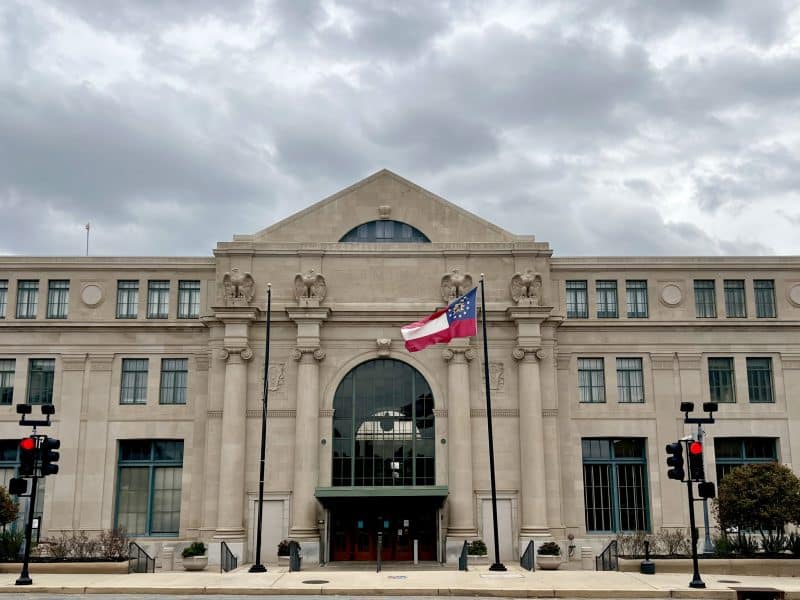
In 2014, the Macon-Bibb County Commission voted to deed Terminal Station to the MTA. The MTA leases offices in the historic train station, built in 1916.
In recent years, the train station has become a sought-after location for filming movies. Terminal Station served as the set for “Superman” in 2024, and part of the interior was transformed into the Daily Planet newsroom.
“We’ve had several movies, and they pay us good money — pretty close to $100,000, depending on how long they’re going to be here,” Ross said, adding that he recently signed a contract for another movie to film there.
The train station also is a popular venue for weddings, reunions and other celebratory gatherings.
“We’re already booked into 2027, so that’s just a little cash cow that keeps coming,” Ross said.
Additionally, the authority rents part of the bus lines at Terminal Station to Flex, a company that acquired Greyhound three years ago.
Fast facts
— Board members include Chair Frank Tompkins, Weston Stroud, David Dickey, Deborah Garcia, Charles Murphy and Lynn Farmer. One seat is vacant.
— Public meetings take place at 5:30 p.m. on the last Tuesday of each month at Terminal Station.
This story is part of “Power,” a series by The Melody examining local authorities — quasi-governmental bodies that make consequential decisions about housing, water, transit, development, health care and public spending — that shape life in Macon-Bibb County.
Author

Related Articles
All aboard? GDOT asks residents to weigh in on restoring passenger train service to Macon
The Georgia Department of Transportation is surveying the public through Aug. 6 to gauge interest in Atlanta-to-Savannah rail service that could include a stop in Macon.
Are corporate investors responsible for one-third of all housing sales since 2020?
Learn the answer to this question in the fact brief in partnership with Gigafact.
Macon’s Boys and Girls Club closed for 90 days, families search for alternatives
The club had many after-school programs that are now on hold.