
New homeless enforcement bill puts Macon on notice
The bill, which pushes cities to enforce existing laws related to homelessness, passed the Georgia Legislature this year.
A new chapter for The Melody
Our team and coverage are moving to The Telegraph. Make sure you look for The Melody's community-first journalism as a section highlighting the people, places and moments that are the rhythm of Macon.
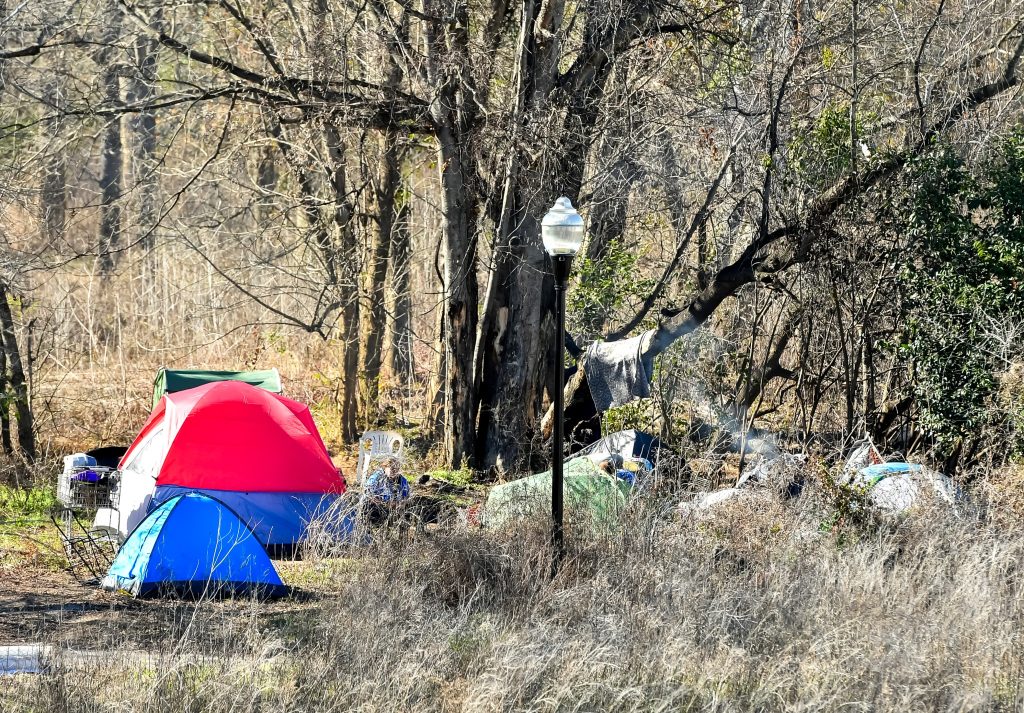
Bibb County resident Andrew Eck is fed up.
Most weekdays, Eck, who makes his living building furniture from salvaged wood and renovating old houses, drives his golf cart down to Macon’s Ocmulgee Heritage Trail — the short river walk that’s been disrupted for years now as the Georgia Department of Transportation revamps the Interstate 75/16 interchange by the trail.
“My scope is to get the downtown river walk clean and safe and usable for everybody,” Eck said one afternoon with a pair of journalists riding with him.
From Eck’s perspective, the thing in the way of that are encampments that sprang up on the riverwalk, belonging to unhoused people who moved in while GDOT rendered much of the trail impassable.
“So right here, this is a pretty big camp,” Eck said as he pulled up to a notch in a wall of trailside bamboo. “This has one guy right here, if you walk in there, he’s got like BB guns and like seven bikes.”
This is just one of the spots Eck has been checking on for some time, and up until now he has been pretty frustrated by the Macon-Bibb County government’s response to this campground and others like it.
He wants the county to clean these camps out.
“That’s not what this was designed for,” Eck said. “There’s 150,000 people in our community that are entitled to use this park. One individual can’t hoard it.”
SEE MORE: ‘If you can help somebody, help’: Macon faces a homelessness crisis with no simple fix
Eck is not alone in his concern about public space and the unhoused.
That feeling inspired a bill that passed the Georgia Legislature this year aimed at pushing cities to enforce laws already on the books related to homelessness.
“And so, as the laws are right now, this is not right,” Eck said, looking at the encampment in the bamboo. “It’s illegal.”
In Macon-Bibb County code, public camping, or at least staying in parks after sundown, is indeed illegal. But camps could be growing here.
Data for Macon-Bibb County from the annual Point-in-Time count, a national census of the homeless, suggests a 33% increase in the total number of unhoused people in the community since 2020. The same data suggests that a growing number of those people are choosing to stay away from traditional homeless shelters.
Republican state Rep. Houston Gaines said he has seen and heard about something similar in Athens-Clarke County, the heart of his district.
“I hear from people whose families, you know, they don’t feel comfortable going to eat downtown because every time they go somewhere they’re being harassed by panhandlers,” Gaines said. “And so those are the kind of issues that we’re trying to address and try to make sure we’re cleaning up.”
His tool is the bill he sponsored — House Bill 295.
“What this bill does is it puts local governments’ feet to the fire,” Gaines said.
HB 295 passed both the Georgia House and Senate and now awaits Gov. Brian Kemp’s signature.
It would work like this: If your community has not been enforcing laws around homelessness, and if you own real property such as a home or a business and that property loses value, you could sue the local government for the loss. You could go to court and try and win a monetary refund.
Gaines said the bare mechanics of HB 295 obscure its real purpose.
“Our goal here is not actually the refunds,” Gaines said. “Our goal is just to get local governments to enforce the law.”
But it would be out of fear of getting sued.
During a recent meeting of the Macon-Bibb County Commission, Mayor Lester Miller made it apparent he had heard the message.
“You’ve got this new House Bill 295, very serious bill, that is going to result in possibly a million dollars’ worth of lawsuits to counties and cities,” Miller told the commission during debate on whether to extend the contract of a private contractor called Root Analytics to complete the 2026 PIT Count for the county, a step Miller argued was critical if the county wanted to know how best to serve housed and unhoused residents alike.
The Bibb County Code Enforcement Department, which Eck wanted to see more of on the Ocmulgee Heritage Trail and many of whose officers have full arrest powers, ultimately reports to Miller, who told commissioners that just successfully defending lawsuits under HB 295 would not be enough to limit harm to the county.
The day before Miller’s warning, Code Enforcement dismantled one of the camps by the river. A few days later, a new camp sprang up on the Ocmulgee Heritage Trail just a little downstream.
Related Articles
Macon’s Boys and Girls Club closed for 90 days, families search for alternatives
The club had many after-school programs that are now on hold.
Downtown Macon breakfast staple Famous Mike’s closes
The restaurant known for its comfort food announced it was shutting its doors Monday.

The lasting legacy of former Macon mayor George Israel, who bridged political divides
Israel, Macon’s second-ever Republican mayor, died last weekend. He was 78.