
A Christmas present starts an epic sewing machine collection
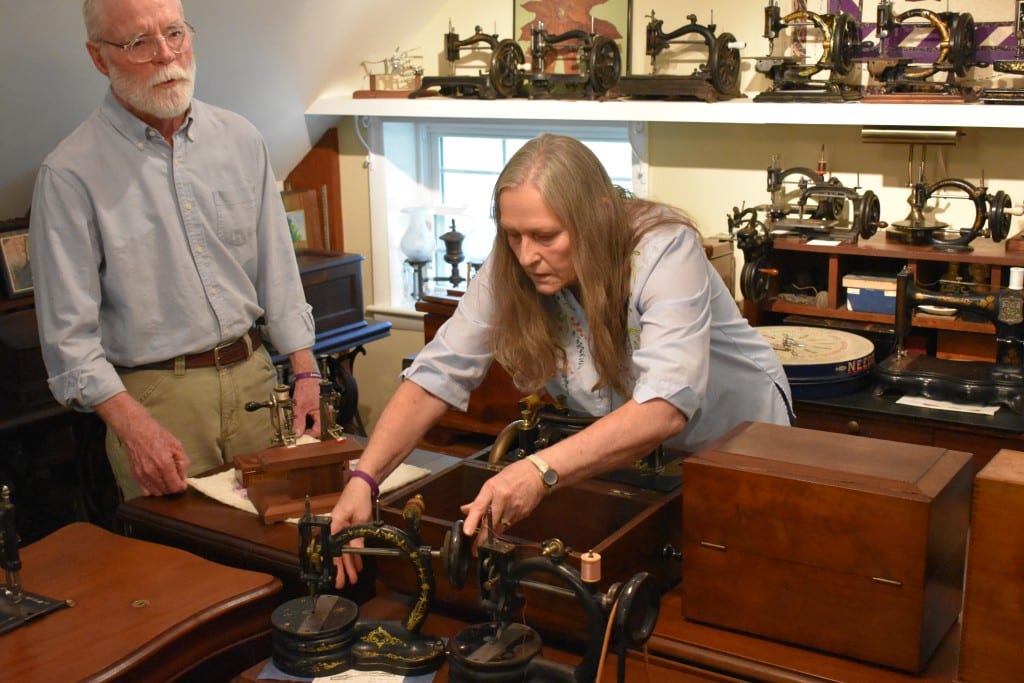
Sharon Funderburk isn’t sure exactly how many vintage sewing machines she owns, but many of them date as far back as the 1850s.
A new chapter for The Melody
Our team and coverage are moving to The Telegraph. Make sure you look for The Melody's community-first journalism as a section highlighting the people, places and moments that are the rhythm of Macon.

BYRON – Once upon a time, Sharon Funderburk was like the little girl whose family surprised her with a puppy for Christmas.
You know the script. First, they build the drama by wrapping up a can of dog food. Then they add to the suspense by having her open a box with a collar and a leash.
But Sharon wasn’t a little girl. She was a grown woman opening her present under the Christmas tree.
And her “puppy’ did not bark. It hummed.
She unwrapped everything from a bobbin winder to a spool pin. There should have been a note: “Some Assembly Required.”
It was an antique Singer sewing machine from the 1850s.
She has been speaking a different language ever since … one with a vernacular of balance wheels and slack thread regulators.
Sharon is not a professional seamstress. She is a retired dental hygienist who worked for Macon dentists Ty Ivey and Bradshaw Ford.
She grew up in a sewing family. Her mother and sisters could all thread a needle. She made some of her clothes in high school. She has always been an avid quilter and collects thimbles and vintage sewing spools.
If you ask Sharon how many vintage sewing machines she now owns, she can only shrug and venture a guess.
Then her curiosity will kick in, as it did on a recent summer afternoon. She started counting them in an upstairs showroom, putting the number at close to 75. Then she remembered four in the living room and two in the hallway. (And two spinning wheels in another part of the upstairs.) She stopped at 90, then moved the needle – no pun intended – closer to 100.
Many date back from the 1850s to 1880s, with intricate workmanship and ornate designs such as mother of pearl.
All of those machines could tell stories from seam to shining seam about all the wedding dresses they altered and the trousers they hemmed.
Sharon’s husband, Frank, is retired and is best known for his years as Bibb County’s extension agent. The Funderburks have spent a lot of time restoring the historic home where Sharon grew up. It dates back to the late 1840s.
The sewing machines should feel right at home in a region where cotton fields sweep across the countryside like a dusting of Georgia snow.
When the Funderburks surprised Sharon with the antique Singer, it was missing a part. She contacted the company and was told they no longer carried parts for that generation of machines. They suggested she search on eBay, which just might be the largest parts store in the world.
“Well, that opened up the whole world of sewing machines to me,’’ Sharon said. “Singer was the only one I knew about. I didn’t realize there were so many others.’’
Her mother, the late Doris Shepard, had a “featherweight” Singer she purchased at the end of World War II. She made clothes for her four daughters.
“The featherweights were popular because they were designed where a woman could take it apart to clean it and put it back together,’’ she said “They were very portable.’’
When Sharon’s father, Virgil, got her mother a fancy Singer, her older sister, Bonnie, took the featherweight to Lexington, Kentucky, and then out to California. Bonnie brought it back after she bought a newer machine, and Sharon has it now in her collection, along with the original table and bench.
Sharon’s oldest machine was manufactured in 1854, so it is pre-Civil War and one of a few of its kind in the world. Over the years, she has developed a close friendship with Mike Anderson, an antique dealer in New Hampshire who specializes in antique sewing machines. She and Frank have been to New Hampshire to visit him, and he recently stopped in Byron on his way to Florida to purchase two vintage sewing machines from her.
Sewing machines were invented during the first Industrial Revolution in the late 1700s, and Sharon considers those founding fathers (and mothers) as brilliant.
“I often wonder how in the world someone could sit down and figure out an easier way to sew two pieces of fabric together besides a needle and thread,’’ she said. “The ingenuity that someone had to start putting it together in their head, thinking of gears and shafts and moving parts. It’s fascinating.’’
It doesn’t always matter if an antique sewing machine is still in working condition. For collectors, the more valuable machines are often the ones that don’t always perform well. They are rare because they were produced in smaller numbers or the company stopped making them.
Her search for the holy grail is a Singer “Turtleback” model, which began production in the late 1850s and was the company’s first attempt at a “family” machine. It was a disaster –think Ford Pinto or AMC Pacer – and Singer began to reduce the inventory.
Sharon is 71 years old. She wonders if her family will want to inherit her collection. Or will they sell them?
Sewing is becoming somewhat of a lost art, but she is hopeful.
“There will always be a handful of people who, regardless of their age, will enjoy antiques,’’ she said “There will always be somebody interested.”
Author

Related Articles

The Odyssey embarrasses anti-woke crusaders
While I am no movie critic, I applaud Nolan for his recreation of the epic, but perhaps one of his greatest accomplishments was embarrassing anti-woke crusaders.

A new chapter for The Melody
Macon’s local newsroom is in for some exciting changes. It’s a great time to reflect on The Melody’s past.
Don’t blame data centers for failed public policy
Data centers have become a kind of boogeyman among voters lately. Recent polling even suggests that new data center construction is less popular than the IRS.