
Don’t wait until spring to tackle annual lawn weeds
fall is time to treat cool-season annual weeds. Henbit, annual bluegrass, chickweed, and Carolina geranium can be prevented with a preemergence herbicide application
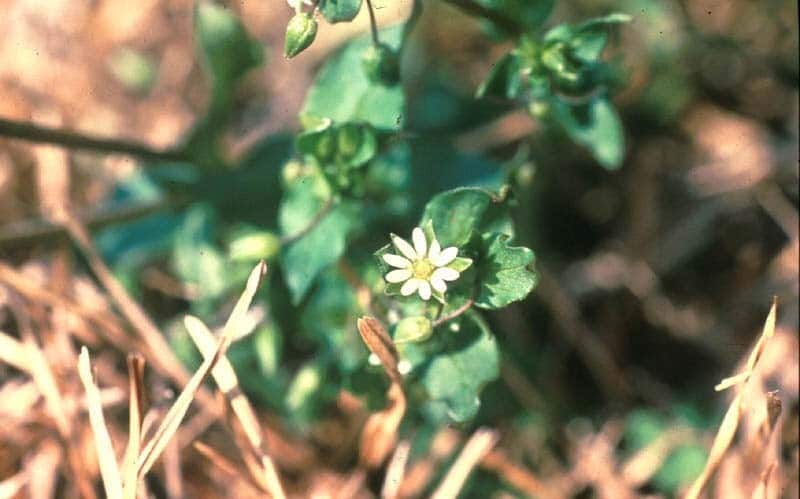
Every March the Extension office starts receiving calls asking how to get rid of weeds showing up like a sore thumb against the background of still-dormant straw-colored lawns. These homeowners don’t get very excited about our typical answer to their question: In the spring, it is recommended to mow and catch the weeds to minimize future weeds.
However, fall is time to treat cool-season annual weeds. Henbit, annual bluegrass, chickweed, and Carolina geranium can be prevented with a preemergence herbicide application – even if you can’t see them yet. Sometime in the next couple of weeks would be the target for that well-timed application to stop these weeds from littering next spring’s landscape.
Here’s why: A large percentage, though not all, of problem weeds in turfgrass are annual weeds because they complete their life cycle from seed to seed within one growing season. So, here in Central Georgia the seeds sprout in the fall and grow, often under the radar, during the winter. Warming temperatures in the early spring trigger them to enter into their reproductive mode, and they grow, bloom and produce seed before hot weather takes them out.
Preemergence herbicides interrupt that cycle by forming a barrier in the top layer of soil that kills the newly germinated seeds as they try to establish their first root into the soil. The key to their effectiveness is having that the barrier in place before the seed sprouts. Late applications are a useless waste of money.
Seeds germinate according to soil temperature, so there’s not a magic date every September to apply herbicide. However, the saying goes, better early than late. In Central Georgia, the optimal time for preemergence application is often the second week in September.
These herbicides come in both liquid concentrate and granular formulations. However, the granular types are the easiest for most homeowners to apply. Regardless of the product you choose, apply it at the rate on the label. Only after it is watered in, either by rain or by a sprinkler, will it form the important herbicide barrier in the soil
The turfgrass scientists at the University of Georgia recommend that you NOT use a combination weed and feed product — either in the fall or in the spring. The reason is based on timing. All types of warm-season turfgrass we grow in the Macon area will go dormant for the winter and should not receive any fertilizer after August.
While chemical products can be useful in managing a lawn, do not neglect the priority of good cultural practices to promote vigorous turfgrass growth. Dense, healthy grass goes a long way in discouraging weeds. Good maintenance includes proper mowing technique, correct pH, right application of fertilizer and water. Do not underestimate the importance of how much sunlight your lawn receives, especially as landscapes mature and trees begin to shade out turfgrass.
To access the UGA calendar for your kind of turfgrass, go to Lawn Care Calendars – Publications | GeorgiaTurf.
If you have any gardening or landscape questions, contact us at 478-310-5350 or email us at bibb.extension@uga.edu.
Before you go...
Thanks for reading The Macon Melody. We hope this article added to your day.
We are a nonprofit, local newsroom that connects you to the whole story of Macon-Bibb County. We live, work and play here. Our reporting illuminates and celebrates the people and events that make Middle Georgia unique.
If you appreciate what we do, please join the readers like you who help make our solution-focused journalism possible. Thank you
Related Articles
Prune for better fruit: late-winter cuts pay off
Proper pruning can feel drastic, but thoughtful cuts now lead to better fruit later.

New director to lead Mercer center for strings, symphony orchestra concert fast approaching
The McDuffie Center for Strings will welcome a new director this fall. Also, the Macon-Mercer Symphony Orchestra will perform Monday.
Roses need love, too: Prune soon
For beautiful garden roses in April, start pruning around Valentine’s Day.