
Japanese beetles arrive for summer feast
Lawns are not immune to the culinary preferences of Japanese beetles. The beetle grubs munch on grass roots, resulting in dead patches of turfgrass.
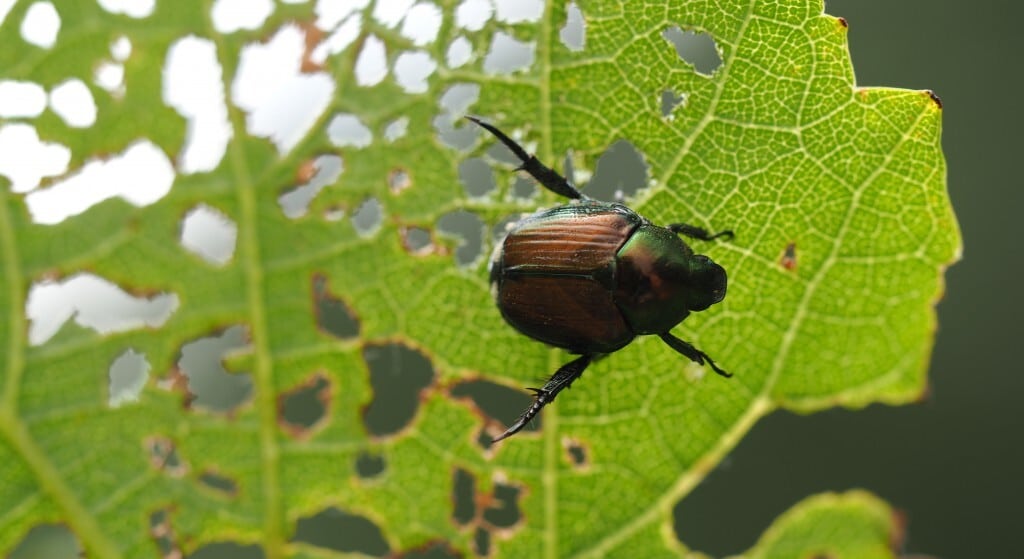
Some of my most unwelcome garden “guests” arrived last week. These invaders find my landscape to be a delectable smorgasbord. How I would prefer for them to “bite the dust” instead of my plants!
I am referring to Japanese beetles, which have a particular fondness for roses, beans, zinnias, crape myrtles, fruit trees and more. In fact, they feast on over 300 plant species, consuming the tissue between the leaf veins, creating a lace-like or
skeletonized appearance to the leaves. They also dine on flowers and fruit.
Lawns are not immune to this insect’s culinary preferences. The beetle grubs munch on grass roots, resulting in dead patches of turfgrass. Upon observation, it becomes clear that the grass probably died because its roots were nibbled off. Further damage can be caused when armadillos dig holes in turfgrass, seeking grubs to eat.
Mercifully, Japanese beetles produce only one generation each year. Their life cycle begins in the summertime when the females lay eggs in the soil, usually in grassy areas. These eggs hatch into larval grubs and grow for months as they feed on plant roots. Then the grubs pupate in the soil, finally emerging this time of year as adult beetles to eat, mate, and begin the life cycle over again.
Japanese beetles are attractive insects. They are about a half inch long with metallic green bodies that are partially covered by iridescent bronze wings. An important identifying characteristic distinguishing them from look-alike beetles is the six small tufts of white hair along the sides of the abdomen under the edges of the wings.
Mechanical traps can be an effective way to monitor when the beetles arrive in the landscape. In the spring, place traps far away from susceptible plants. Remove them after beetle emergence is detected. The traps utilize floral scents and insect pheromones as bait to attract the beetles. While they are effective in attracting beetles, research indicates that they tend to attract more beetles than they capture. This has the potential for increasing plant damage.
When it comes to control, homeowners have limited options. If the beetle population is small and the insects are feeding at an accessible height on the plants, the best option may be to simply drown them in a bowl of soapy water. This is an effective method I use with my roses. Japanese beetles are clumsy fliers, and I can easily knock them into the suds as I hold the bowl underneath their feeding area. I devote a few minutes every morning, and sometimes evening, during “beetle season” to this task. In some cases, using a fine net can also serve as a physical barrier. These approaches provide damage control without the use of insecticides, which may harm beneficial insects at work in my landscape.
However, sometimes insecticides can be warranted. As with all pesticides, prevention is generally more effective than cure. Therefore, the best chemical control may be to treat the grubs when they are small in mid-summer. Short residual insecticides can be sprayed on foliage and flowers to help manage adult beetles.
For specific insecticide recommendations, please contact your local UGA Extension office. Bibb County Extension can be reached at bibb.extension@uga.edu or (478)310-5350.
Before you go...
Thanks for reading The Macon Melody. We hope this article added to your day.
We are a nonprofit, local newsroom that connects you to the whole story of Macon-Bibb County. We live, work and play here. Our reporting illuminates and celebrates the people and events that make Middle Georgia unique.
If you appreciate what we do, please join the readers like you who help make our solution-focused journalism possible. Thank you
Related Articles
A parade of color: the magic of native azaleas
With careful planning and species selection, one can have native azaleas blooming from March into September in Georgia.

Gallery West to close doors, ‘reSISTERS’ exhibit opens at Macon Arts Alliance
Macon artist She Keene’s exhibit, “reSISTERS,” focuses on heroes of the women’s right-to-vote movement.
A local gallery will close its doors at the end of May.

Billy dishes on Food Truck Frenzy and supporting local businesses
While the Cherry Blossom Festival brings in visitors from all over, it is also powered by the people who live here. The families, the workers, the small business owners and the locals who show up year after year to support what makes Macon special.