
New school specializes in teaching dyslexic students
The Roberts Academy opened its doors last week to 31 students and uses an alternative method to teaching its students.
A new chapter for The Melody
Our team and coverage are moving to The Telegraph. Make sure you look for The Melody's community-first journalism as a section highlighting the people, places and moments that are the rhythm of Macon.
A new school affiliated with Mercer’s college of education is teaching dyslexic elementary schoolers foundational learning skills using a more tailored teaching method.
The Roberts Academy at Mercer University instructs students in 2nd through 5th grade and is the only school specially designed for students with dyslexia in Middle Georgia. The academy is a few blocks from the campus and Tattnall Square Park on Linden Avenue.
Classes started on Aug. 14, with 31 students enrolled from 11 different counties. The school can hold up to 180 students and tuition starts at $10,000 —with some students on scholarship— which Head of School Joy Wood said is affordable for private schools.
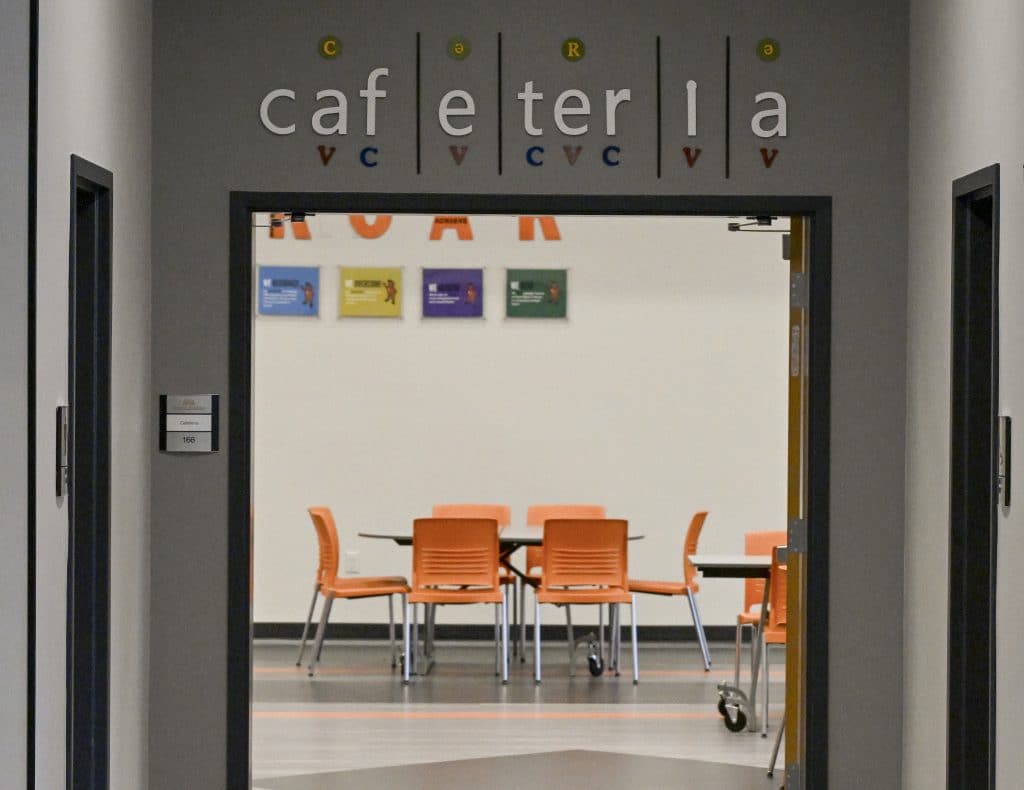
The Roberts Academy utilizes the Orton-Gillingham Method, a more explicit, systematic approach to teaching involving repetitions and sensory details with movements. The academy was built and endowed via a gift from Hal and Marjorie Roberts.
Caroline Grove, the school’s student information specialist and a reading teacher, said she hopes the school’s use of the Orton-Gillingham method will create a “ripple effect” and change how other schools teach.
“Orton-Gillingham is tied with everything, reading, math, ELA,” Grove said. “It’s proven to be an emotionally sound way to teach kids.”
Allison Roberts, a third grade teacher at the school, said the approach allows for more individualized instruction, and she can be “constantly assessing” whether students need additional teaching.
Roberts, who has been a teacher for 25 years, used the analogy of manual versus automatic transmission to compare a dyslexic brain and a neurotypical brain. Students with dyslexia have to work harder to take steps in reading that a typical person would take for granted, like differentiating between long and short vowels or sounding out vowel-consonant combinations.
That’s why all over the school they have signs for different parts of the building noting vowels and consonants and splitting the names into syllables.
Kids will follow the usual elementary schedule, with time for math, science, art, but also with an hour or so just for working on reading. Kids will also be broken into smaller reading groups of six, each with its own teacher, to hone their reading skills.
The new campus has everything a school needs, a cafeteria, a library, a playground and several classrooms. In addition, the school comes equipped with a music room, art room and a sensory room, which lets kids figure out how to regulate their emotions, said fourth grade teacher Elizabeth Eidson.
Eidson was at the ribbon cutting back in spring 2023, and said she was drawn to working at the new academy because of their support for teachers using the Orton-Gillingham method.
Eidson said the 12:1 student to teacher ratio will allow teachers to be more effective in teaching kids how to read.
“You’re able to change the way you’re teaching in real time, which is very exciting to have that autonomy and flexibility as a teacher,” she said.
The academy is a “transitional school,” Grove said, and while kids learn at different paces, some kids should be able to go back to a more traditional school, but no kid is ever “cured” of dyslexia.
The school is not subject to standardized testing; instead it has “learning celebrations.” Grove said assessments in public schools are designed for neurotypical learners, not those with dyslexia.
“A lot of these kids are super smart,” Eidson said. “They just haven’t been given the right assessment to prove it.”
Author

Related Articles

New podcast to offer locals a taste of Macon
The Melody’s food columnist Billy Hennessey will be launching a brand-new podcast in partnership with Visit Macon and 100.9 The Creek.

Five things we must never forget
In the midst of our forgetfulness, what should we strive to remember?
Newt Collier reflects on 81st birthday, the late Alan Walden, why Macon needs a music district and more
Today, Newton Collier is an ambassador for Macon, an active community volunteer, a beloved grandfather figure in music and an electronic trumpet player.