
Nearly 50 years later, Macon reconnects with its moon tree
In 1971 on the Apollo 14 mission, hundreds of seeds were taken to space. Forty-eight years ago, one of the seedlings was planted in Macon. It’s more than 80 feet tall today. Here’s is the story of the Moon Tree.
A new chapter for The Melody
Our team and coverage are moving to The Telegraph. Make sure you look for The Melody's community-first journalism as a section highlighting the people, places and moments that are the rhythm of Macon.
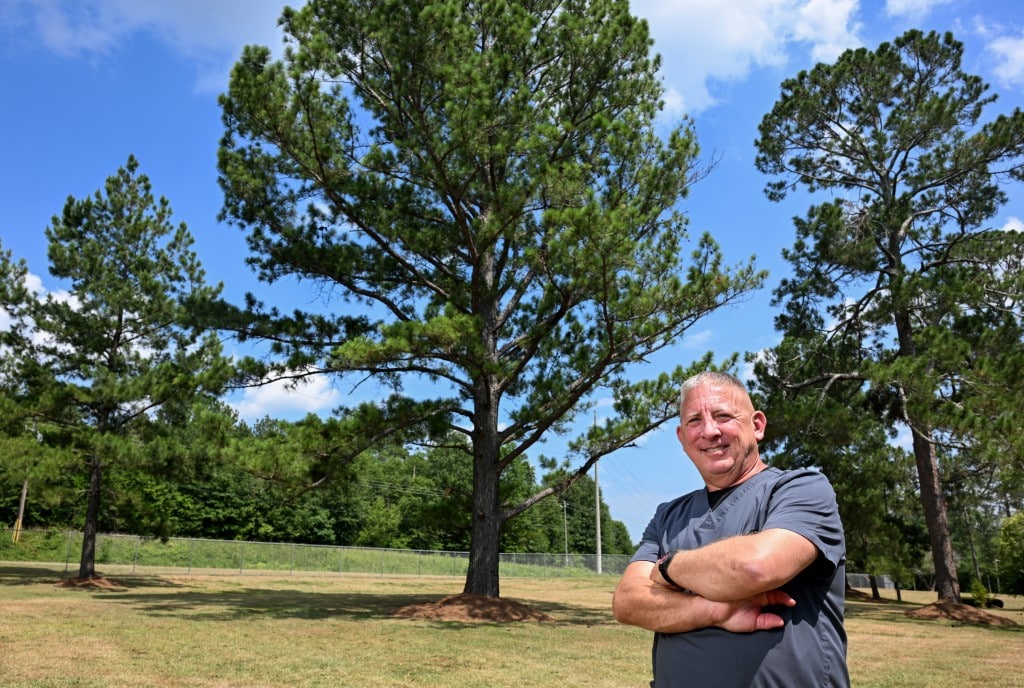
Ben Bradshaw wasn’t at home on the Saturday morning: his wife opened the front door and a man she did not know was standing there.
“I’m not trying to sell you anything, I’m not trying to buy anything, and I’m not trying to convert you,’’ Sam Macfie told Stacy Bradshaw. “But if I say ‘moon tree,’ does that mean anything to you?”
Stacy’s face lit up. “Oh, my God. Is this for real?” she asked.
“How could I make it up?’’ Sam said.
Ben is 54 years old, a father and a grandfather. He served in the Marines, Army and National Guard. He works as an optometry health technician for the Veterans Administration.
The moon tree came into his life on a spring morning in 1976, when he was 5 years old. That was many moons ago, but the memory has ridden shotgun with him like a space traveler across the decades.
Until two months ago, Sam had never heard of a moon tree. He had never met Ben. He became a man on a mission, though. A moon mission.
“It was the detective in me,’’ he said. “It was a challenge to put the pieces together. It was 48 years of a cold case.’’
Sam is vice-president for development at Batson-Cook, a construction company headquartered in Atlanta. In March, he attended a meeting of the Construction Owners Association of America at Mercer. During the conference, he met Melanie Ford, the senior director of construction at the University of Georgia.
When she found out Sam lived in Macon, she enlisted his help with the mysterious moon here.
Melanie has a Masters in historic preservation, and has been working on another Masters in landscape architecture. While doing research for her thesis, she discovered a “moon tree” had been planted in Athens during America’s bicentennial year in 1976.
It was one of several planted in Georgia, including one at the state headquarters of the Georgia Forestry Commision on Riggins Mill Road in Dry Branch, a few miles southeast of Macon. The tree seedlings were grown from hundreds of seeds taken into space aboard the Apollo 14 mission in 1971 by astronaut Stuart Roosa, a former smoke jumper for the forest service.
Astronauts have historically been allowed to take a personal possession with them, and Roosa chose the seeds as a favor to his friends at the forest service. (Macon native Sonny Carter carried freeze-dried Fincher’s barbecue on the space shuttle Discovery in 1989, so the iconic Macon barbecue restaurant could later boast about having the “First Pigs in Space.’’)
The seeds never set foot on the moon. They orbited inside the lunar module with Roosa, while astronauts Alan Shepard and Edgar Mitchell explored the moon’s surface.
But the moon trees still went where no seeds had gone before them.
When the seed varieties of pines, redwoods, firs, sycamores, redwoods and sweetgums returned to earth, they were germinated by the forest service and planted at select locations across the U.S. and the world.
Melanie began retrofitting the puzzle, starting with a few details about the Macon tree. She found a photograph in the September 1976 issue of Georgia Forestry newsletter, a quarterly publication of the Georgia Forestry Commission.
The photo was of Ben and Danielle Allen, who were kindergarten students at the KinderCare on Rocky Creek Road. They had attended a ceremonial tree planting with their classmates on a field trip to the forestry commission. The date was March 22, 1976.
When officials at the ceremony asked for volunteers, Danielle and Ben were handpicked to “plant” the loblolly pine for a photo op, as their classmates and officials from the forestry commission and the Macon Beautification Committee looked on. Among them was Carolyn Crayton, who founded the first Cherry Blossom Festival six years later.
There are now more than 350,000 Yoshino cherry trees in Macon. But only one moon tree. And only a handful of people have been aware of its existence and exact whereabouts over the years.
Sam checked the county’s property records to find Ben. It’s a small world. Ben lives just 1.2 miles from Sam’s house.
Tracking down Danielle was more of a challenge. She is a pharmacist in Augusta. She has two daughters. She graduated from Northeast High School in 1988, and her mother taught at Southwest. Sam was able to locate her through records at the Bibb County Board of Education.
Julia Daniely, a friend of Danielle’s from high school, sent her a message on Facebook. At first, Danielle did not respond because she thought it might be a scam. Then, Julia attached a screenshot of the photo from the Georgia Forestry newsletter.
When Danielle finally responded, Julia asked: “Do you know how many people are looking for you?”
When you are 5 years old, you can be excused if you get more excited about nursery rhymes with a cow jumping over the moon than in planting a tree that traveled almost a half-million miles to the moon and back.
But Danielle was starstruck. She said her lifelong interest in space and space exploration had its roots in her moon tree experience. As a child, she loved to go to the planetarium at the Museum of Arts & Sciences on Forsyth Road. She would beg her parents to send her to space camp in Huntsville, Alabama. She also became a huge fan of the “Star Wars” movies.
“What I remember about that day is wondering why my mom had dressed me up,’’ Danielle said. “She probably dressed me like that all the time, but I just remember that day feeling cute and special in my little dress.
“I also remember how fascinated I was that those seeds had been to outer space. As a little kid, it was like, ‘Wow,’ I remember the dirt and being there with the newspaper and all those people. I was glad I got a chance to be one of the ones to help put it in the ground.’’
Danielle said her mother kept a scrapbook with the moon tree photo. So did Ben’s grandmother. She kept it in her kitchen.
“When she sold her house in 2002, I wanted that cork board, and I took it home,’’ Ben said. “So it has either been in a box or hanging up everywhere I’ve lived ever since. The clipping was a constant reminder. Over the years, I’ve wondered how that tree was doing.’’
Despite his lifetime association with the photograph, he never paid careful attention to where the tree planting had taken place. Until a few years ago, his visual image of that late March morning was at the Ocmulgee Indian Mounds, so his mental geography was off the mark. The forestry commission is about 5 miles from the Ocmulgee Monument.
“Any time I went by Ocmulgee mounds I would wonder where the tree was,’’ Ben said. “My wife and I would sometimes go to the Native American celebrations. One time, I walked around the main building trying to find it. I even asked the people inside about it. They just looked at me like I was crazy.’’
Melanie grew up in Huntsville, Alabama, home of the U.S. Space and Rocket Center. Her father worked for Lockheed and the NASA space program.
“When I found out about the moon trees, it kind of resonated with me,’’ she said, “I said, ‘Wow, that’s so flipping cool.’ So I embarked on this adventure. My thesis is a study of the moon trees in terms of what impact they had, both on the surrounding landscapes and on people’s lives. I am combining the historic preservation initiative as well as the landscape architecture.’’
As part of her project, she interviewed NASA officials. She also talked with Rosemary Roosa, who is president of the Moon Tree Foundation, an educational non-profit established to honor her astronaut father’s legacy. Stuart Roosa died in 1994.
Melanie also was invited to speak at a session called “Tree Stories” at the Royal Geographic Society international conference in London in September 2023. She challenged its members to locate the 15 moon trees reportedly planted in England.
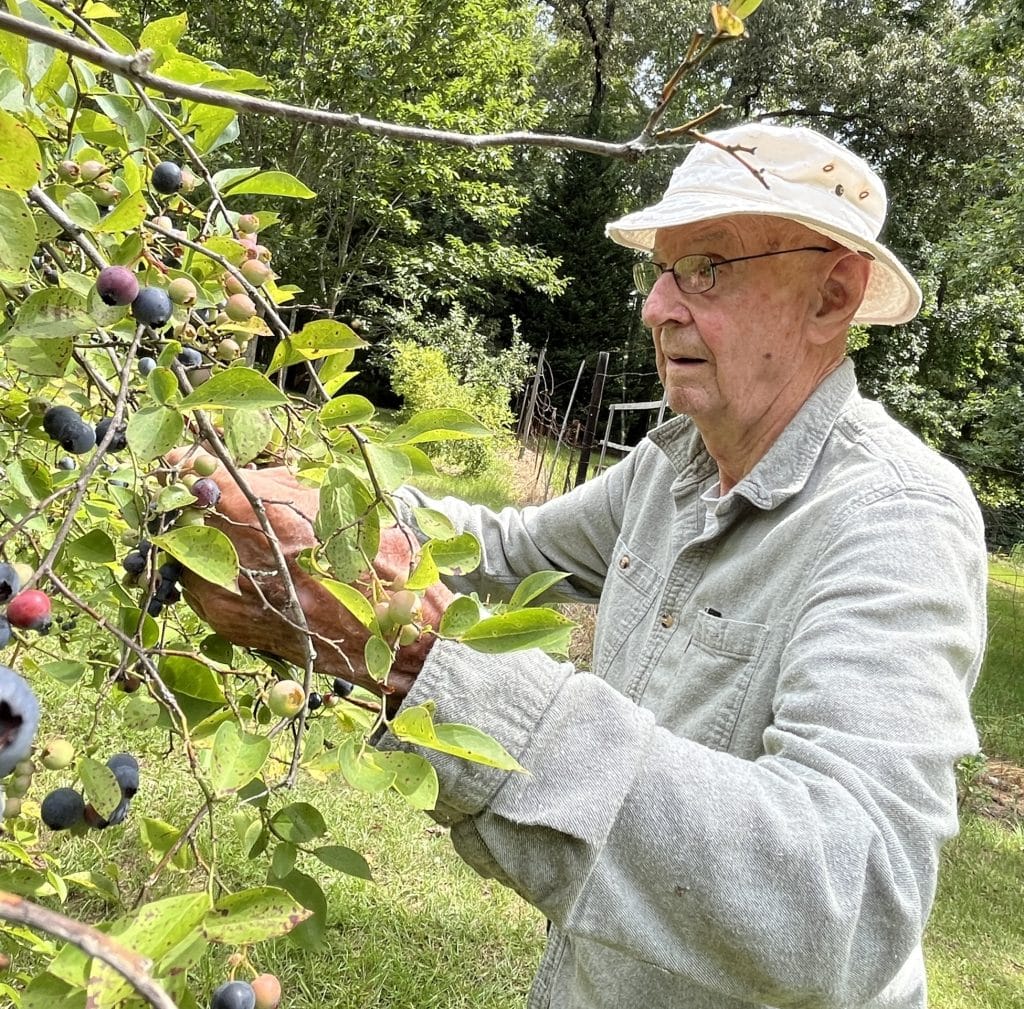
John Branan’s history with the moon trees is deep-rooted. He spent 44 years with the forestry commission, retiring in December 2001 as chief of the reforestation department.
“They asked me to get up some seeds, and I got the best I could find,’’ he said. “I knew those seeds had to go to the seed lab because that is what you have to do before you send them out of the country. I sent some live oaks to France one time, but never to the moon.’’
He assigned foresters to traverse the state to search for superior trees. “We would graft them and put them in a seed orchard,’’ John said. “Each one had a name and number, and we would collect seeds from them.’’
John estimated there were about 100 loblolly pines, but he has no idea how many came back from the moon and where they went. He said he believed one tree was sent to the Hitachi Experimental Forest in Jones County.
According to NASA, some of the seed bags Roosa carried with him broke open after Apollo 14 returned from space. Those seeds were scattered, damaged and possibly contaminated.
Moon trees were distributed to about 40 states. A loblolly pine was planted at the White House. Another tree was put in the ground at Washington Square, near Independence Hall in Philadelphia. Other tree varieties were sent to England, Brazil, Switzerland and Japan.
When Melanie began her research, she determined there were at least four moon trees in Georgia, but she could only verify the location of two.
“Everybody seemed to know about the one in Waycross (at a research station in the Okefenokee Swamp) but only a small handful of people knew about the one here in Athens because it didn’t have a sign,’’ she said.
It was located outside a government building on West Dougherty Street. A plaque was installed in May 2021 to commemorate the 50th anniversary of Apollo 14.
Melanie located another moon tree at the state capitol building in Atlanta and interviewed the man who planted it. She said there were reports of a tree in Savannah but no one could identify where it was planted.
For unknown reasons, the moon tree at the forestry commission in Macon is unmarked. Melanie spent hours trying to determine its location. She even contacted Carolyn Crayton for more information. “We had a great conversation, but she told me at this point she could not tell me which one,’’ Melanie said. (Carolyn has probably been to at least 693,429 tree plantings in her lifetime.)
When Melanie met with Ben and Sam at the forestry commission on April 18, she had narrowed the tree candidates down to two. She concluded it was the loblolly pine near the front entrance. The tree is now 82 feet tall and its base is 31.2 inches in circumference, according to Troy Clymer, of the Macon forestry management office.
“When I took Ben to the first tree, he said he didn’t remember walking up a hill when he was a child,’’ Melanie said. “But when we went to the other tree (near the main entrance) he said, ‘This is it.’ He remembered the building. It was definitely the tree. It began making sense. It was a lot of detective work.’’
Sam matched the background topography across Riggins Mill Road with the original photograph. A maintenance worker later told them a lower fence had been replaced six years ago by the chain-link fence that now guards the property.
“Ben and I were looking around and holding the photo up. It exactly matched the lay of the land,’’ Sam said. “The tree has more of a Christmas tree shape, and not what I would envision as being a typical loblolly.’’
Then he laughed. “But I’m not saying that the gamma rays affected it like the man-in-the-moon marigolds,” he said, laughing at his reference to the 1972 Paul Newman movie.
Melanie said she hopes a ceremony will be organized in the future to have the tree re-dedicated and to re-enact a photo with Danielle and Ben, especially since a new round of moon trees are now being distributed from the Artemis I unmanned moon mission in 2022.
At first glance, Macon’s moon tree doesn’t appear to be anything special … certainly not a tree that has been to the moon and back.
But for Ben, there might as well be a rope swing from its branches, a tether to the past.
“The biggest thing for me was remembering where it was, to see how it has grown and to think, ‘I planted that,’ ’’ he said. “Well … I patted some dirt.’’
Author

Related Articles

New podcast to offer locals a taste of Macon
The Melody’s food columnist Billy Hennessey will be launching a brand-new podcast in partnership with Visit Macon and 100.9 The Creek.

Five things we must never forget
In the midst of our forgetfulness, what should we strive to remember?
Newt Collier reflects on 81st birthday, the late Alan Walden, why Macon needs a music district and more
Today, Newton Collier is an ambassador for Macon, an active community volunteer, a beloved grandfather figure in music and an electronic trumpet player.